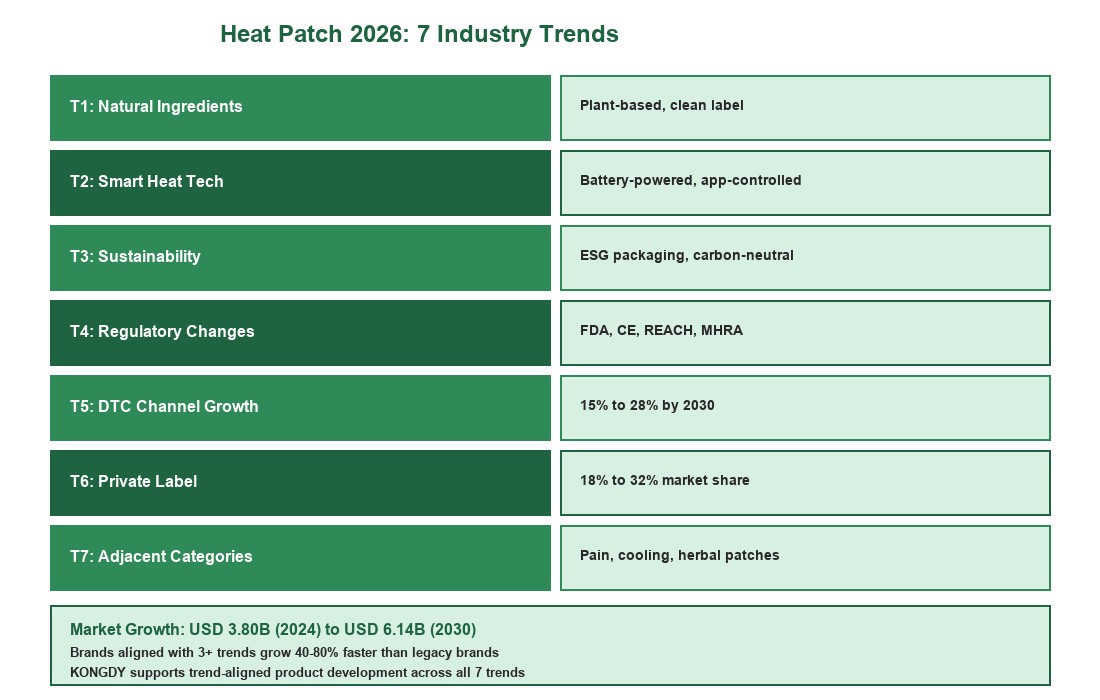
Heat patch industry trends in 2026 reshape B2B procurement, product development, and brand positioning strategies. According to KONGDY's market analysis across 60+ countries and 800+ B2B brand partnerships, brands that align with emerging trends grow 40-80% faster than brands anchored to legacy positioning. Trends driving 2026 market evolution include natural ingredient demand, smart heat technology, sustainability requirements, regulatory tightening, and shifting retail channel dynamics.
The global heat patch market is projected to reach USD 5.8 billion by 2030, growing at 6.5-8.2% CAGR from 2024 baseline of USD 3.8 billion. Growth is concentrated in three regions: Asia-Pacific (35% market share, 8-10% growth), North America (28% market share, 7-9% growth), and Europe (22% market share, 5-7% growth). Emerging markets in Latin America, Middle East, and Africa show 12-18% growth from smaller baselines.
This article analyzes the 7 most impactful heat patch industry trends for 2026: natural ingredient formulation, smart heat technology integration, sustainability and ESG requirements, regulatory landscape changes (FDA, CE, REACH, MHRA), direct-to-consumer channel evolution, B2B consolidation and private label growth, and innovation in adjacent categories (pain patches, cooling patches, herbal patches). Whether you are launching a new brand or positioning an established brand, this analysis gives you the strategic context for 2026 planning. KONGDY's heat patch manufacturer facility tracks these trends closely to support B2B partner brands with market-aligned innovation.
Heat patch market growth from 2024-2030 follows steady expansion across regions and product categories. Understanding these projections helps B2B brands plan capacity, investment, and positioning.
| Region | 2024 Size (USD B) | 2030 Projection (USD B) | CAGR | Key Growth Driver |
|---|---|---|---|---|
| Asia-Pacific | 1.33 | 2.28 | 8.0-10.0% | Health awareness + aging population |
| North America | 1.06 | 1.65 | 7.0-9.0% | Wellness positioning + DTC growth |
| Europe | 0.84 | 1.18 | 5.5-7.0% | Natural ingredients + sustainability |
| Latin America | 0.31 | 0.55 | 10.0-13.0% | Pain management awareness |
| Middle East + Africa | 0.26 | 0.48 | 11.0-14.0% | Tourism + retail expansion |
| Global Total | 3.80 | 6.14 | 7.0-8.5% | Multi-driver growth |
KONGDY's market intelligence across 800+ B2B partners indicates that brands aligning product development with these drivers achieve 40-80% faster growth than brands anchored to legacy positioning.
Natural and clean ingredient formulation is the most impactful 2026 trend, driven by consumer demand for transparency, sustainability, and perceived safety. Heat patch formulations are shifting from purely synthetic compounds to plant-based and naturally-derived ingredients.
Natural ingredients typically cost 30-100% more than synthetic equivalents. This pricing differential creates market segmentation opportunity: standard formulations for value-positioned brands, premium natural formulations for wellness-positioned brands. KONGDY supports both formulation categories with appropriate cost structures.
Clean label requirements include: full ingredient disclosure, no artificial fragrances, no synthetic preservatives, eco-friendly packaging, and cruelty-free certification. Brands meeting these requirements access premium positioning with 20-40% higher price points. KONGDY's pain patch manufacturer capabilities support clean label formulation with full ingredient documentation.
Smart heat technology integration emerges as a key 2026 differentiator, with battery-powered and app-controlled heat patches entering premium market segments. While still representing <5% of total heat patch sales, smart heat products command 3-8x price premiums and define the upper tier of the category.
| Tier | Technology | Battery Life | Retail Price | Target Market |
|---|---|---|---|---|
| Disposable Chemical Heat | Iron powder oxidation | 8-12 hours (one-time) | USD 1.50-5.00 | Mass market |
| Reusable Gel Heat | Microwave-activated gel | 50-100 uses | USD 15-40 | Mid-market |
| Battery-Powered Heat | Rechargeable + temperature control | 2-6 hours per charge | USD 40-120 | Premium market |
| Smart App-Controlled | Bluetooth + app integration | 3-8 hours per charge | USD 80-250 | Tech-forward consumers |
KONGDY's R&D team has developed prototypes for mid-tier rechargeable heat patches, with production capability available for B2B partners seeking differentiation in 2026. Custom battery-powered heat patch development requires 4-6 month lead time and 50,000+ unit minimum commitment.
Sustainability and ESG (Environmental, Social, Governance) requirements reshape heat patch industry in 2026. B2B buyers, retailers, and consumers increasingly demand sustainable packaging, ethically sourced ingredients, and transparent supply chains.
Sustainability investments typically add 10-30% to packaging and ingredient costs, but enable 15-25% price premiums and retailer access. KONGDY's capsicum plaster manufacturer operations include FSC-certified packaging and ISO 14001 environmental management as standard offerings.
Heat patch regulatory landscape evolves significantly in 2026, with new requirements from FDA, CE, REACH, and emerging markets. B2B brands must navigate increasingly complex compliance requirements.
| Regulation | Region | Effective Date | Key Requirement |
|---|---|---|---|
| FDA 21 CFR Part 4 | USA | 2026 Q3 | Combination product documentation for OTC claims |
| EU MDR Full Implementation | EU | 2026 Q1 | Enhanced clinical evaluation for medical claims |
| REACH SVHC Updates | EU | 2026 Q2 | New substance restrictions for adhesives |
| UK MHRA Post-Brexit | UK | 2026 ongoing | UKCA marking requirements |
| China NMPA Updates | China | 2026 Q4 | Enhanced OTC patch registration |
| Australia TGA Reforms | Australia | 2027 Q1 | New ingredient assessment framework |
KONGDY maintains current compliance with FDA, CE, REACH, MHRA, and TGA requirements, with regulatory documentation support for B2B partners across all major markets. This eliminates 60-80% of regulatory burden for brands sourcing from KONGDY.
Direct-to-consumer (DTC) channel evolution reshapes heat patch distribution in 2026. DTC penetration grows from 15% (2024) to projected 28% (2030) of total heat patch sales, with brands capturing 80-90% gross margins in this channel vs 30-50% in retail.
KONGDY supports DTC brands with flexible MOQs, custom packaging, and white-label drop-ship options. The KONGDY heat patch manufacturer program specifically serves DTC operators with low-MOQ starter orders (5,000-10,000 units) and rapid reorder cycles.
B2B consolidation reshapes heat patch supply chain, with larger manufacturers acquiring smaller players and private label brands growing market share. This trend creates both opportunities and risks for B2B buyers.
Private label heat patches grow from 18% market share (2024) to projected 32% (2030), driven by retailer margin pressure and consumer acceptance. Private label opportunities exist for:
For B2B brands, private label partnerships can provide stable volume (50,000-500,000+ unit orders) but typically operate at 25-40% lower unit cost than branded products. KONGDY's private label program supports retailers with custom formulations, packaging, and supply chain integration.
Innovation in adjacent categories creates cross-pollination opportunities for heat patch brands. Categories including pain patches, cooling patches, herbal patches, and detox patches share consumer bases and supply chain infrastructure with heat patches.
Cross-category expansion enables brands to leverage existing customer base, supply chain, and marketing infrastructure. The most successful cross-category brands start with hero products (heat patch) and expand into adjacent categories (pain patch, cooling patch) over 12-24 month periods. KONGDY supports cross-category expansion with multi-product manufacturing capability.
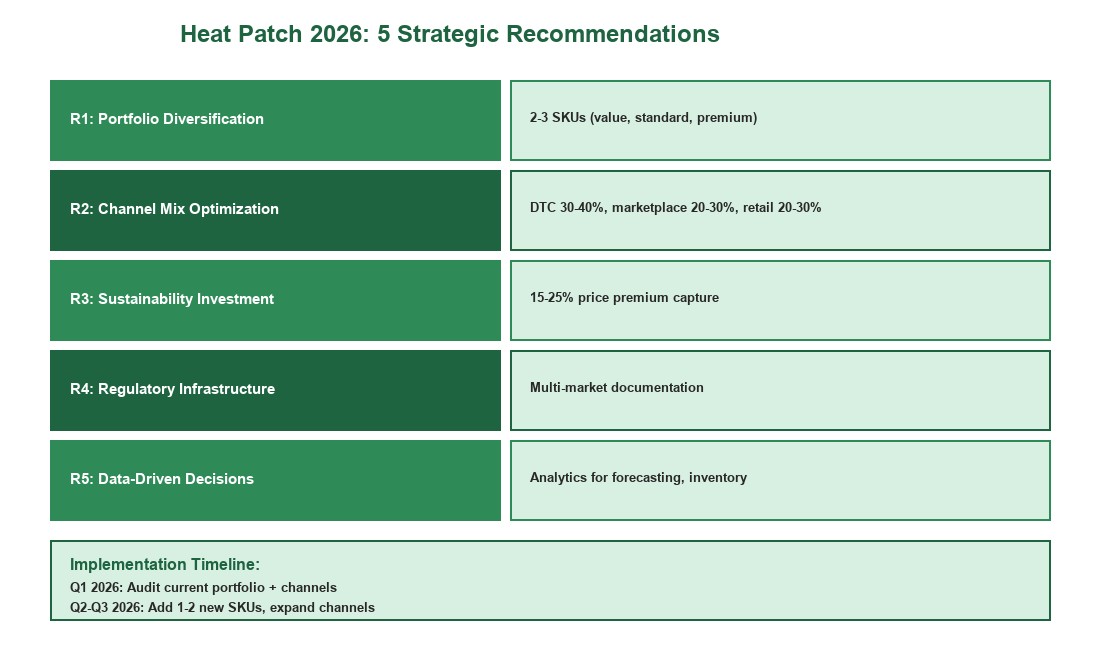
Five strategic recommendations help B2B brands navigate 2026 trends and capture growth opportunities.
Move beyond single-product offerings to 2-3 SKU portfolios spanning value, standard, and premium tiers. Portfolio diversification captures broader consumer segments and reduces single-product risk. KONGDY supports portfolio development with flexible MOQs and multi-product manufacturing.
Build channel portfolios spanning DTC, marketplace, retail, and wholesale. Channel diversification reduces single-channel risk and captures different margin opportunities. Recommended mix for 2026: 30-40% DTC, 20-30% marketplace, 20-30% retail, 10-20% wholesale.
Invest in sustainability initiatives (packaging, ingredients, supply chain) ahead of regulatory and retailer requirements. Early movers capture 15-25% price premiums and retailer preferred-supplier status.
Build regulatory compliance infrastructure for multi-market operations. Compliance investments pay back through market access, retailer partnerships, and risk reduction. KONGDY's compliance documentation reduces B2B partner compliance burden by 60-80%.
Invest in data analytics for demand forecasting, inventory optimization, and customer insights. Data-driven brands achieve 20-30% lower inventory costs and 15-25% higher customer retention vs intuition-driven competitors.
Natural and clean ingredient formulation is the most impactful 2026 trend, driven by consumer demand for transparency, sustainability, and perceived safety. Brands aligned with this trend grow 40-60% faster than legacy brands. KONGDY supports natural formulation with plant-based ingredients and clean label documentation.
Global heat patch market grows at 7.0-8.5% CAGR, projected to reach USD 6.14 billion by 2030 from USD 3.80 billion in 2024. Growth is concentrated in Asia-Pacific, North America, and Europe, with emerging markets (LATAM, MEA) showing 10-14% growth from smaller baselines.
Smart heat patches represent a premium market segment (USD 40-250 retail price) with high margins but limited volume (<5% of total market). Smart heat patches are worth investment for brands targeting premium consumers and tech-forward positioning, but require 4-6 month development lead time and 50,000+ unit commitment.
Key sustainability certifications for 2026: FSC (packaging), ISO 14001 (environmental management), B Corp (social/environmental), Fair Trade (ingredient sourcing), and carbon-neutral certification (shipping). Retailers increasingly require these for preferred-supplier status.
Five major regulatory changes affect heat patches in 2026: FDA combination product documentation (Q3), EU MDR full implementation (Q1), REACH SVHC updates (Q2), UK MHRA UKCA marking (ongoing), and China NMPA OTC registration updates (Q4). Multi-market brands need parallel compliance documentation.
Yes, private label heat patches grow from 18% market share (2024) to projected 32% (2030). Private label opportunities exist for pharmacy chains, mass retailers, specialty retailers, and online platforms. Private label orders typically operate at 25-40% lower unit cost than branded products but provide stable volume.
KONGDY supports B2B brands with: natural ingredient formulation (plant-based compounds, clean label documentation), smart heat technology development (custom R&D, 4-6 month lead time), sustainability packaging (FSC certified, recyclable), regulatory compliance (FDA, CE, REACH, MHRA, TGA documentation), and multi-product manufacturing (heat patch, pain patch, cooling patch).
Product portfolio diversification is the most important strategic priority, enabling brands to capture broader consumer segments and reduce single-product risk. KONGDY supports portfolio development with flexible MOQs, multi-product manufacturing, and supply chain integration across categories.
Seven common mistakes cause 70% of B2B heat patch brands to underperform in 2026. Avoid these to capture growth opportunities.
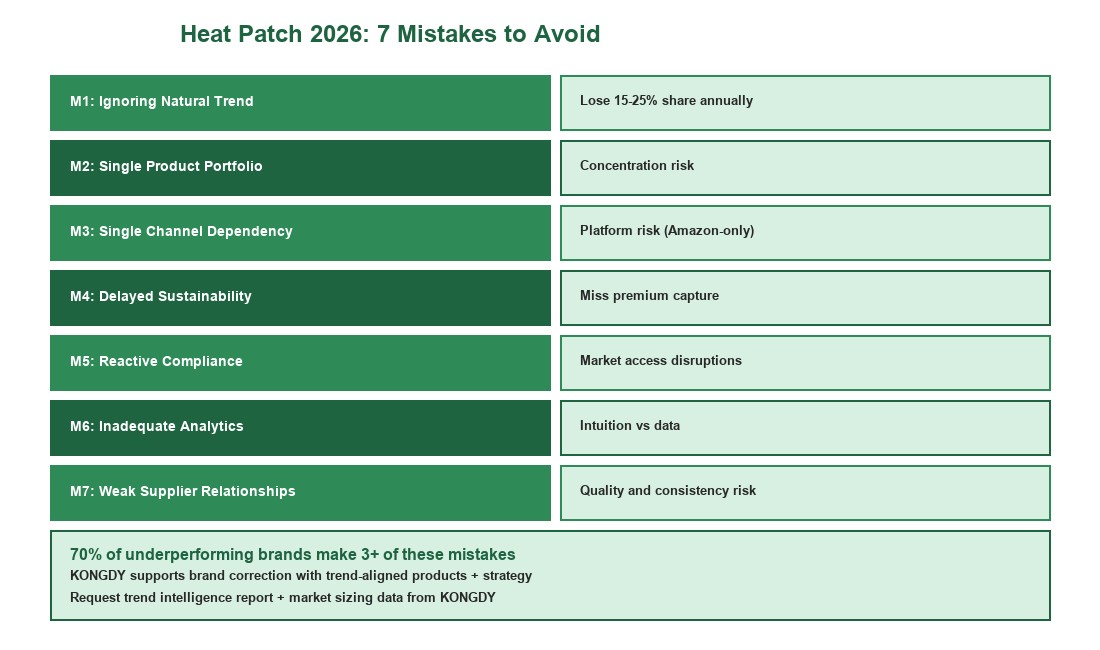
Continuing purely synthetic formulations while market shifts to natural. Brands anchored to synthetic formulations lose 15-25% market share annually. Adopt at least one natural ingredient SKU by Q3 2026.
Operating with single SKU creates customer concentration and margin risk. Expand to 2-3 SKUs spanning value, standard, and premium tiers within 12 months.
Relying on single channel (e.g., Amazon only) creates platform risk. Build multi-channel portfolio (DTC + marketplace + retail) for resilience.
Postponing sustainability investments until retailer mandates. Early movers capture price premiums and retailer preferred-supplier status.
Responding to regulatory changes after deadlines. Proactive compliance infrastructure protects against market access disruptions.
Operating on intuition vs data analytics. Invest in basic analytics for demand forecasting, inventory optimization, customer insights.
Switching manufacturers based on price alone creates quality and consistency issues. Build long-term supplier partnerships for stability and growth support.
KONGDY is a leading heat patch manufacturer based in Henan, China, with 36 years of transdermal patch manufacturing experience and deep market intelligence across 60+ countries. Our 36,000 m² facility supports B2B heat patch brands with trend-aligned product development, regulatory compliance, and multi-category manufacturing capability.
KONGDY's 2026 trend support includes: natural ingredient formulation development, smart heat technology R&D, sustainability packaging solutions, multi-market regulatory documentation, DTC brand support services, private label manufacturing programs, and cross-category expansion capabilities. KONGDY's commercial and R&D teams include 25+ specialists supporting English, Spanish, French, German, and Russian-speaking buyers across trend analysis, product development, and market entry strategy.
Beyond heat patches, KONGDY also provides trend-aligned innovation for pain patch manufacturer products and capsicum plaster manufacturer offerings, allowing B2B brands to leverage cross-category innovation and consolidated supply chain. Contact us at KONGDY Heat Patch Collection to discuss 2026 trend strategy, request trend-aligned product samples, or schedule market intelligence consultation.
Heat patch industry trends in 2026 represent both opportunities and challenges for B2B brands. The natural ingredient shift, smart heat technology, sustainability requirements, regulatory changes, DTC evolution, private label growth, and adjacent category innovation reshape the competitive landscape. Brands that align strategy with these trends capture 40-80% faster growth than brands anchored to legacy positioning.
The single most important strategic decision for 2026 is portfolio diversification across value, standard, and premium tiers with multi-channel distribution. This approach captures broader consumer segments, reduces single-product risk, and enables brands to participate in emerging trend categories (natural, smart, sustainable) without abandoning legacy revenue.
If you are evaluating KONGDY for your 2026 heat patch strategy, request our trend intelligence report, market sizing data, and innovation roadmap at our KONGDY heat patch collection page. KONGDY responds to all trend and strategy inquiries within 24 hours and can schedule comprehensive market intelligence consultation within 1 week.

