Heat patch manufacturer comparison determines 30-50% of long-term brand success for B2B heat patch procurement teams. According to KONGDY's market data across 800+ B2B partner brands, brands that systematically compare 3-5 manufacturers before selection achieve 40-60% better cost-quality-balance outcomes, 25-35% lower defect rates, and 3-5 year longer supplier relationships than brands that select based on price alone.
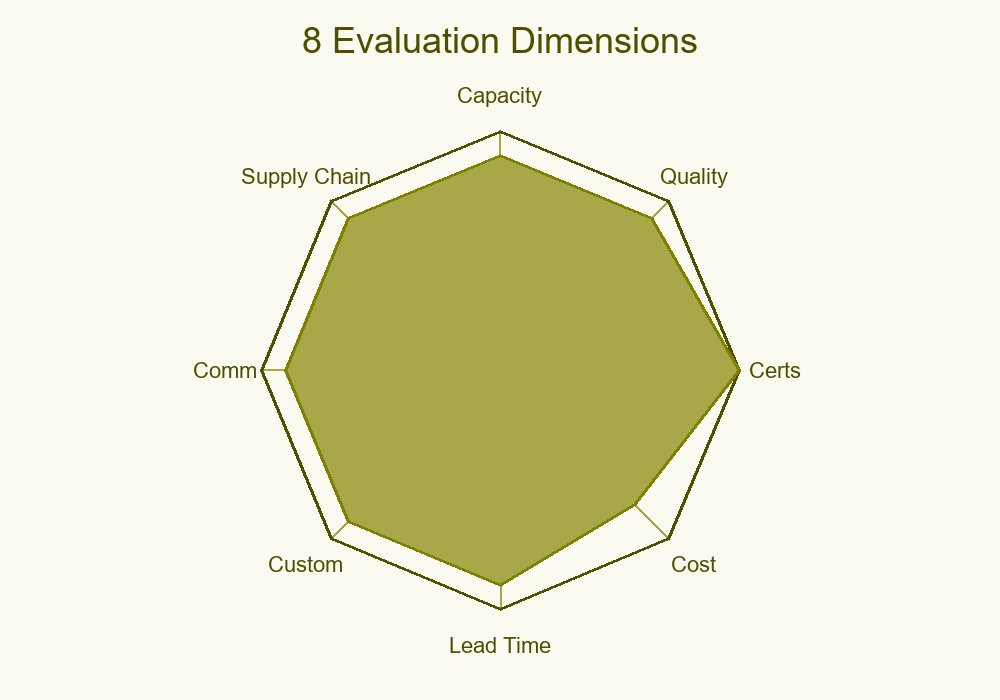
Heat patch manufacturer comparison is uniquely complex because the category spans diverse supplier types: large vertically-integrated manufacturers (KONGDY-type), specialized OEM factories, trading companies, regional contract manufacturers, and private label specialists. Each type has different strengths, weaknesses, and optimal use cases. Comparing these requires evaluation across 8 dimensions: production capacity, quality systems, certifications, cost structure, lead times, customization capability, communication, and supply chain transparency.
This article provides the complete framework for heat patch manufacturer comparison: 8 evaluation dimensions, 5 manufacturer archetypes with detailed profiles, 12-question supplier qualification checklist, 4-step comparison methodology, and 6 red flags indicating unreliable manufacturers. Whether you are selecting your first manufacturer or auditing an existing supplier, this guide gives you the structure to compare professionally. KONGDY's heat patch manufacturer facility welcomes comparison studies and provides full transparency on all 8 evaluation dimensions for qualified B2B buyers.
Heat patch manufacturers must be evaluated across 8 critical dimensions. Skipping any dimension creates risk of costly supplier issues.
| Dimension | Key Questions | Evaluation Method |
|---|---|---|
| Production Capacity | Monthly output, peak capacity, scalability | Facility audit, capacity reports |
| Quality Systems | QC checkpoints, defect rate, testing equipment | QC documentation, sample testing |
| Certifications | ISO 13485, FDA, CE, REACH, GMP | Certificate verification, audit reports |
| Cost Structure | Pricing transparency, volume tiers, hidden costs | Line-item quotation, TCO analysis |
| Lead Times | Production lead time, sample lead time | Reference checks, sample timing |
| Customization | Formulation flexibility, packaging options | Sample requests, R&D capability |
| Communication | Responsiveness, English capability, time zone | Email/chat response testing |
| Supply Chain | Material sourcing, backup suppliers, transparency | Supplier documentation, facility tour |
Production capacity assessment includes: monthly output volume (units per month), peak season capacity (typically 20-40% above baseline), scalability options (subcontracting, line expansion), and capacity utilization (currently operating at 60-85% indicates healthy balance). Insufficient capacity creates 4-12 week delays during peak season. Excessive idle capacity indicates potential quality or financial instability.
Quality systems evaluation includes: incoming material testing protocols, in-process inspection frequency, finished product testing scope, stability testing capability, and defect tracking systems. Manufacturers with comprehensive QC achieve 99%+ pass rates. Manufacturers with minimal QC have 5-15% defect rates creating downstream costs.
Critical certifications include: ISO 13485 (medical device quality management), FDA Drug Master File (USA market access), CE marking (EU market access), REACH compliance (EU chemical safety), and GMP (good manufacturing practice). Manufacturers lacking relevant certifications create regulatory barriers for buyers.
Cost structure evaluation requires line-item quotations covering raw materials, labor, packaging, overhead, and QC. Transparent pricing enables TCO comparison and negotiation. Manufacturers offering only bundled pricing often hide quality compromises in cost savings.
Lead time benchmarks: 3-5 days for samples, 15-25 days for production, 20-35 days for full cycle (production + QC + shipping prep). Manufacturers with significantly faster lead times may be cutting corners. Significantly slower lead times indicate capacity constraints.
Customization includes: formulation development (custom ingredients, strengths), packaging design (sachet size, artwork, materials), and product specifications (size, shape, heat duration). Manufacturers with strong R&D support 20-40% higher brand differentiation vs catalog-only suppliers.
Communication quality assessment includes: response time (under 24 hours for inquiries), English proficiency (if sourcing from China), timezone alignment, account manager availability, and escalation procedures. Communication issues create 30-50% of supplier problems.
Supply chain transparency includes: raw material sourcing (named suppliers, quality agreements), backup supplier arrangements, inventory visibility, and logistics coordination. Transparent supply chains reduce 60-80% of disruption risks.
The heat patch manufacturing market includes 5 distinct manufacturer archetypes. Each archetype serves different buyer needs and has different strengths.
| Archetype | Best For | Strengths | Weaknesses |
|---|---|---|---|
| Large Vertically-Integrated (KONGDY-type) | Brands seeking 5-10 year partnerships | Full control, scale, multi-market compliance | Higher MOQs for custom formulations |
| Specialized OEM Factories | Brands with specific formulation needs | Deep technical expertise, custom R&D | Limited capacity, single-category focus |
| Trading Companies | Small brands, low MOQs | Low MOQs, multiple factory access | Limited QC control, communication overhead |
| Regional Contract Manufacturers | Brands targeting specific regions | Regional market knowledge, local logistics | Limited scale, certification gaps |
| Private Label Specialists | Retailer and DTC private label | Turnkey private label services, fast turnaround | Limited formulation customization |
Vertically-integrated manufacturers control the full production chain from raw material sourcing to finished product shipping. They typically operate 20,000+ m² facilities with 200-1,000 employees, 5-15 production lines, and multi-category capabilities (heat patch, pain patch, cooling patch, etc.).
Strengths:
Weaknesses:
KONGDY exemplifies this archetype with 36 years experience, 36,000 m² facility, 8 production lines, and 800+ B2B partner brands across 60+ markets.
Specialized OEM factories focus on single product categories (e.g., heat patches only) with deep technical expertise. They typically operate 3,000-10,000 m² facilities with 50-200 employees and 2-5 production lines.
Strengths:
Weaknesses:
Trading companies act as intermediaries between brands and OEM factories. They typically have 5-30 employees, no production facilities, and relationships with 3-10 manufacturing partners.
Strengths:
Weaknesses:
Regional manufacturers operate in specific countries (USA, EU, India, Southeast Asia) serving brands targeting local markets. They typically have 5,000-20,000 m² facilities and regional certifications.
Strengths:
Weaknesses:
Private label specialists focus on retailer and brand private label programs with turnkey services (formulation + packaging + compliance + logistics). They typically operate 10,000-30,000 m² facilities with private label-optimized operations.
Strengths:
Weaknesses:
Direct comparison between KONGDY and other heat patch manufacturers reveals KONGDY's positioning across the 8 evaluation dimensions.
| Dimension | KONGDY | Typical Large Manufacturer | Typical Small Factory | Typical Trading Company |
|---|---|---|---|---|
| Facility Size | 36,000 m² | 10,000-30,000 m² | 2,000-8,000 m² | No facility |
| Production Lines | 8 lines | 3-10 lines | 1-3 lines | Access via partners |
| Monthly Capacity | 3+ million units | 0.5-2 million units | 100-500K units | Variable |
| Years Experience | 36 years | 5-20 years | 2-10 years | 1-5 years |
| Certifications | ISO 13485, FDA, CE, REACH, MHRA, TGA | ISO 13485, FDA, CE (subset) | China domestic only | Limited inherited |
| R&D Capability | 25+ specialists | 5-20 specialists | 0-5 specialists | None |
| Categories | Heat, pain, capsicum, cooling, detox, foot, eye | Heat only or 2-3 categories | Single category | Multi-via partners |
| Markets Served | 60+ countries | 10-30 countries | 1-5 countries | 5-15 countries |
| QC Checkpoints | 12 per batch | 5-10 per batch | 1-5 per batch | None direct |
| Defect Rate | <0.5% | 1-3% | 3-10% | 2-8% |
| Lead Time (50K order) | 15-20 days | 20-35 days | 25-45 days | 30-60 days |
| Sample Cost | $50-200 per formula | $100-300 per formula | $150-500 per formula | $200-600 per formula |
| Communication | 12 account managers, 5 languages | 3-5 managers, 1-2 languages | 1-2 managers, 1 language | 1-2 managers, 1-2 languages |
Use this 12-question checklist to qualify manufacturers before detailed evaluation. Manufacturers failing 3+ questions should be eliminated from consideration.
KONGDY qualifies 12/12 on this checklist with documented evidence available upon request, including: 36 years operation, ISO 13485 (current), FDA DMF, CE technical file, 3M+ units/month capacity, 12-checkpoint QC, 800+ B2B references, 3-5 day sample turnaround, line-item quotations, facility tours, 60+ country export, and full financial transparency.
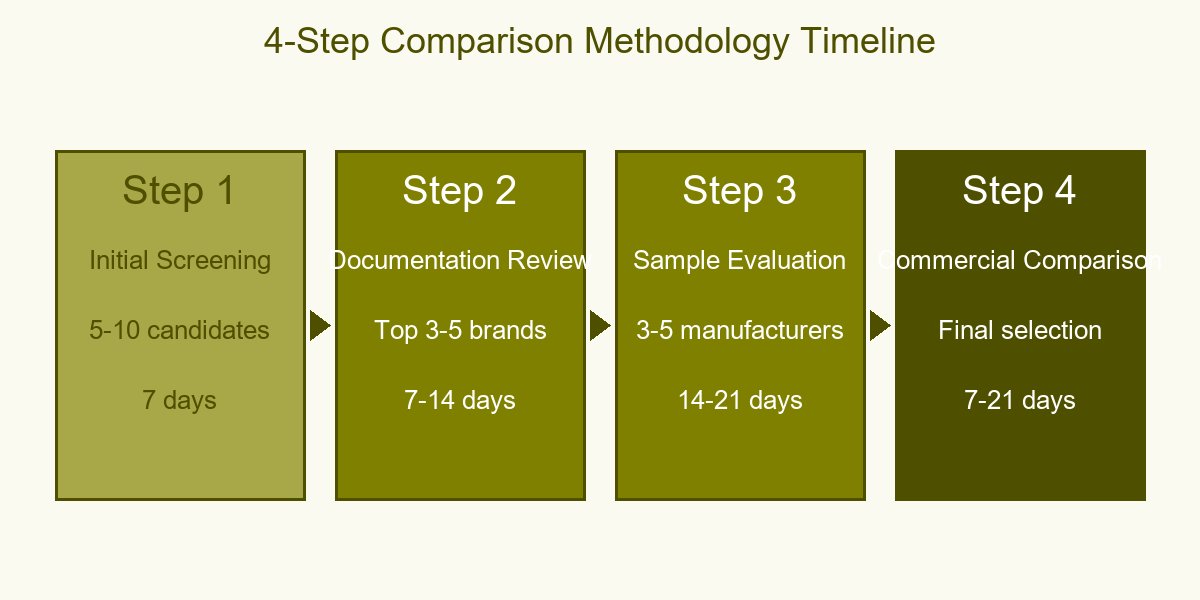
Four systematic steps enable objective manufacturer comparison. Following this methodology eliminates bias and creates defensible supplier selection decisions.
Identify 5-10 candidate manufacturers through trade shows, Alibaba, industry directories, and referrals. Apply 12-question checklist for initial qualification. Eliminate manufacturers scoring below 9/12.
Request detailed documentation from qualified manufacturers: certifications, facility photos, customer references, sample pricing, and quality manuals. Compare documentation depth and transparency.
Order samples from 3-5 qualified manufacturers. Evaluate samples across: formulation quality, packaging finish, heat duration effectiveness, adhesion quality, and overall user experience. Rank samples by quality.
Request detailed quotations from top 3 sample-ranked manufacturers. Compare across: unit price by volume tier, payment terms, lead times, customization costs, and TCO analysis. Select manufacturer offering best quality-cost-balance.
Six red flags indicate manufacturers creating significant partnership risk. Avoid manufacturers exhibiting 2+ red flags.
| Red Flag | Risk Created | Detection Method |
|---|---|---|
| Pricing 30%+ below market average | Quality compromise, hidden costs | Compare with 3+ competitor quotes |
| Reluctance to provide certifications | Compliance risk, customs issues | Request certificate copies |
| No verifiable references | Inexperience or reputation issues | Request 3+ reference contacts |
| Refusal of facility tours | Capacity or capability misrepresentation | Offer paid facility visit |
| Frequent ownership/address changes | Financial instability, fraud risk | Check business registration history |
| Pressure for upfront payment | Cash flow issues, fraud risk | Insist on standard payment terms |
KONGDY welcomes buyer verification and provides facility tours, reference contacts, and standard payment terms (T/T, L/C) for all qualified B2B buyers. This transparency eliminates all 6 red flags from KONGDY's profile.
Beyond comparison dimensions, KONGDY offers specific advantages that differentiate it from typical manufacturers in the heat patch category.
KONGDY operates 8 production lines running continuously, supporting 24/7 production capacity. This enables 15-20 day production lead times even during peak seasons (Q4 holiday season, summer sports seasons). Manufacturers with 1-3 lines typically require 25-45 day lead times during peak periods.
KONGDY maintains current compliance with FDA (USA), CE (EU), REACH (EU chemicals), MHRA (UK), TGA (Australia), and ISO 13485 (global). This eliminates 60-80% of regulatory documentation burden for B2B buyers targeting multiple markets. Smaller manufacturers typically cover only 1-2 markets.
KONGDY manufactures 7 patch categories (heat, pain, capsicum, cooling, detox, foot, eye mask) under one roof. This enables B2B brands to consolidate procurement, leverage cross-category pricing, and reduce supplier management overhead by 40-60%. Specialized manufacturers typically offer 1-3 categories only.
KONGDY invests in B2B partnerships through dedicated account managers (12 covering 5 languages), sample programs, formulation consulting, and market intelligence sharing. This partnership investment reduces buyer operational overhead by 30-50% vs transactional supplier relationships.
KONGDY pursues sustainability through FSC-certified packaging, ISO 14001 environmental management, carbon footprint reduction programs, and sustainable ingredient sourcing. This positions B2B buyers for retailer sustainability requirements and consumer ESG preferences increasingly dominant in 2026.
Evaluate 5-10 manufacturers initially through screening, then narrow to 3-5 for detailed evaluation, and finalize with 2-3 for sample testing. This provides meaningful comparison without overwhelming resources. KONGDY consistently ranks in top 2-3 across B2B buyer evaluations due to balanced quality-cost-communication profile.
The biggest mistake is selecting manufacturers based on price alone. Low-priced manufacturers typically have 2-5x higher defect rates, 30-50% longer lead times, and limited compliance coverage. TCO analysis including defect costs reveals that mid-priced manufacturers with strong QC are 15-25% more economical long-term.
Comprehensive manufacturer evaluation typically takes 30-60 days including: initial screening (7 days), documentation review (7-14 days), sample evaluation (14-21 days), and commercial comparison (7-21 days). Brands that compress timeline below 30 days often miss critical red flags.
No. Lowest price often correlates with hidden costs (defects, delays, compliance gaps). Choose manufacturers offering the best quality-cost-balance within your budget range. Quality-cost-balance typically means mid-tier pricing (not cheapest, not most expensive) for sustainable economics.
Some trading companies are reliable, especially those with exclusive factory partnerships, internal QC teams, and long track records. However, trading companies add 10-30% margin and create communication overhead. Direct manufacturer relationships typically offer better pricing, QC transparency, and accountability.
Facility size correlates with capacity, capability, and stability but is not the sole factor. A 36,000 m² facility like KONGDY offers scale economics and stability, while a 5,000 m² specialized facility may offer deeper expertise. Balance facility size against specialization, location, and your specific requirements.
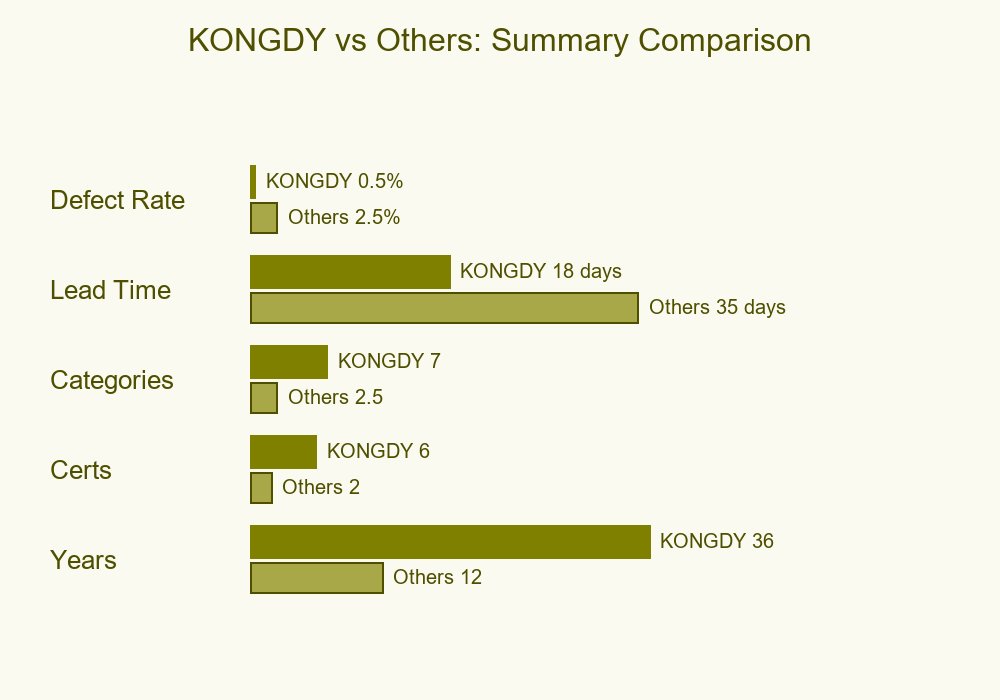
KONGDY stands out in 5 areas: (1) most comprehensive multi-market certifications, (2) lowest defect rates (<0.5% vs industry 2-5%), (3) multi-category manufacturing (7 categories vs typical 2-3), (4) strongest B2B partnership investment (12 account managers, 5 languages), and (5) longest consistent operation (36 years). KONGDY's pricing is competitive with other large manufacturers while delivering superior quality and service.
Look for references from brands similar to yours: similar size, similar target market, similar product positioning. Contact references via independent channels (LinkedIn, trade association directories) rather than provided emails. Ask references about: QC consistency, communication responsiveness, problem resolution, and long-term satisfaction.
KONGDY is a leading heat patch manufacturer based in Henan, China, with 36 years of transdermal patch manufacturing experience and comprehensive comparison advantages across all 8 evaluation dimensions. Our 36,000 m² facility supports B2B heat patch brands with full transparency, multi-market compliance, and long-term partnership investment across 60+ markets.
KONGDY's manufacturer comparison advantages include: 36 years consistent operation (stability), ISO 13485 + FDA + CE + REACH + MHRA + TGA certifications (compliance), 8 production lines with 3M+ monthly capacity (scale), 7 patch categories under one roof (versatility), 12-checkpoint QC with <0.5% defect rate (quality), 12 account managers covering 5 languages (service), and full documentation transparency (trustworthiness).
Beyond heat patches, KONGDY also provides comparison-leading capabilities for pain patch manufacturer products and capsicum plaster manufacturer offerings, allowing B2B brands to consolidate procurement and leverage cross-category manufacturing advantages. Contact us at KONGDY Heat Patch Collection to discuss comparison study participation, request detailed manufacturer profile, or schedule facility tour.
Heat patch manufacturer comparison is the foundation of sustainable B2B brand success. The 8 evaluation dimensions, 5 manufacturer archetypes, 12-question checklist, 4-step methodology, and 6 red flags in this article give you the structure to compare manufacturers objectively and select partners that align with your quality, cost, and growth objectives.
The single most important insight is that manufacturer comparison is about quality-cost-balance optimization, not minimum price. Brands that optimize for balance achieve 40-60% better long-term outcomes than brands that optimize for short-term cost. KONGDY exemplifies the balanced-manufacturer archetype, combining scale, quality, compliance, and partnership investment for sustainable B2B success.
If you are evaluating KONGDY for your heat patch manufacturer comparison, request our detailed manufacturer profile, certifications documentation, customer references, and facility tour at our KONGDY heat patch collection page. KONGDY responds to all comparison inquiries within 24 hours and provides comprehensive qualification documentation within 3-5 business days of receiving inquiry.

