Pain Patch Ingredients: Complete Guide to Transdermal Patch Components
Categories
Categories

Pain Patch Ingredients: What Goes Into a Transdermal Patch (And Why It Matters)

A complete breakdown of pain patch ingredients: 5-layer anatomy, 8+ common actives (menthol, lidocaine, camphor), 7 functional categories, and how ingredient choice affects efficacy, pricing, and market positioning for B2B buyers.
Jun 26th,2026 164 Views

Key Statistics

Understanding pain patch ingredients is essential for B2B buyers evaluating formulations and for brand owners marketing to ingredient-conscious consumers. KONGDY Health's 36 years of manufacturing expertise spans 100+ ingredient combinations. Below is a complete breakdown of the 5-layer anatomy, 8+ common ingredients, and 7 functional categories of a transdermal pain patch.

  • 5 structural layers in every pain patch: release liner, adhesive matrix, backing film, active layer, optional perforation
  • 35% of patch weight is the pressure-sensitive adhesive (PSA) polymer
  • 8+ common actives: menthol, camphor, lidocaine, methyl salicylate, capsaicin, eucalyptus oil, etc.
  • 100+ formulations available at KONGDY Health
  • 60+ countries served by KONGDY with market-specific ingredient profiles
  • 5K MOQ private label, lead time 30 days, FOB pricing $0.08-$0.55/patch

TL;DR

A pain patch consists of 5 structural layers (release liner, adhesive matrix, backing film, active layer, optional perforation) and contains 8+ common ingredients spanning 7 functional categories. The three primary actives are menthol (cooling, fast onset), camphor (warming, penetration enhancer), and lidocaine (nerve-blocking, long duration). KONGDY Health manufactures 100+ ingredient combinations with 5K MOQ private label and 30-day lead time. Browse the KONGDY pain patch catalog to see formulation samples.

Key Takeaways

  • 5-layer anatomy: every pain patch has the same 5 structural components regardless of active.
  • Menthol + camphor combination is the most common formulation (60%+ of global market).
  • PSA polymer is 35% of weight: the adhesive matrix is the largest single ingredient.
  • Penetration enhancers (camphor, eucalyptus) are critical for actives to cross the skin barrier.
  • Backing film choice affects breathability, comfort, and wear time.
  • Antioxidants and preservatives extend shelf life from 12 to 36 months.
  • Custom formulations are available at KONGDY Health for buyers wanting unique ingredient profiles.

Quick Answer: What Ingredients Are in a Pain Patch?

A pain patch contains 5 structural layers and 8+ active ingredients. The three primary actives are menthol (3-10%, cooling sensation), camphor (1-3%, warming + penetration enhancer), and lidocaine (1-5%, nerve blocking). The adhesive matrix (35% by weight) is typically acrylic or silicone-based. Backing film is polyurethane or PE foam. Optional ingredients include methyl salicylate, capsaicin, eucalyptus oil, antioxidants (BHT, Vitamin E), and preservatives. Browse the KONGDY pain patch catalog to see full ingredient lists.

Why Pain Patch Ingredients Matter for B2B Buyers

The ingredient composition of a pain patch determines its efficacy, regulatory pathway, market positioning, and consumer perception. For B2B buyers, understanding ingredients is essential for:

  • Formulation selection: matching active to target pain type
  • Regulatory compliance: each active has different FDA/EU status
  • Marketing differentiation: ingredient story sells to ingredient-conscious consumers
  • Quality control: knowing what to test for
  • Pricing strategy: lidocaine costs more than menthol
  • Shelf life planning: ingredient stability affects expiration dating

For brand owners, distributors, and importers evaluating pain patch manufacturers, ingredient transparency is a non-negotiable quality marker. KONGDY Health provides full ingredient disclosure with COA documentation. For the broader manufacturer selection process, see our OEM/ODM buying guide.
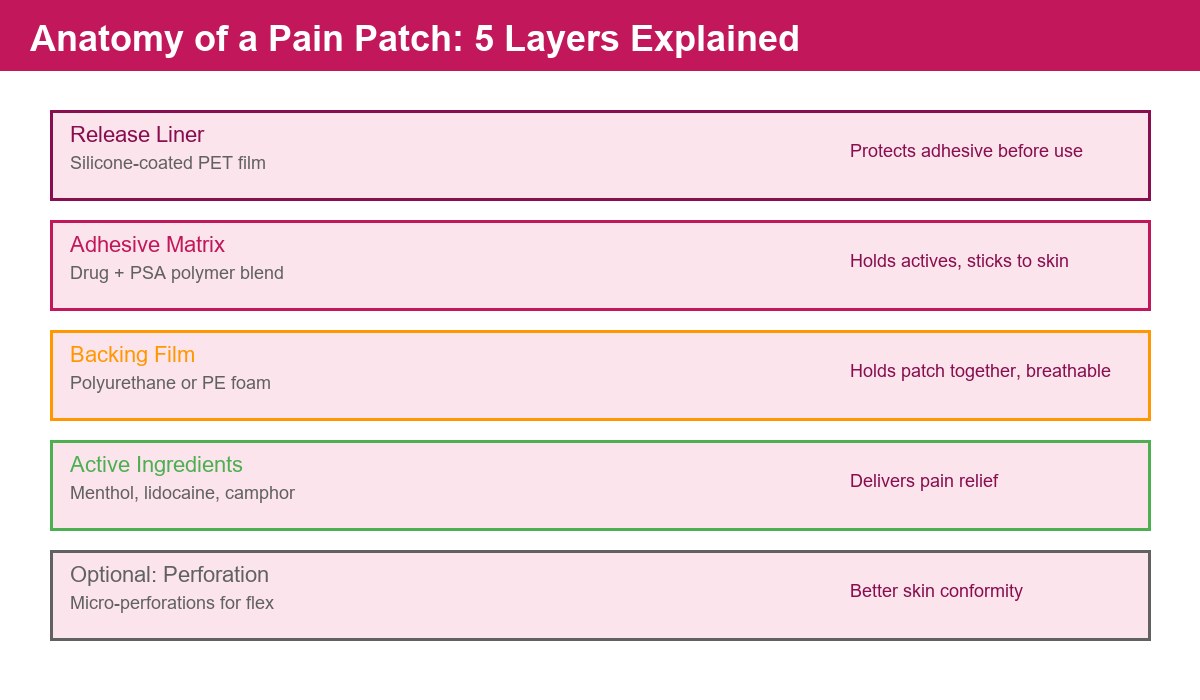
Anatomy of a Pain Patch: 5 Structural Layers

Pain patch 5-layer anatomy diagram

Every pain patch has the same 5-layer structure regardless of which active it contains. Understanding these layers helps B2B buyers compare manufacturing quality and pricing.

Layer 1: Release Liner (5-10% by weight)

  • Material: Silicone-coated PET (polyethylene terephthalate) film
  • Thickness: 50-100 microns
  • Function: Protects the adhesive matrix before use; peeled off and discarded
  • Release force: 5-30 g/inch (low enough to peel easily, high enough to stay on during storage)
  • Quality marker: Consistent release force across the entire patch surface

Layer 2: Adhesive Matrix (30-40% by weight)

  • Material: Pressure-sensitive adhesive (PSA) polymer - typically acrylic or silicone-based
  • Composition: PSA polymer + active ingredients + penetration enhancers + antioxidants
  • Thickness: 50-150 microns
  • Function: Holds the patch to skin; releases active ingredients over time
  • Quality marker: Uniform thickness, consistent adhesion across patch

Layer 3: Backing Film (40-50% by weight)

  • Material: Polyurethane (PU) film, polyethylene (PE) foam, or non-woven fabric
  • Thickness: 20-50 microns (film) or 500-1500 microns (foam)
  • Function: Holds patch together; allows skin to breathe; provides structural integrity
  • Quality marker: Breathability (MVTR 500-2000 g/m2/day), flexibility, comfort

Layer 4: Active Layer (incorporated into matrix)

  • Composition: Active pharmaceutical ingredients (menthol, lidocaine, capsaicin) + penetration enhancers
  • Distribution: Uniformly dispersed in the adhesive matrix
  • Function: Delivers therapeutic effect through skin
  • Quality marker: Content uniformity within +/- 5% across patch

Layer 5: Optional Perforation (design feature)

  • Type: Micro-perforations in backing film
  • Function: Improves skin conformity, breathability, comfort during movement
  • Common in: Joint/muscle patches, sports patches, premium SKUs

For a deeper look at how these layers come together in production, see our OEM process guide. For QC testing of each layer, see our quality control guide.
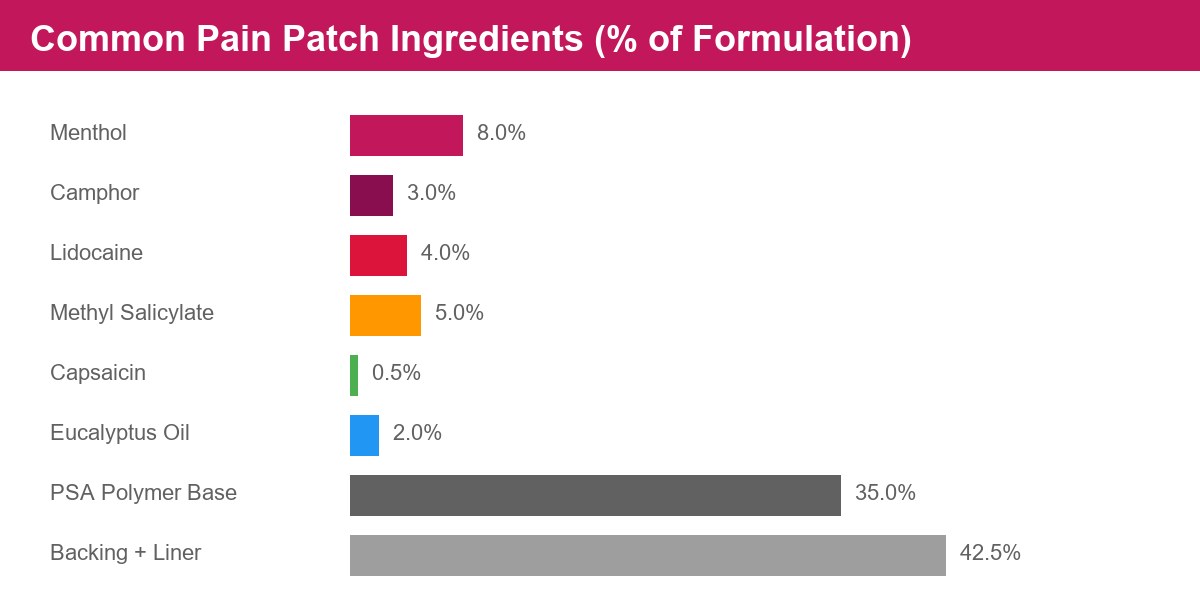
Active Pharmaceutical Ingredients (APIs) in Pain Patches

Pain patch ingredients percentage chart

The active ingredient is what makes a pain patch therapeutic. Here are the 8 most common APIs in B2B pain patches:

1. Menthol (3-10%)

  • Type: Cooling agent (natural or synthetic)
  • Mechanism: Activates TRPM8 cold receptors in skin
  • Effect: Cooling sensation + pain signal override
  • Onset: 5-10 minutes
  • Market share: 45% of global pain patch volume
  • FDA status: OTC monograph (external analgesic)
  • Cost: $5-$15/kg

2. Camphor (1-3%)

  • Type: Counter-irritant (warming)
  • Mechanism: Activates TRPV1/TRPV3 heat receptors
  • Effect: Warming sensation + penetration enhancer for menthol
  • Onset: 10-15 minutes
  • Market share: 40% of patches contain camphor alongside menthol
  • FDA status: OTC monograph (combined with menthol)
  • Cost: $10-$25/kg

3. Lidocaine (1-5%)

  • Type: Local anesthetic
  • Mechanism: Sodium channel blocker, blocks nerve conduction
  • Effect: Numbing + long-duration pain relief
  • Onset: 15-30 minutes
  • Market share: 25% of global volume, growing fast
  • FDA status: Rx-only at 5%; OTC monograph at 1-4%
  • Cost: $200-$400/kg

4. Methyl Salicylate (5-15%)

  • Type: Counter-irritant (wintergreen-derived)
  • Mechanism: Produces salicylate effect + warming sensation
  • Effect: Warming + mild analgesic
  • Onset: 15-20 minutes
  • Market share: 15% (popular in Asia and sports markets)
  • FDA status: OTC monograph
  • Cost: $8-$20/kg

5. Capsaicin (0.025-0.1%)

  • Type: Chili pepper-derived compound
  • Mechanism: Depletes substance P (pain neurotransmitter)
  • Effect: Initially warming/burning, then long-term pain relief
  • Onset: 30-60 minutes (initial burning), 2 weeks for full effect
  • Market share: 8% (Rx-positioned, neuropathic pain)
  • FDA status: Rx-only at higher concentrations
  • Cost: $300-$800/kg

6. Eucalyptus Oil (1-3%)

  • Type: Natural penetration enhancer
  • Mechanism: Increases skin permeability + mild cooling
  • Effect: Helps other actives penetrate skin
  • Onset: 5-10 minutes
  • Market share: 20% (often combined with menthol)
  • FDA status: GRAS (Generally Recognized as Safe)
  • Cost: $15-$30/kg

7. Herbal Extracts (variable)

  • Common herbs: Capsicum, ginger, turmeric, arnica, comfrey
  • Mechanism: Various (anti-inflammatory, circulation-enhancing)
  • Effect: Mild to moderate pain relief
  • Market share: 10% (premium natural positioning)
  • FDA status: Cosmetic or OTC depending on claims
  • Cost: $50-$500/kg depending on herb

8. NSAIDs (variable)

  • Common NSAIDs: Diclofenac, ketoprofen
  • Mechanism: Anti-inflammatory (COX inhibition)
  • Effect: Reduces inflammation + pain
  • Market share: 5% (Rx-positioned in EU + Japan)
  • FDA status: Rx-only
  • Cost: $500-$2,000/kg

For a comparison of the two leading actives (menthol vs lidocaine), see our lidocaine vs menthol guide. Browse the KONGDY pain patch catalog to see products with each active type.
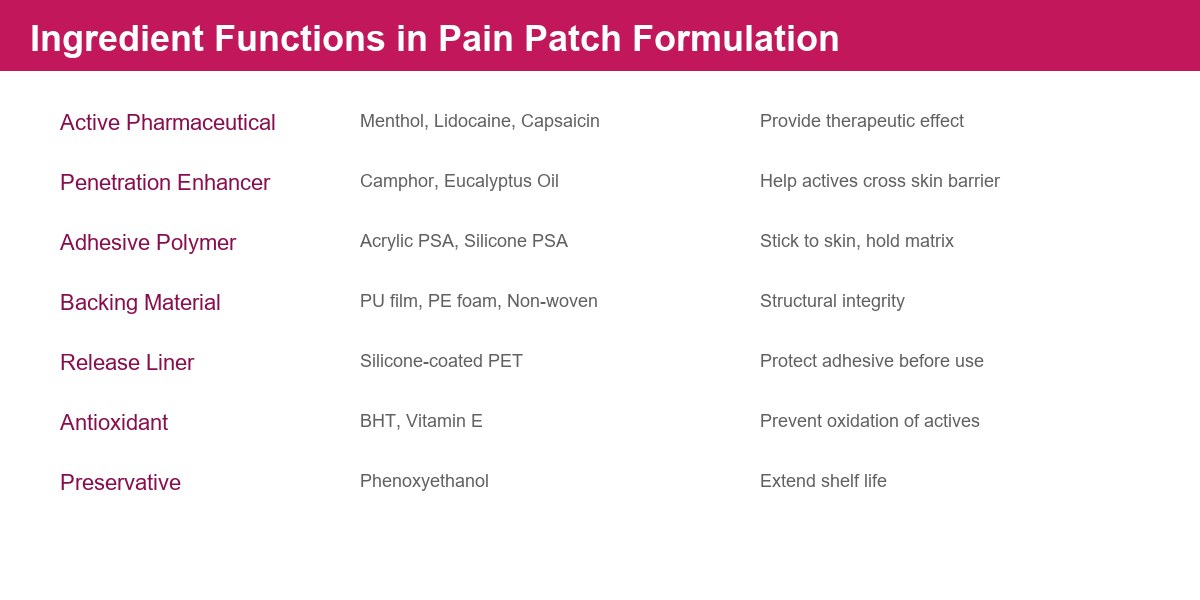
Non-Active Ingredients: The Hidden Components

Pain patch ingredient functions chart

Beyond the APIs, pain patches contain 7 functional categories of non-active ingredients that determine performance:

1. Adhesive Polymer (PSA, 30-40% by weight)

The largest single ingredient. Two main types:

  • Acrylic PSA: Most common; good adhesion, moderate breathability, low cost ($3-$8/kg)
  • Silicone PSA: Premium; excellent breathability, gentle removal, higher cost ($15-$40/kg)

Acrylic PSA dominates 80% of the market. Silicone PSA is preferred for sensitive skin and premium SKUs.

2. Penetration Enhancers (1-5%)

  • Function: Help actives cross the skin barrier (stratum corneum)
  • Common enhancers: Camphor, eucalyptus oil, menthol itself, oleic acid
  • Why critical: Without enhancers, actives stay on skin surface and don't reach nerve endings

3. Plasticizers (1-5%)

  • Function: Improve flexibility and conformability of the patch
  • Common plasticizers: Triacetin, glycerin, propylene glycol
  • Why important: Without plasticizers, patches crack or peel off during movement

4. Antioxidants (0.1-0.5%)

  • Function: Prevent oxidation of actives (especially menthol, capsaicin)
  • Common antioxidants: BHT (butylated hydroxytoluene), Vitamin E (tocopherol)
  • Why critical: Without antioxidants, actives degrade and patches lose potency

5. Preservatives (0.1-0.3%)

  • Function: Prevent microbial growth in water-based or herbal formulations
  • Common preservatives: Phenoxyethanol, methylparaben, propylparaben
  • Why important: Required for USP <61> <62> microbial compliance

6. Backing Film Additives

  • Function: UV blockers, colorants, print primers for branding
  • Common additives: Titanium dioxide (white pigment), carbon black, UV stabilizers
  • Why important: Protects actives from UV degradation; enables brand printing

7. Release Liner Silicone Coating

  • Function: Controls release force (how easily liner peels off)
  • Type: Solvent-based or solvent-free silicone
  • Why critical: Wrong release force = patch falls off or doesn't release

For QC testing of each ingredient category, see our quality control guide.

Ingredient Selection by Market

Different markets prefer different ingredient profiles. KONGDY Health's distribution data shows:

Market Preferred Active Common Combinations
USA Lidocaine + Menthol Lidocaine 4% / Menthol 5% + camphor
EU Menthol + Camphor Menthol 8% + Camphor 3% + Eucalyptus
Japan + Korea Methyl Salicylate + Menthol Methyl salicylate 10% + Menthol 5%
Southeast Asia Menthol only Menthol 10% + Eucalyptus
Latin America Menthol + Camphor Menthol 8% + Camphor 3%
Middle East Menthol + Capsaicin Menthol 7% + Capsaicin 0.05%

For B2B buyers, matching the active profile to your target market is critical for sell-through. KONGDY Health offers 100+ combinations. Browse the KONGDY pain patch catalog for market-specific formulations.

Frequently Asked Questions

1. What is the main ingredient in pain patches?

The main ingredient in most pain patches is menthol (3-10%), often combined with camphor (1-3%). Menthol dominates 45% of the global pain patch market by volume. Lidocaine is the second most common active (25% market share), used for nerve-targeted relief. The adhesive polymer (acrylic or silicone PSA) makes up 35% of the patch by weight.

2. Are pain patches safe for long-term use?

Pain patches are generally safe for long-term use when applied as directed. Menthol and camphor patches have very low systemic absorption and are safe for daily use. Lidocaine patches can be used long-term but should follow the 12 hours on / 12 hours off cycle. Capsaicin patches may cause skin sensitivity with prolonged use. For chronic pain management, consult a healthcare provider.

3. What is the difference between lidocaine and menthol patches?

The difference is mechanism and duration. Lidocaine blocks nerve sodium channels, providing 8-12 hour relief at $0.30-$0.55/patch. Menthol activates cold receptors, providing 4-8 hour relief at $0.08-$0.25/patch. Lidocaine is positioned for nerve pain and EU/USA markets; menthol for muscle pain and global mass market. For full comparison, see our lidocaine vs menthol guide.

4. Can pain patches be customized with different ingredients?

Yes - KONGDY Health offers 100+ ingredient combinations and custom formulations. Common customizations: concentration adjustment (menthol 3-15%, lidocaine 1-5%), additional actives (capsaicin, methyl salicylate), natural/herbal positioning (eucalyptus, ginger, turmeric), and fragrance variations (unscented, light scent, strong menthol). Custom formulations require 10K+ MOQ and 45-day lead time. Contact sales for a custom formulation quote.

5. What is the adhesive in pain patches made of?

The adhesive in pain patches is a pressure-sensitive adhesive (PSA) polymer, typically acrylic-based (80% of patches) or silicone-based (20% of premium/sensitive-skin patches). Acrylic PSA costs $3-$8/kg and offers good adhesion. Silicone PSA costs $15-$40/kg and offers superior breathability and gentle removal. The adhesive matrix also contains the active ingredients, so it's the largest functional component of the patch.

6. Do pain patches contain preservatives?

Yes - pain patches contain small amounts of preservatives (0.1-0.3%) to prevent microbial growth and extend shelf life. Common preservatives include phenoxyethanol, methylparaben, and propylparaben. These meet USP <61> <62> microbial limits. Antioxidants like BHT or Vitamin E are also added to prevent oxidation of active ingredients. Both preservative and antioxidant systems are required for shelf life beyond 12 months.

7. Are there natural or organic pain patch options?

Yes - KONGDY Health offers natural and organic pain patch lines. These use: natural menthol (from peppermint, not synthetic), natural camphor (from camphor tree), organic herbal extracts (capsicum, ginger, turmeric, arnica), natural rubber-based adhesives, and organic cotton backings. Natural patches cost 30-50% more than synthetic equivalents but command premium retail prices in natural wellness markets.

8. What ingredients should I avoid in a pain patch?

For sensitive skin, avoid: high menthol concentrations (>10%), strong fragrances, methyl salicylate (especially in children), capsaicin (initial burning sensation), and parabens (if allergic). For pediatric use, avoid lidocaine above 2.5% and methyl salicylate entirely. For pregnant women, consult a healthcare provider before using menthol or lidocaine patches. KONGDY Health offers sensitive-skin formulations with reduced actives and silicone-based adhesives.

9. How do I read a pain patch ingredient label?

Pain patch ingredient labels follow INCI (International Nomenclature of Cosmetic Ingredients) or FDA OTC drug labeling. APIs are listed first (menthol, lidocaine), followed by inactive ingredients in descending order of concentration. Look for: active section (with concentration), inactive section (adhesive, backing, preservatives), warnings (age restrictions, application limits), and storage (temperature, humidity). KONGDY Health provides full COA and ingredient disclosure for every batch.

10. What is the shelf life of pain patches?

Shelf life depends on the active ingredients and packaging. Menthol/camphor patches typically have 36 months shelf life due to chemical stability. Lidocaine patches typically have 24 months shelf life. Capsaicin patches typically have 18-24 months. Herbal patches typically have 12-18 months due to natural ingredient degradation. KONGDY Health performs accelerated stability testing (40C/75% RH for 6 months) to validate shelf life claims.

Quick Reference: Pain Patch Ingredients at a Glance

Layer / Function Key Materials % by Weight
Active (API) Menthol, Lidocaine, Camphor 3-15%
Adhesive Matrix Acrylic or Silicone PSA 30-40%
Backing Film PU, PE foam, Non-woven 40-50%
Release Liner Silicone-coated PET 5-10%
Penetration Enhancer Camphor, Eucalyptus 1-5%
Plasticizer Triacetin, Glycerin 1-5%
Antioxidant BHT, Vitamin E 0.1-0.5%
Preservative Phenoxyethanol 0.1-0.3%

About KONGDY Health

KONGDY Health is a 36-year pain patch manufacturer operating a 20,000 sqm ISO 13485, FDA, CE, and GMP-certified facility in Zhoukou, Henan. We produce 100+ ingredient combinations of pain patches for brand owners, importers, and distributors in 60+ countries. Our transparent ingredient disclosure, 5K MOQ private label program, 30-day lead time, and full OEM/ODM support make launching a custom pain patch brand accessible for B2B buyers at any scale. Browse the KONGDY pain patch catalog to see formulation samples, or contact us to discuss custom ingredient profiles.

Related Articles

References & External Resources

To discuss custom pain patch ingredient profiles or request formulation samples, browse our pain patch catalog or contact KONGDY Health.

Get A Free Quote
Name
Whatsapp/Phone
Email*
Your Inquiry*
We use Cookie to improve your online experience. By continuing browsing this website, we assume you agree our use of Cookie.