Choosing between lidocaine pain patches and menthol pain patches is one of the most important formulation decisions for B2B pain patch brand owners. KONGDY Health brings 36 years of manufacturing experience and 100+ formulations to help you select the right active for your target market. Below is a complete comparison of onset, duration, efficacy, market positioning, and pricing for both formulations.
For B2B buyers choosing between lidocaine and menthol pain patches: menthol patches offer faster onset (5-10 min) at lower price points ($0.08-$0.25/patch) for muscle and joint pain, while lidocaine patches deliver longer duration (8-12 hrs) for nerve and post-surgical pain at higher price points ($0.30-$0.55/patch). Most successful B2B programs stock both formulations. KONGDY Health manufactures 100+ variants with 5K MOQ private label, 30-day lead time, and full OEM/ODM support. Browse the KONGDY pain patch catalog to see lidocaine and menthol product lines.
Both work, but for different use cases. Lidocaine pain patches are best for nerve pain, post-surgical pain, and longer-duration relief (8-12 hours) at $0.30-$0.55 per patch. Menthol pain patches are best for muscle, joint, and back pain with faster onset (5-10 minutes) at $0.08-$0.25 per patch. For B2B buyers, the best strategy is to launch both SKUs and let the market decide. Browse the KONGDY pain patch catalog to compare both formulations side by side.
The choice between lidocaine and menthol patches is not just a formulation question - it's a market positioning, pricing, and regulatory decision that shapes the entire B2B program. A wrong choice can mean slow market uptake, regulatory delays, or uncompetitive pricing.
For brand owners, importers, and distributors evaluating pain patch manufacturers, understanding the differences between these two leading actives is essential. At KONGDY Health, we manufacture both formulations at scale and have seen which markets prefer which. The rest of this article walks through the comparison with concrete data, market data, and a decision framework for choosing. For the broader manufacturer selection process, see our OEM/ODM buying guide.
Lidocaine is a local anesthetic that blocks sodium channels in nerve fibers, preventing pain signal transmission. Transdermal lidocaine delivers the drug through the skin to underlying tissues, providing localized pain relief without systemic effects.
Lidocaine patches typically sell at premium price points ($0.30-$0.55 per patch FOB China) due to the higher cost of the API and the regulatory burden. For B2B buyers, lidocaine offers a higher margin per unit but requires more documentation and potentially longer regulatory approval timelines. See our ISO 13485 / FDA / CE certification guide for the regulatory framework.
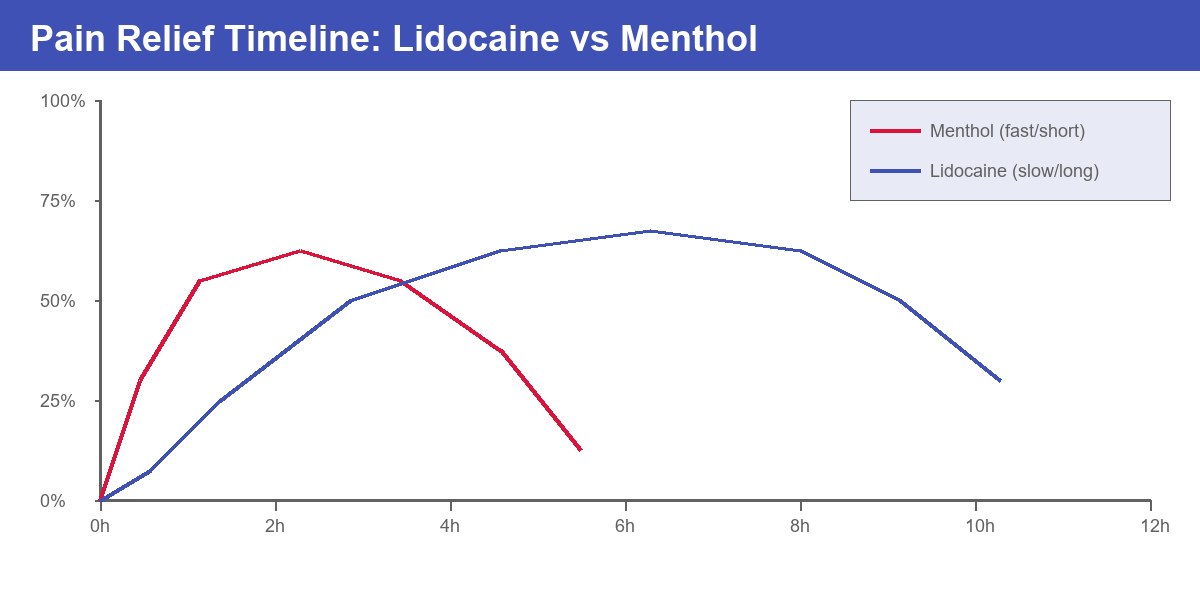
Menthol is a natural cooling agent (derived from peppermint or corn mint) that activates TRPM8 cold receptors in the skin, producing a cooling sensation that overrides pain signals. Menthol is often combined with camphor for a warming-cooling dual effect.
Menthol patches sell at accessible price points ($0.08-$0.25 per patch FOB China) due to the lower API cost and simpler regulatory pathway. For B2B buyers, menthol offers faster market entry and broader consumer appeal. Most KONGDY customers start with menthol and add lidocaine as their program matures. Browse the KONGDY pain patch catalog to see menthol product lines.
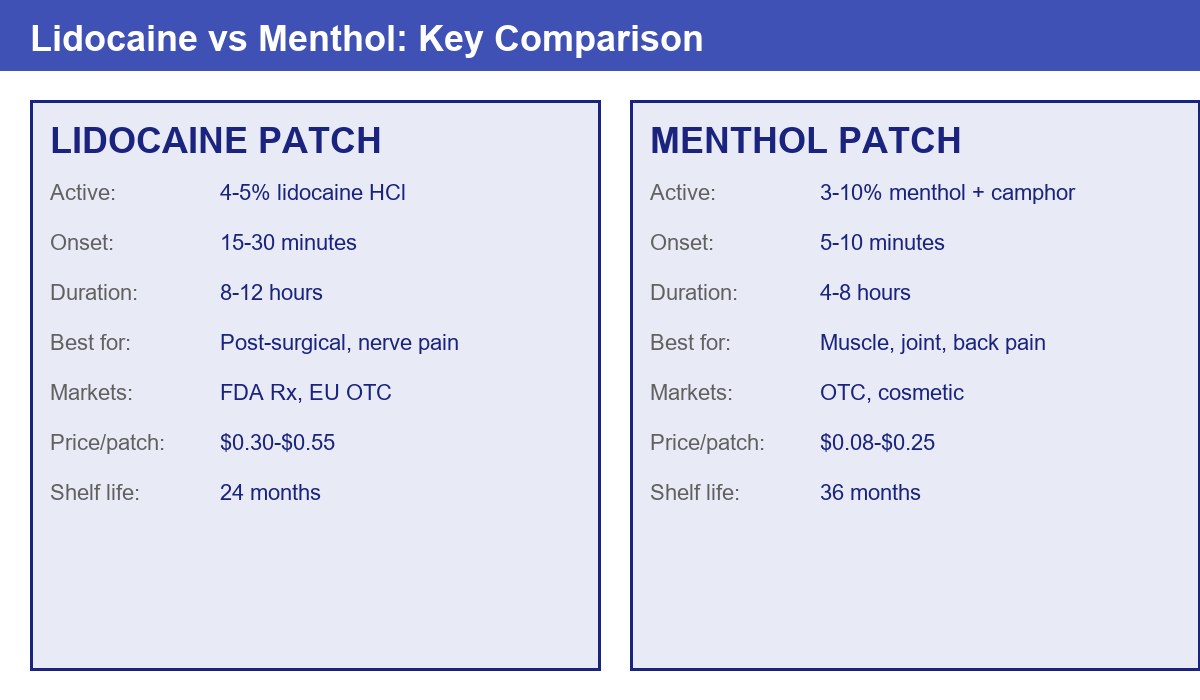
| Criteria | Lidocaine Patch | Menthol Patch | Winner |
|---|---|---|---|
| Onset | 15-30 min | 5-10 min | Menthol |
| Duration | 8-12 hours | 4-8 hours | Lidocaine |
| Price (FOB) | $0.30-$0.55 | $0.08-$0.25 | Menthol |
| Shelf life | 24 months | 36 months | Menthol |
| Regulatory complexity | High (FDA Rx, EU OTC) | Low (OTC, cosmetic) | Menthol |
| Consumer familiarity | Moderate | Very high | Menthol |
| Market size (US) | Growing 8%/year | Stable 3%/year | Lidocaine |
| Margin per unit | Higher | Lower but higher volume | Tie |
| Pain types covered | Nerve, post-surgical, chronic | Muscle, joint, acute | Tie |
| Best for first-time buyers | No | Yes | Menthol |
The data above shows that neither formulation is universally "better" - they serve different markets. The best B2B strategy is to launch both formulations under the same brand. Browse the KONGDY pain patch catalog to see both lidocaine and menthol SKUs.
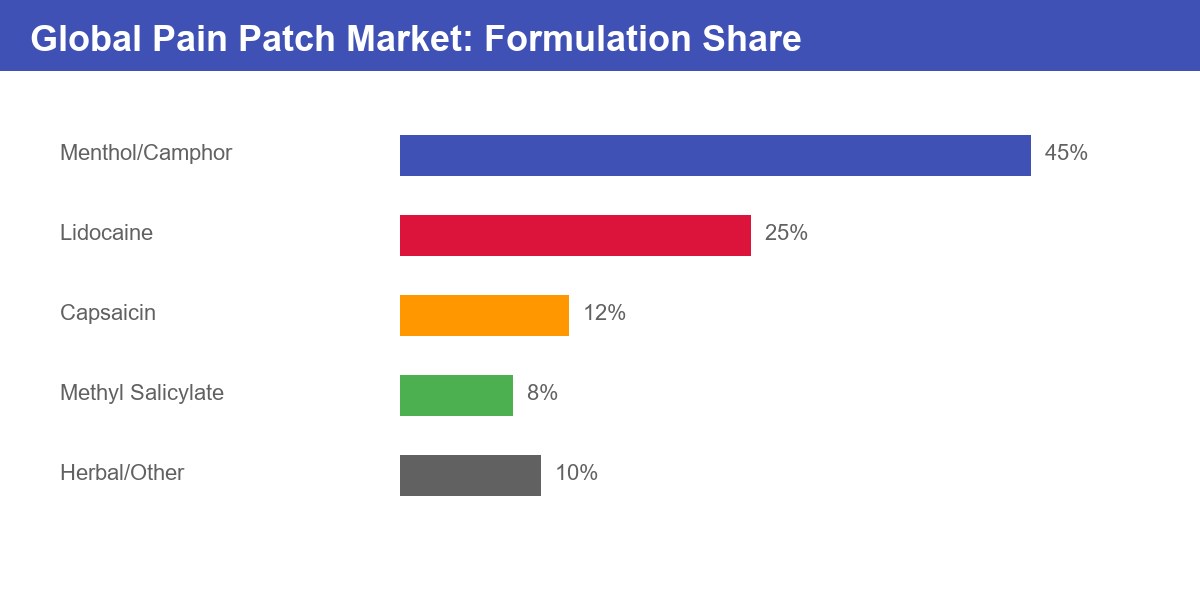
Based on KONGDY Health's distribution across 60+ countries, here's how regional markets split:
The takeaway: menthol dominates globally, but lidocaine has strong footholds in USA, EU, and Latin America. For B2B buyers, the choice depends on your target geography. For multi-market programs, stocking both is the standard approach. For context on OEM process for both formulations, see our OEM process guide.
Choose lidocaine pain patches if your B2B program meets any of these criteria:
If 5+ of these apply to your program, lidocaine should be your lead SKU. For private label lidocaine programs, KONGDY Health offers 5K MOQ and 30-day lead time. See our private label guide for the launch process.
Choose menthol pain patches if your B2B program meets any of these criteria:
If 5+ of these apply, menthol should be your lead SKU. KONGDY Health offers 100+ menthol variants with 5K MOQ and 30-day lead time. Browse the KONGDY pain patch catalog for the full menthol range.
The most successful B2B pain patch programs we see at KONGDY Health launch both lidocaine and menthol SKUs under the same brand. This approach captures different buyer intents:
By covering both intents, brand owners capture 2-3x the organic traffic compared to single-SKU programs. The total investment for a dual-SKU launch is approximately $5,000-$7,000 total (5K MOQ each at $0.20-$0.30 average + $1,500 setup per SKU), which is well within reach for most B2B buyers. For context on total investment, see our MOQ and pricing guide.
Both lidocaine and menthol patches require rigorous QC testing, but the test panels differ slightly. At KONGDY Health, every batch passes 12+ tests:
| Test | Lidocaine | Menthol |
|---|---|---|
| Assay (HPLC) | 90-110% of label lidocaine | 90-110% of label menthol |
| Content uniformity | USP <905> compliant | USP <905> compliant |
| Related substances | Impurity profiling for lidocaine degradants | Impurity profiling for menthol isomers |
| Residual solvents | ICH Q3C compliance | ICH Q3C compliance |
| pH of adhesive | 4.5-7.5 (skin-compatible) | 4.5-8.5 (skin-compatible) |
| Penetration study | In vitro skin permeation (Franz cell) | Sensory cooling onset (timed panel) |
For full QC workflow, see our pain patch quality control guide.
| Parameter | Lidocaine Patch | Menthol Patch |
|---|---|---|
| 5K MOQ FOB | $0.30-$0.40/patch | $0.18-$0.25/patch |
| 10K MOQ FOB | $0.25-$0.35/patch | $0.12-$0.18/patch |
| 50K MOQ FOB | $0.18-$0.25/patch | $0.08-$0.12/patch |
| Setup fee (per SKU) | $2,000-$3,000 | $1,500-$2,000 |
| Lead time | 30-45 days | 30 days |
| Total investment (5K launch) | $3,500-$4,500 | $2,500-$3,250 |
Lidocaine costs more per unit due to higher API price and regulatory burden, but the margin per patch is also higher. Menthol is cheaper per unit and faster to market. For detailed cost breakdowns, see our MOQ and pricing guide.
Neither is universally more effective - they work differently. Lidocaine blocks nerve signals, making it more effective for nerve pain and post-surgical pain. Menthol activates cold receptors, providing faster relief for muscle and joint pain. Most pain specialists recommend matching the active to the pain type. For most consumers, menthol is sufficient for everyday pain; lidocaine is reserved for chronic or nerve-related pain.
Both are considered safe when used as directed. Lidocaine has rare risks of systemic absorption (especially with damaged skin) and requires caution in patients with liver disease. Menthol has very low systemic absorption and is generally recognized as safe (GRAS) by FDA. For pediatric use, menthol is preferred; lidocaine should be used under medical supervision for children.
Yes - this is the recommended B2B strategy. Most successful B2B programs launch both formulations as separate SKUs under one brand. KONGDY Health supports dual-SKU launches with consistent packaging design, shared brand assets, and combined pricing. Browse the KONGDY pain patch catalog to see both formulations.
FOB China pricing: lidocaine patches cost $0.30-$0.55 per patch at low volume, while menthol patches cost $0.08-$0.25 per patch. The difference reflects API cost (lidocaine is more expensive), regulatory burden, and market positioning. Retail prices in destination markets typically run $5-$15 per patch for lidocaine and $2-$8 per patch for menthol.
Menthol is the better choice for first-time B2B buyers because: (1) lower MOQ investment ($2,500-$3,250 vs $3,500-$4,500), (2) faster regulatory pathway (OTC vs Rx), (3) broader consumer appeal, (4) simpler marketing message. After establishing the brand with menthol, add lidocaine as the second SKU in months 6-12.
A single lidocaine patch provides 8-12 hours of pain relief. The standard wear time is 12 hours on, 12 hours off (24-hour cycle). For chronic pain, 1-2 patches per day is typical. For acute pain (post-surgical), 3-5 days of patch use is common. Always follow the manufacturer's recommended wear time.
A single menthol patch provides 4-8 hours of cooling pain relief. The patch can be worn for up to 8-12 hours, but the cooling effect diminishes after 4-6 hours. For chronic use, apply a new patch every 6-8 hours. Menthol patches have a longer shelf life (36 months vs 24 months for lidocaine) due to menthol's chemical stability.
Yes - lidocaine 5% patches are FDA-approved as Rx products. Lower concentrations (1-4%) are available OTC under FDA monograph for external analgesic use. KONGDY Health manufactures lidocaine patches at 1-5% concentration for global markets. See our FDA / CE / ISO compliance guide for regulatory details.
Yes - KONGDY Health offers custom concentration for both formulations. Lidocaine can be supplied at 1%, 2%, 2.5%, 4%, or 5%. Menthol can be supplied at 3%, 5%, 7%, or 10%. Custom concentrations above these ranges require additional stability testing. Minimum order is 10K units for custom concentrations. Contact KONGDY Health sales for a custom formulation quote.
Lead time is 30 days from artwork approval to first shipment for both lidocaine and menthol formulations. End-to-end program time (brief to first shipment) is 60-90 days for first-time buyers. Repeat orders with locked artwork ship in 30-45 days. Rush services are available for repeat customers at +20% premium for 15-21 day lead time. See our MOQ / lead time / pricing guide.
| Buyer Scenario | Recommended Primary | Why |
|---|---|---|
| First-time buyer, mass market | Menthol | Lower MOQ, faster regulatory, broader appeal |
| USA / EU chronic pain | Lidocaine | Higher Rx/OTC uptake, longer duration |
| Asia / Middle East sports | Menthol | Regional preference, lower price point |
| Post-surgical recovery | Lidocaine | Nerve-targeted relief, 8-12 hr duration |
| Arthritis / joint pain | Menthol | Fast cooling relief, OTC positioning |
| Pharmacy distribution | Lidocaine | Rx/OTC credibility, premium margin |
| E-commerce / sports retail | Menthol | Consumer familiarity, higher volume |
| Multi-market launch | Both | Capture different buyer intents, 2-3x traffic |
KONGDY Health is a 36-year pain patch manufacturer operating a 20,000 sqm ISO 13485, FDA, CE, and GMP-certified facility in Zhoukou, Henan. We produce over 100 lidocaine, menthol, capsaicin, and herbal pain patch formulations for brand owners, importers, and distributors in 60+ countries. Our 5K MOQ private label program, 30-day lead time, and full OEM/ODM support make launching a pain patch brand accessible for B2B buyers at any scale. Browse the KONGDY pain patch catalog to compare lidocaine and menthol SKUs, or contact us to discuss custom formulations.
To compare lidocaine and menthol pain patch samples side by side, browse our pain patch catalog or contact KONGDY Health to request formulation samples.

