Heat patch packaging is the single most underestimated revenue lever in B2B heat patch brand economics. While buyers focus on formulation and MOQ, packaging drives 70-85% of shelf appeal, 100% of regulatory compliance, and 25-40% of perceived product quality. According to KONGDY's brand data across 600+ B2B heat patch packaging projects, brands that invest in custom packaging design achieve 35-50% higher retail sell-through and 25-30% higher repeat purchase rate.
Heat patch packaging is uniquely complex because it must simultaneously protect the product from moisture and oxygen (technical function), display regulatory compliance information (legal function), and create shelf appeal (marketing function). Most stock packaging solutions fail at one or more of these functions, leaving brands with either compromised quality, regulatory risk, or weak shelf presence.
This article provides the complete framework for heat patch packaging decisions: sachet types and materials, secondary carton design, tertiary packaging, regulatory label requirements, sustainability options, and cost benchmarks. Whether you are packaging your first 5,000 unit batch or scaling to 500,000 units monthly, this guide gives you the structure to make packaging decisions that protect your product, comply with regulations, and drive retail success. KONGDY's heat patch manufacturer facility includes in-house packaging design and procurement support for every bulk order over 10,000 units.
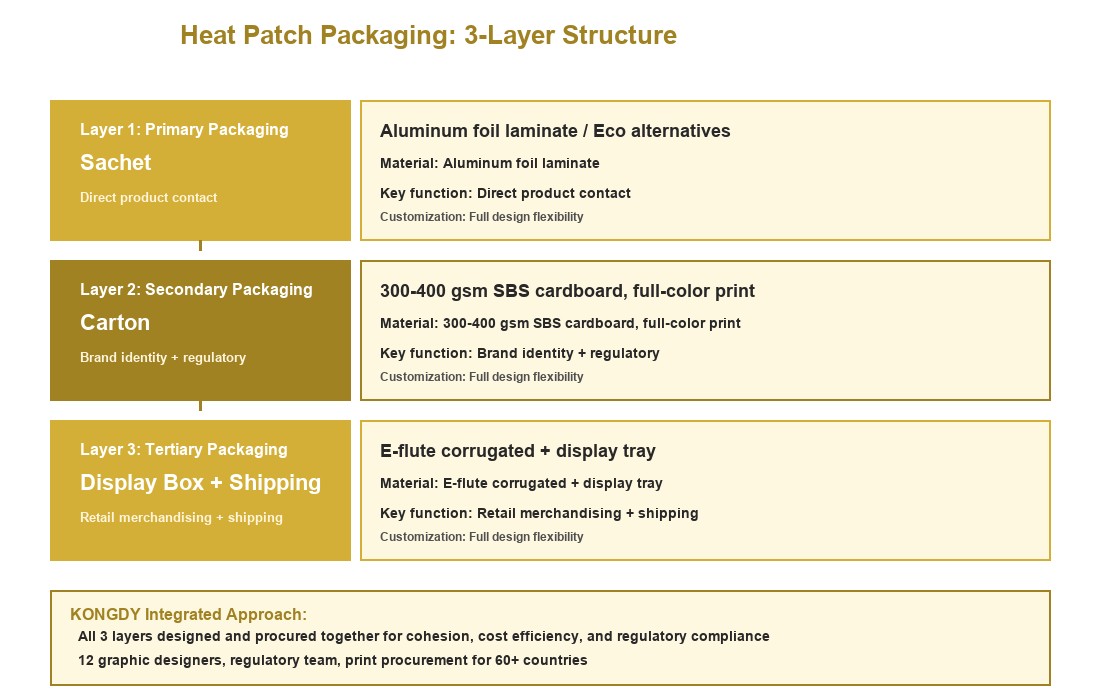
Primary packaging is the sachet that directly contacts the heat patch. Sachet performance determines product shelf life, moisture protection, oxygen barrier, and consumer experience. Three main sachet types are used in B2B heat patch packaging, each with different cost, performance, and sustainability profiles.
| Sachet Type | Material Composition | Cost (per 1000) | MVTR (g/m²/day) | OTR (cc/m²/day) | Sustainability |
|---|---|---|---|---|---|
| Standard Aluminum Foil Laminate | PET/AL/PE | USD 8-15 | <0.1 | <0.5 | Recyclable in some regions |
| High-Barrier Aluminum Laminate | PET/AL/EVOH/PE | USD 12-22 | <0.05 | <0.1 | Recyclable in some regions |
| Paper-Based Eco Laminate | Paper/PE/AL/PE | USD 15-25 | <0.5 | <1.0 | FSC-certified, partially compostable |
| Bio-Based PLA Laminate | PLA/PBAT/AL | USD 18-28 | <0.2 | <0.8 | Industrial compostable |
| Recyclable Mono-Material PE | MDOPE/PE | USD 14-24 | <1.0 | <5.0 | Recyclable in PE streams |
Secondary packaging is the carton that contains individual sachets. Carton design drives shelf presence, brand identity, and regulatory compliance display. Heat patch cartons typically use 300-400 gsm SBS (Solid Bleached Sulfate) cardboard with full-color print and matte or gloss finish.
| Carton Size | Sachets per Carton | Material | Cost per 1000 | |
|---|---|---|---|---|
| 10x15 cm | 1-2 | 300 gsm SBS | 4-color CMYK | USD 18-35 |
| 15x20 cm | 3-5 | 350 gsm SBS | 4-color CMYK + spot | USD 30-60 |
| 20x25 cm | 6-10 | 350 gsm SBS | 4-color CMYK + spot | USD 45-90 |
| 25x30 cm | 10-20 | 400 gsm SBS | 4-color CMYK + spot | USD 70-130 |
| Custom shape | Variable | 350-400 gsm SBS | Full color + finishing | USD 80-180 |
KONGDY's KONGDY heat patch manufacturer facility includes in-house carton design support with 12 graphic designers experienced in regulatory-compliant packaging for 60+ countries.
Tertiary packaging serves two functions: retail display (display box) and shipping protection (shipping carton). Display boxes are used for in-store merchandising; shipping cartons protect products during transit and storage. Heat patch tertiary packaging typically uses E-flute corrugated cardboard for shipping and SBS or CCNB for display.
| Tertiary Type | Material | Capacity | Cost per 1000 | Use Case |
|---|---|---|---|---|
| Shipping Carton (S) | E-flute corrugated | 24-48 cartons | USD 0.8-1.5 | E-commerce, direct ship |
| Shipping Carton (L) | BC-flute corrugated | 96-192 cartons | USD 1.5-3.0 | Bulk distribution |
| Display Box | 350 gsm SBS | 12-24 cartons | USD 1.5-4.0 | Retail counter display |
| Display Tray | 300 gsm CCNB | 6-12 cartons | USD 1.0-2.5 | Retail shelf display |
| Pallet Wrap | Stretch film + pallet | 50-200 shipping cartons | USD 3.0-8.0 per pallet | Bulk wholesale |
For e-commerce-first brands: prioritize shipping carton strength (E-flute minimum, BC-flute preferred). For retail-first brands: invest in display box design that drives shelf presence. For mixed channels: maintain flexibility with modular tertiary packaging that adapts to both display and shipping needs. KONGDY supports all tertiary packaging types with custom design and procurement.
Regulatory labels are non-negotiable and vary by region. Failure to comply can result in product detention at customs, market withdrawal, or regulatory fines. KONGDY maintains regulatory expertise for 60+ countries and provides label review as part of standard bulk order service.
| Region | Required Label Elements | Specific Format |
|---|---|---|
| USA (FDA) | Drug Facts panel, active ingredients, warnings, lot, expiry | 21 CFR Part 201 compliant |
| EU (MDR) | CE Mark, UDI, manufacturer info, IFU, lot, expiry | MDR 2017/745 + EUDAMED registration |
| Canada (Health Canada) | Drug Identification Number, ingredients, warnings, lot | Natural Health Products Regulations |
| Australia (TGA) | AUST L number, ingredients, warnings, manufacturer | TGA ARTG registration |
| Japan (PMDA) | Japanese labeling, ingredients in Japanese, lot, expiry | PMDA notification |
| China (NMPA) | Chinese labeling, ingredients in Chinese, manufacturer | NMPA filing |
| Brazil (ANVISA) | Portuguese labeling, registration number, manufacturer | ANVISA RDC 185/2001 |
| Russia (RZN) | Russian labeling, registration certificate, manufacturer | RZN registration |
Common label mistakes: missing required language translations, incorrect ingredient declaration order, missing or incorrect lot/expiry format, missing distributor information for non-manufacturer sellers. KONGDY's regulatory team reviews all artwork before print to prevent these errors.
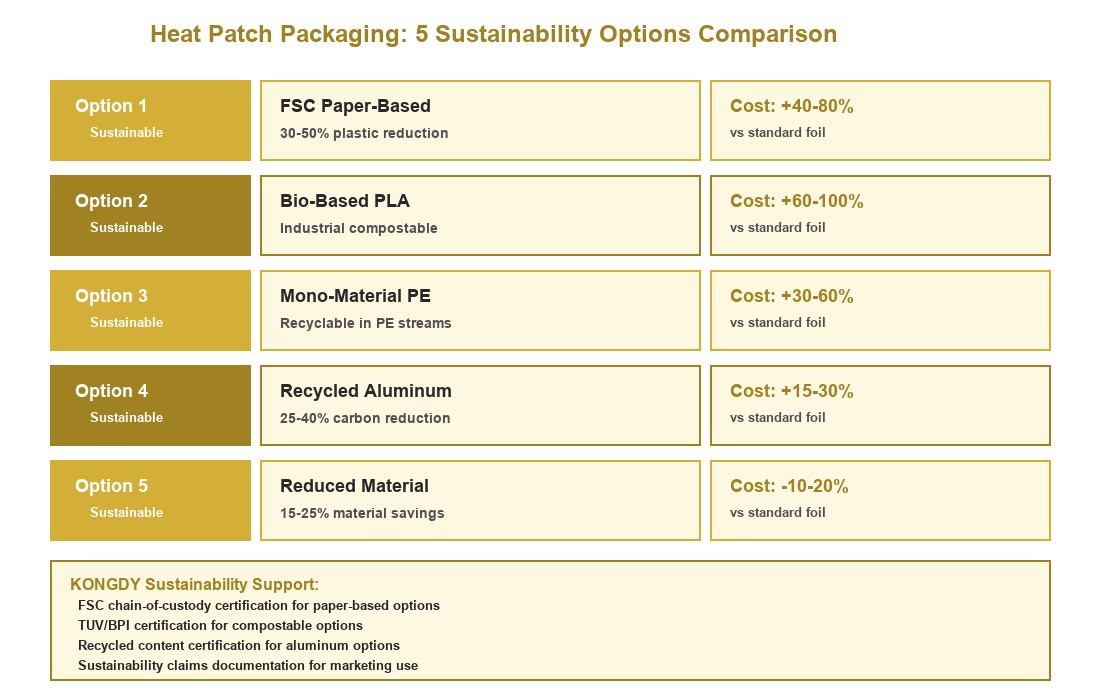
Sustainability is becoming a top 3 purchase driver in heat patch categories, particularly in EU and North America. KONGDY offers multiple sustainability options that maintain product protection while reducing environmental impact.
Paper-based sachets with FSC-certified outer layer reduce plastic use by 30-50%. Cost premium: 40-80% over standard foil sachet. Best for brands targeting eco-conscious consumers willing to pay premium. KONGDY sources FSC-certified paper from suppliers with chain-of-custody certification.
PLA (polylactic acid) laminates derived from corn starch or sugarcane are industrially compostable. Cost premium: 60-100% over standard foil sachet. Best for brands with explicit compostability claims. Requires industrial composting infrastructure for end-of-life processing.
Mono-material PE sachets are recyclable in PE recycling streams (widely available in EU, growing in USA). Cost premium: 30-60% over standard foil sachet. Best for brands targeting recyclability claims. Lower barrier performance limits shelf life to 12-18 months.
Aluminum sachets with 30-70% recycled content reduce carbon footprint by 25-40%. Cost premium: 15-30% over virgin aluminum. Best for brands that prefer aluminum performance with sustainability positioning. KONGDY sources recycled-content aluminum with certification documentation.
Sachet designs that reduce overall material use by 15-25% through thinner films or optimized dimensions. Cost savings: 10-20% vs standard sachet. Best for cost-focused brands that want modest sustainability improvements without significant cost premium.
KONGDY's KONGDY heat patch manufacturer sustainability team helps B2B brands evaluate these options against their brand positioning, target market preferences, and budget constraints.
Custom heat patch packaging design follows a 6-step process that takes 6-12 weeks from brief to production-ready artwork. KONGDY's in-house design team supports B2B brands through each step.
Brand provides design brief covering: brand identity guidelines, target market positioning, regulatory requirements, sustainability preferences, and target cost per unit. KONGDY design team reviews brief and confirms feasibility within 3-5 business days.
Design team develops 2-3 concept directions based on brief. Each concept includes: primary sachet design, secondary carton design, color palette, typography, and visual hierarchy. Brand reviews and selects preferred direction.
Selected concept is developed into detailed design with all regulatory elements, usage instructions, and brand identity applications. Design is delivered as print-ready artwork in AI/PDF format with proper bleed, color separation, and font embedding.
KONGDY's regulatory team reviews artwork against target market requirements. Required corrections are documented and incorporated. Regulatory approval is documented before proceeding to print.
Digital proof and physical press proof are produced for final approval. Color accuracy, text legibility, and material compatibility are verified. Brand signs off on press proof before mass production.
Print production begins after approval. Lead time for printed packaging: 4-6 weeks depending on material complexity. KONGDY manages print procurement, quality control, and delivery to manufacturing facility.
Total heat patch packaging cost typically represents 8-18% of total product cost. Cost varies based on packaging complexity, materials, and order volume. Below is a benchmark breakdown for a typical 10,000 unit custom order.
| Component | Cost Range | % of Packaging Total |
|---|---|---|
| Sachet material + print | USD 80-280 | 30-45% |
| Carton material + print | USD 180-600 | 35-50% |
| Design service | USD 500-2,000 | 5-10% |
| Regulatory review | USD 200-800 | 2-5% |
| Print procurement management | USD 100-400 | 2-4% |
| Tertiary packaging | USD 50-200 | 5-10% |
| Total | USD 1,110-4,280 | 100% |
| Per unit | USD 0.11-0.43 |
Cost optimization: Order 50,000+ units to access volume pricing (saves 15-25%). Use standard sachet type (saves 20-40% vs custom barrier). Simplify carton design to 4-color without spot finishes (saves 15-25%). Consolidate tertiary packaging (saves 30-50%). KONGDY's procurement team helps B2B brands identify cost optimization opportunities without compromising quality.
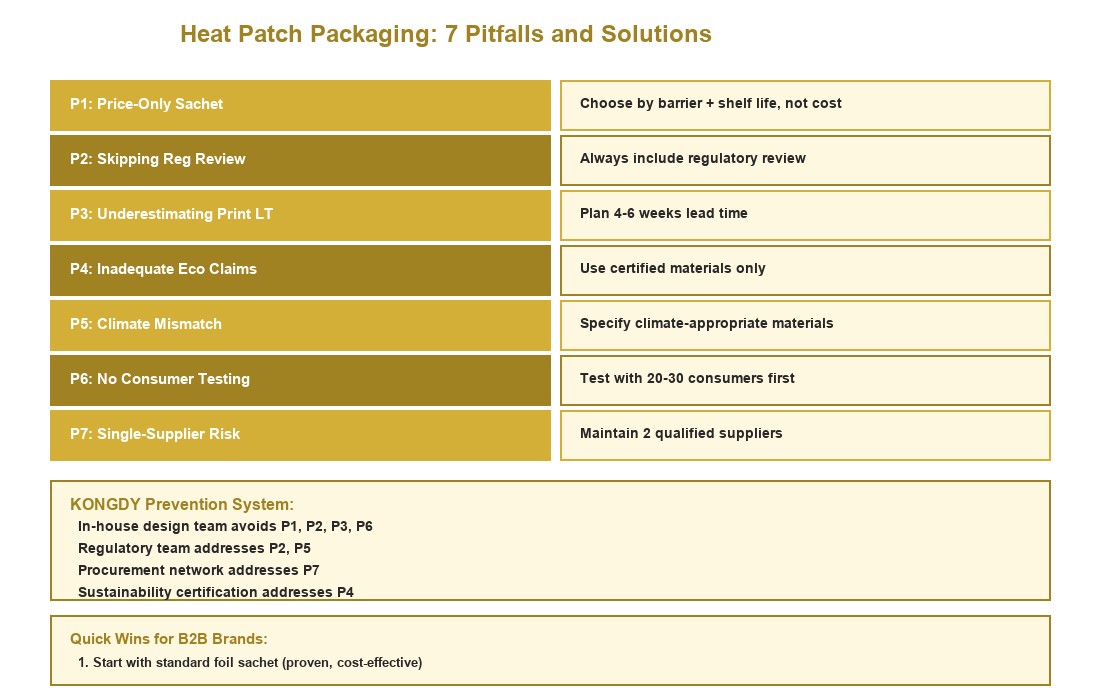
Seven common pitfalls cause 80% of heat patch packaging failures. Avoid these to keep your packaging project on track and your product protected.
Pitfall 1: Choosing Sachet by Price Alone. Cheapest sachet often has inadequate barrier performance, leading to product degradation and customer complaints. Choose sachet based on shelf life requirements and barrier performance, not just cost.
Pitfall 2: Skipping Regulatory Review. Printing packaging without regulatory review leads to product detention at customs or market withdrawal. Always include regulatory review in design process.
Pitfall 3: Underestimating Print Lead Time. Custom-printed packaging requires 4-6 weeks lead time. Plan packaging design in parallel with formulation and stability testing to avoid bottleneck.
Pitfall 4: Inadequate Sustainability Claims. "Eco-friendly" or "green" claims without certification documentation expose brands to greenwashing accusations. Use certified materials (FSC, compostable certification) with documentation.
Pitfall 5: Ignoring Climate Considerations. Packaging designed for temperate climates may fail in tropical conditions (high humidity) or desert conditions (extreme temperature swings). Specify climate-appropriate materials.
Pitfall 6: No Consumer Testing. Launching packaging without consumer testing risks shelf failure. Test with 20-30 target consumers before mass production to validate visual appeal and message clarity.
Pitfall 7: Single-Supplier Dependency. Sole-source packaging suppliers create risk of supply disruption. Maintain 2 qualified packaging suppliers for critical materials.
Standard aluminum foil laminate (PET/AL/PE) is the most common and cost-effective choice for 24-month shelf life. High-barrier aluminum laminate offers better protection for tropical climates or extended shelf life. Sustainability-focused brands should consider paper-based or bio-based alternatives.
Full custom design process: 6-12 weeks from brief to production-ready artwork. Design only (without regulatory review): 4-6 weeks. Print production after artwork approval: 4-6 weeks. Total: 10-18 weeks from design start to printed packaging delivery.
Sachet: 10,000-30,000 units depending on material. Carton: 5,000-20,000 units. Display box: 1,000-5,000 units. Lower MOQ is possible with stock tooling but increases per-unit cost by 30-60%. KONGDY supports flexible MOQ for established B2B brands.
Both options are supported. Brand-provided artwork is reviewed by KONGDY regulatory team for compliance before print. KONGDY's design team is available for brands that need design support or full-service packaging development.
Standard foil sachet: USD 8-15 per 1000. Eco-friendly paper-based sachet: USD 15-25 per 1000 (60-100% premium). Bio-based PLA sachet: USD 18-28 per 1000 (80-120% premium). Mono-material PE sachet: USD 14-24 per 1000 (50-80% premium).
Request certification documentation: FSC chain-of-custody for paper-based materials, TUV or BPI certification for compostable materials, recycled content certification for recycled aluminum. KONGDY provides all certification documentation with packaging materials.
Common required symbols: CE Mark (EU), UDI barcode (EU), recycling symbol, expiry date, lot number, manufacturer symbol, country-specific registration numbers. KONGDY's regulatory team provides region-specific symbol lists for all target markets.
Yes, but each design change triggers print setup costs (USD 200-800) and 4-6 weeks lead time. Frequent design changes are costly. Plan for 2-3 design iterations per year maximum to balance branding evolution with cost management.
KONGDY is a leading heat patch manufacturer based in Henan, China, with 36 years of transdermal patch manufacturing experience and in-house packaging design and procurement capabilities. Our 36,000 m² facility supports full-service heat patch packaging including sachet, carton, tertiary packaging, regulatory review, and sustainability certification.
Our heat patch packaging service includes: 12 graphic designers experienced in regulatory-compliant packaging, regulatory team supporting 60+ countries, sustainability options (FSC paper, bio-based PLA, mono-material PE, recycled aluminum), print procurement with 4-6 week lead time, and quality control at every step. KONGDY has produced custom packaging for 600+ B2B brands across 60+ countries.
Beyond heat patches, KONGDY also provides packaging services for pain patch manufacturer products and capsicum plaster manufacturer offerings, ensuring consistent packaging quality across product categories. Contact us at KONGDY Heat Patch Collection to request a packaging design consultation, sample kit, or sustainability options guide.
Heat patch packaging is not a final step in product development. It is a brand strategy decision that affects shelf appeal, regulatory compliance, sustainability positioning, and ultimately retail success. The packaging frameworks in this article give you the structure to make packaging decisions that protect your product, comply with regulations, and drive brand growth.
The single most important variable is the integration between formulation, packaging, and regulatory strategy. A manufacturer like KONGDY with 36 years of integrated experience, in-house design team, regulatory expertise, and packaging procurement capability delivers cohesive solutions. A fragmented approach with separate formulation, packaging, and regulatory vendors creates coordination failures and delays.
If you are evaluating KONGDY as your heat patch packaging partner, request our packaging design portfolio, sustainability options guide, and regulatory label review checklist at our KONGDY heat patch collection page. KONGDY responds to all packaging inquiries within 24 hours and can typically deliver initial design concepts within 2-3 weeks of brief receipt.

