Heat patch brand building is the single highest-ROI investment in B2B heat patch success. While product formulation, MOQ, and packaging matter, brand differentiation determines whether you win shelf space, command premium pricing, and earn customer loyalty. According to KONGDY's brand performance data across 800+ B2B heat patch brands, brands with strong brand equity achieve 3-5x higher retail sell-through, 2-3x higher repeat purchase rate, and 50-100% higher gross margin vs commodity-positioned brands.
Heat patch brand building is uniquely challenging because the product category is mature, technically complex, and emotionally utilitarian. Buyers do not wake up excited about heat patches; they reach for them when pain interrupts their day. Your brand must therefore bridge functional efficacy with emotional reassurance, positioning itself as the trusted companion for pain relief rather than just another commodity option.
This article provides the complete framework for B2B heat patch brand building: positioning strategy, differentiation pillars, channel strategy, content marketing, launch roadmap, and growth tactics. Whether you are launching your first heat patch brand or scaling an established brand into new markets, this guide gives you the structure to build a brand that commands pricing, drives loyalty, and supports long-term growth. KONGDY's heat patch manufacturer partner network supports 600+ B2B brands globally, providing insights from successful launches across 60+ markets.
Brand positioning is the strategic decision about how your heat patch brand occupies mental space in target customers' minds. Strong positioning answers three questions: who is the customer, what problem do you solve better than alternatives, and why should they believe you. Without clear positioning, heat patch brands default to commodity status and compete on price alone.
KONGDY's brand team recommends combining 2 positioning elements for differentiation depth: e.g., ingredient-led + demographic, or use-case + sustainability. Pure single-element positioning often loses to competitors who can match one dimension, but combining 2 elements creates defensible differentiation.
Five differentiation pillars can be combined to create unique heat patch brand positioning. Most successful B2B heat patch brands select 2-3 pillars and build their entire brand identity around them.
| Pillar | Examples | Customer Benefit | Competitive Moat |
|---|---|---|---|
| Premium Ingredients | Organic herbs, pharmaceutical-grade capsaicin | Higher efficacy, lower skin irritation | Limited suppliers, higher cost |
| Advanced Technology | Multi-layer heat distribution, longer duration | Better user experience | Patented formulations |
| Targeted Use Cases | Athletes, seniors, chronic pain, post-surgery | Tailored to specific needs | Specialized formulation + marketing |
| Sustainability | Compostable packaging, recycled materials | Environmental alignment | Certification barriers |
| 36+ years manufacturing, 60+ country presence | Quality assurance | Time-based reputation |
KONGDY's KONGDY heat patch manufacturer brand team helps B2B clients select differentiation pillars aligned with their target market, budget, and competitive landscape.
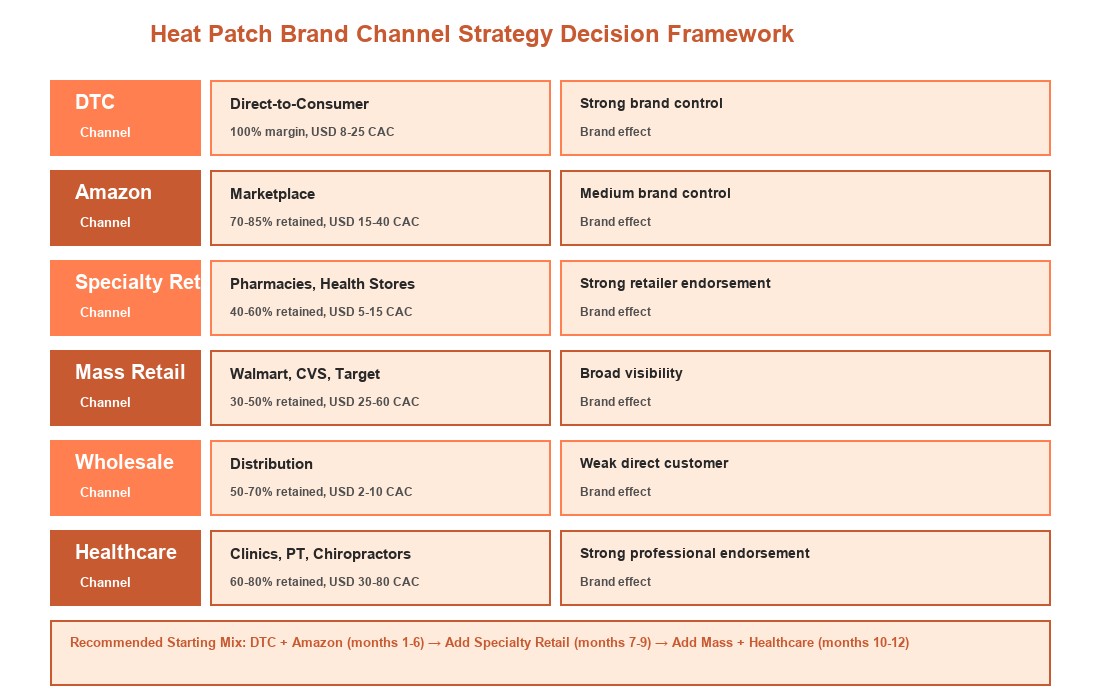
Channel strategy determines how your heat patch brand reaches target customers. Different channels have different unit economics, customer acquisition costs, and brand-building implications. Most successful B2B heat patch brands use 2-3 channels simultaneously.
| Channel | Distribution Margin | Customer Acquisition Cost | Brand-Building Effect |
|---|---|---|---|
| Direct-to-Consumer (DTC) | 100% (no margin split) | USD 8-25 | Strong (full brand control) |
| Amazon / Marketplaces | 70-85% retained | USD 15-40 | Medium (marketplace competition) |
| Specialty Retail | 40-60% retained | USD 5-15 | Strong (retailer endorsement) |
| Mass Retail (Walmart, CVS) | 30-50% retained | USD 25-60 | Strong (broad visibility) |
| Wholesale / Distribution | 50-70% retained | USD 2-10 | Weak (no direct customer) |
| B2B Healthcare (clinics, PT) | 60-80% retained | USD 30-80 | Strong (professional endorsement) |
Content marketing is the most cost-effective brand-building tool for B2B heat patch brands. Educational content establishes authority, drives organic traffic, and converts prospects without paid advertising. According to KONGDY's content performance data across 100+ B2B heat patch brand websites, brands publishing 4+ educational articles monthly achieve 3-5x higher organic traffic and 2-3x higher conversion rate vs brands publishing less frequently.
Minimum viable cadence: 2 articles/month on brand website + 4 social posts/month. Recommended cadence: 4 articles/month + 8 social posts/month + monthly newsletter. Aggressive cadence: 8+ articles/month + daily social + weekly video. KONGDY's content team supports B2B brands with topic ideation, content briefs, and editorial planning for heat patch brand content.
Packaging is the most visible expression of heat patch brand positioning. Shelf presence, regulatory compliance, sustainability positioning, and brand personality are all communicated through packaging design. Differentiation in heat patch packaging drives 35-50% of retail sell-through according to KONGDY's KONGDY heat patch manufacturer retail data.
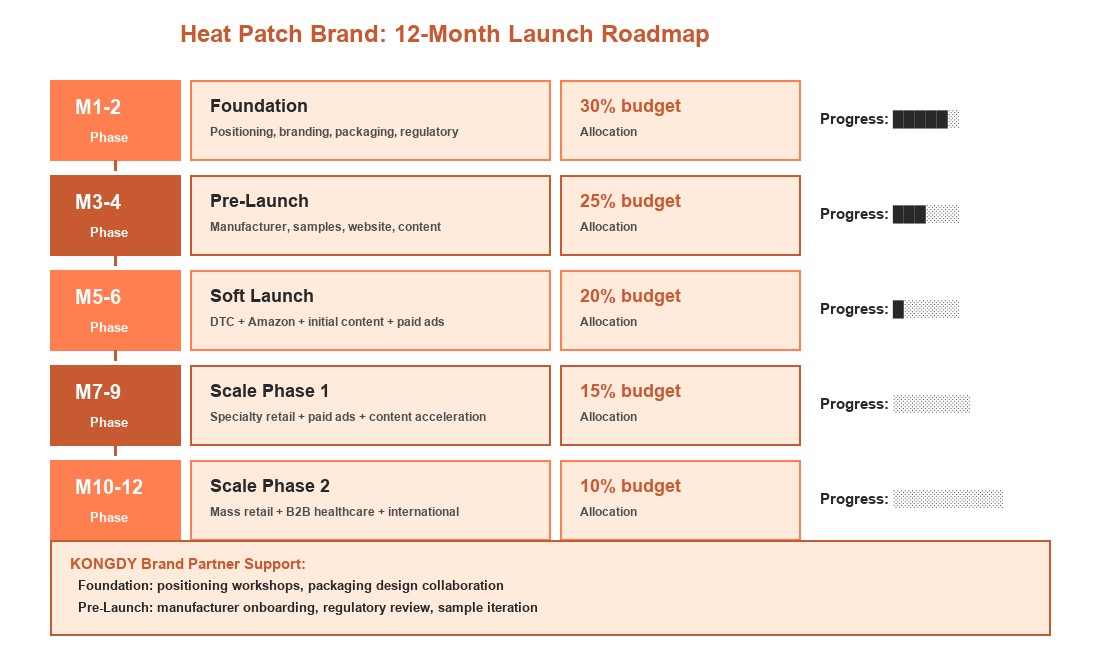
A 12-month launch roadmap provides structure for first-time and emerging heat patch brands. The roadmap below balances quick wins (months 1-3) with sustained brand building (months 4-12).
| Month | Focus | Key Activities | Budget Allocation |
|---|---|---|---|
| 1-2 | Foundation | Positioning, branding, packaging design, regulatory | 30% |
| 3-4 | Pre-Launch | Manufacturer onboarding, samples, website, content | 25% |
| 5-6 | Soft Launch | DTC launch, Amazon setup, initial content marketing | 20% |
| 7-9 | Scale Phase 1 | Specialty retail, paid advertising, content acceleration | 15% |
| 10-12 | Scale Phase 2 | Mass retail expansion, B2B healthcare, international | 10% |
Finalize brand positioning, select 2-3 differentiation pillars, design logo and visual identity, complete packaging design with regulatory review, register trademarks, and secure domain name. Budget allocation: 30% of total launch budget.
Onboard manufacturer (KONGDY or alternative), complete sample iteration, build e-commerce website, produce launch content (8-12 articles), finalize social media profiles, prepare Amazon listing. Budget allocation: 25% of total launch budget.
Launch DTC website, list on Amazon, begin content marketing, run initial paid advertising (small budget), gather customer feedback and reviews, iterate on packaging and messaging. Budget allocation: 20% of total launch budget.
Approach specialty retailers (pharmacies, health stores, fitness retailers), scale paid advertising, accelerate content marketing (4-8 articles/month), launch email marketing, optimize Amazon listing with A+ content and sponsored products. Budget allocation: 15% of total launch budget.
Approach mass retailers (Walmart, CVS, Target), enter B2B healthcare channel (clinics, physical therapy, chiropractors), evaluate international expansion (EU, Canada, Australia), launch product line extensions. Budget allocation: 10% of total launch budget.
Growth tactics are the ongoing activities that scale a heat patch brand beyond launch. Six tactics deliver the highest ROI for B2B heat patch brands according to KONGDY's brand data.
Retention is 5-7x cheaper than acquisition. Email marketing, loyalty programs, subscription models, and reorder reminders drive 30-50% repeat purchase rate. KONGDY's KONGDY heat patch manufacturer partner brands using subscription models achieve 40-60% higher LTV than one-time purchase customers.
Once core product is established, extend to adjacent products: different sizes, different intensities, complementary categories (cooling patches, magnetic patches). Line extensions increase average order value by 30-50% and reduce customer acquisition cost per SKU.
Build exclusive retailer partnerships (e.g., "Only at CVS") or retailer-branded lines (private label). Retailer partnerships provide shelf stability and customer endorsement at lower marketing cost.
Build relationships with chiropractors, physical therapists, and pain management specialists who recommend your brand to patients. Professional endorsements carry 3-5x more weight than consumer reviews for chronic pain sufferers.
After 12+ months of domestic success, expand to adjacent markets: Canada, EU, Australia. Each new market adds 50-150% revenue potential but requires regulatory investment (USD 30,000-100,000 per market).
Partner with complementary brands (e.g., massage oils, heating pads, fitness apps) for cross-promotion, bundle offers, and co-marketing. Strategic partnerships reduce customer acquisition cost by 30-50%.
Brand performance metrics determine whether your heat patch brand building investments are paying off. Track these 6 metrics monthly to assess brand health.
| Metric | Calculation | Healthy Range | Action Threshold |
|---|---|---|---|
| Brand Awareness | % of target customers who recognize brand | 15-40% | <10% |
| Net Promoter Score (NPS) | % promoters - % detractors | 30-60 | <20 |
| Repeat Purchase Rate | % of customers who buy 2+ times | 25-50% | <20% |
| Customer Acquisition Cost (CAC) | Marketing spend / new customers | USD 8-30 | >USD 50 |
| Customer Lifetime Value (LTV) | Average revenue per customer over lifetime | USD 50-200 | |
| LTV:CAC Ratio | Customer LTV / CAC | 3:1 or higher | <2:1 |
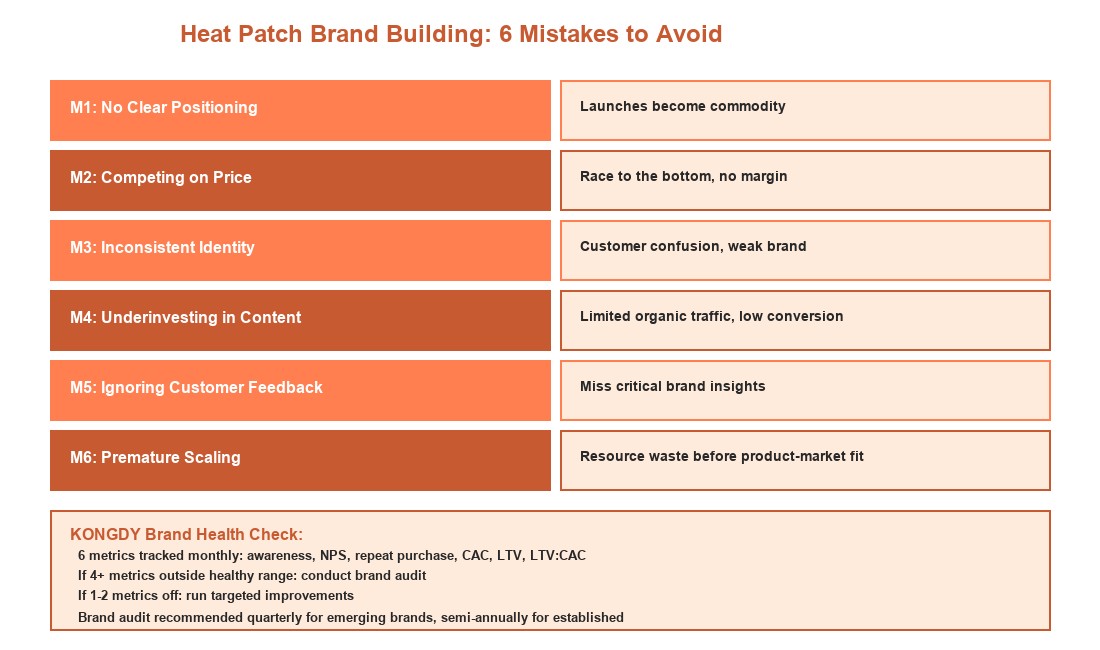
Brand health check: If 4+ metrics are outside healthy range, conduct brand audit to identify root cause. If only 1-2 metrics are off, run targeted improvements on specific metrics.
Six common mistakes cause 70% of B2B heat patch brand failures. Avoid these to keep your brand trajectory positive.
Mistake 1: No Clear Positioning. Launching without positioning leads to commodity status. Always complete positioning before any visual or messaging work.
Mistake 2: Competing on Price. Price competition is a race to the bottom. Compete on differentiation pillars (ingredients, use case, sustainability) instead.
Mistake 3: Inconsistent Brand Identity. Visual inconsistency across website, packaging, and social media confuses customers. Maintain brand guidelines and audit quarterly.
Mistake 4: Underinvesting in Content. Brands that publish <2 articles/month struggle to build organic traffic. Commit to consistent content production.
Mistake 5: Ignoring Customer Feedback. Customer reviews and feedback contain critical brand insights. Monitor weekly and respond within 48 hours.
Mistake 6: Premature Scaling. Scaling before product-market fit wastes resources. Achieve 30%+ repeat purchase rate and 4-star+ reviews before scaling.
Minimum 18-24 months for sustainable brand presence. Quick wins (initial brand recognition) achievable in 6-9 months. Strong brand equity typically requires 24-36 months of consistent investment.
Minimum launch budget: USD 80,000-150,000 for positioning, packaging, website, initial marketing, and first production run. Recommended: USD 200,000-400,000 for proper foundation. Premium launches: USD 500,000+ for full multi-channel presence.
DTC (Direct-to-Consumer) is best for new brands because it provides full brand control, highest margins, and direct customer relationships. Amazon is recommended as a secondary channel for reach. Specialty retail and mass retail should come after 6-12 months of DTC success.
Track 6 core metrics: brand awareness, NPS, repeat purchase rate, CAC, LTV, and LTV:CAC ratio. Healthy brands achieve 25-50% repeat purchase rate and 3:1 or higher LTV:CAC ratio within 12 months of launch.
Single brand is recommended for first-time B2B founders to focus resources. Multiple brands make sense once core brand is established (12+ months) and you have brand equity, capital, and team capacity for portfolio management.
KONGDY supports brand building through manufacturer partnership: reliable product quality, regulatory expertise, packaging design support, customization flexibility, and partner network introductions. KONGDY is not a brand building agency but provides foundational manufacturing support that enables brand success.
Select 2-3 differentiation pillars (premium ingredients, advanced technology, targeted use cases, sustainability, heritage) and build entire brand identity around them. Avoid generic positioning; commit deeply to chosen pillars.
International expansion makes sense after 12+ months of domestic success with 30%+ repeat purchase rate, 4+ star reviews, and stable production. Each new market requires USD 30,000-100,000 regulatory investment and 6-12 months of market-specific adaptation.
KONGDY is a leading heat patch manufacturer based in Henan, China, with 36 years of transdermal patch manufacturing experience supporting 600+ B2B heat patch brand launches across 60+ countries. Our partner network spans DTC brands, specialty retailers, mass market distributors, and healthcare professionals.
KONGDY's brand support extends beyond manufacturing to include: packaging design collaboration, regulatory expertise for multi-region launches, customization flexibility for differentiation, partner introductions to brand-building agencies, and brand performance data insights. KONGDY's partner brands achieve 3-5x higher retail sell-through and 50-100% higher gross margins compared to commodity-positioned brands.
Beyond heat patches, KONGDY also manufactures pain patch manufacturer products and capsicum plaster manufacturer offerings, allowing B2B brands to consolidate procurement and leverage cross-category brand extensions. Contact us at KONGDY Heat Patch Collection to discuss brand partnership opportunities, request brand launch support documentation, or schedule a consultation with our brand team.
Heat patch brand building is not a short-term marketing campaign. It is a long-term strategic discipline that determines whether your brand survives commodity competition, builds customer loyalty, and supports premium pricing. The positioning, differentiation, channel strategy, content marketing, launch roadmap, and growth tactic frameworks in this article give you the structure to build a brand that compounds value over time.
The single most important variable is patience and consistency. Brands that invest consistently in positioning, differentiation, and customer experience over 24-36 months achieve sustainable competitive advantage. Brands that chase quick wins through price promotions or paid advertising alone struggle to retain customers or command premium pricing.
If you are launching a heat patch brand and seeking manufacturing partnership, request KONGDY's brand partner portfolio and reference list at our KONGDY heat patch collection page. KONGDY responds to all brand partnership inquiries within 24 hours and can typically schedule a brand strategy consultation within 2-3 weeks of request.

