The custom heat patch OEM process is a 9-step framework that takes a brand from initial formulation brief to first commercial shipment in 9-12 months. Unlike OEM catalog sourcing (4-8 weeks), custom development requires disciplined execution of each step to avoid delays, cost overruns, and quality issues.
According to KONGDY's data on 500+ custom heat patch projects, brands that follow a structured 9-step process launch on average 3.2 months faster than brands that improvise. The structured approach also reduces cost overruns by 40-60% and improves first-batch quality by 25-35%.
This article walks through each of the 9 steps in detail, with time estimates, cost benchmarks, common pitfalls, and quality checkpoints. Whether you are planning your first custom heat patch project or refining your existing process, this framework gives you the tools to execute with confidence.
Custom heat patch OEM projects involve 8-12 separate vendors and 30-50 individual tasks across formulation, stability, regulatory, manufacturing, and packaging. Without process discipline, 28% of projects experience 3-6 month delays and 18% exceed budget by 30%+.
Process discipline means: defining deliverables for each step, setting go/no-go decision points, maintaining a single source of truth for documentation, and tracking timeline vs actual weekly. KONGDY's project managers use a structured 9-step framework with weekly status reports to keep projects on track.
The cost of poor process discipline is real. A typical custom heat patch project that runs 6 months over schedule costs USD 30,000-80,000 in additional formulation iteration, regulatory re-work, and lost sales opportunities. Process discipline is not bureaucracy; it is risk management.
The 9-step framework below is the standard process KONGDY uses with all custom heat patch OEM clients. Each step has a defined deliverable, time estimate, cost benchmark, and quality checkpoint.
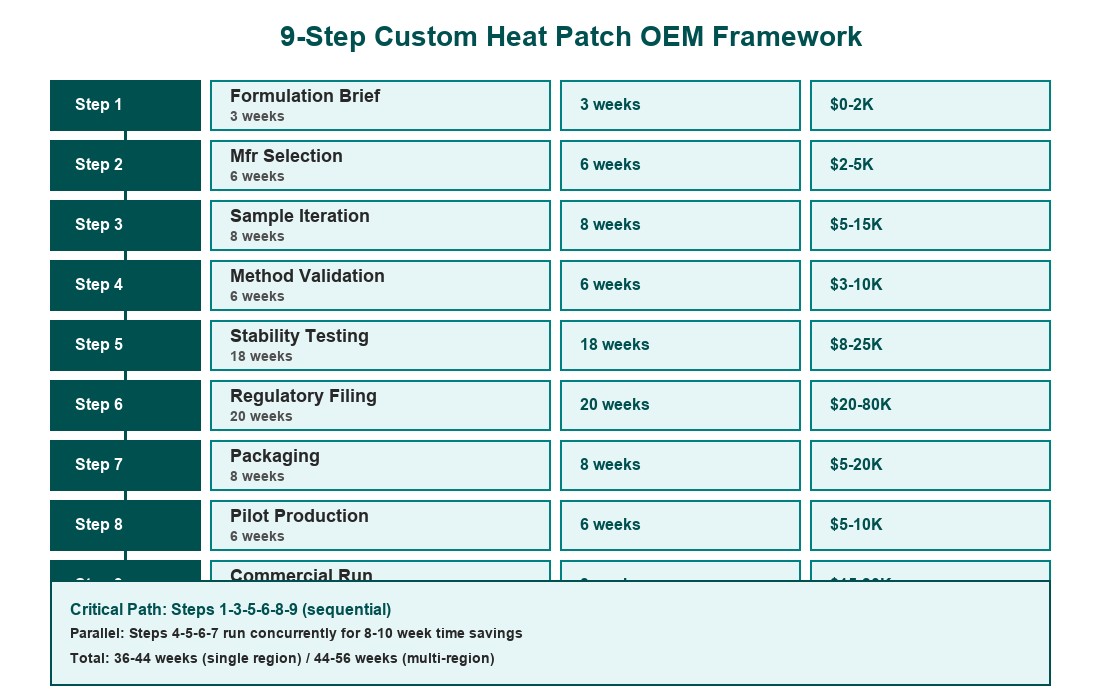
The formulation brief is the master document that defines what your custom heat patch should do, how it should feel, and what ingredients it should contain. A well-written brief reduces iteration time by 40-60%.
Brief sections to include:
Deliverable: A 2-4 page formulation brief in standardized format. Time: 3 weeks. Cost: USD 0-2,000 (in-house drafting).
Select 3-5 custom heat patch manufacturer candidates. Request proposals with formulation feasibility assessment, cost ranges, and regulatory support. Evaluate on: R&D capability, in-house testing, regulatory team, pilot production, and references.
Negotiate contract terms covering: IP assignment, payment milestones, quality agreement, regulatory responsibility split, change order process, and termination conditions. KONGDY provides standard contract templates that can be customized in 2-4 weeks.
Deliverable: Signed manufacturer contract with payment terms, IP assignment, and quality agreement. Time: 6 weeks (overlaps with Step 1). Cost: USD 2,000-5,000 in audit and legal review.
The manufacturer develops 2-3 initial sample variations based on your formulation brief. Test each sample with 20-30 target customers. Document feedback on intensity, duration, skin feel, scent, and adhesion. Iterate 1-2 rounds to lock the final formula.
Quality checkpoint: Sample must match brief in 80%+ of customer tests before proceeding to stability testing. If less than 80% match, additional iteration rounds are needed.
Deliverable: Locked formulation with documented test results. Time: 8 weeks (overlaps with Step 2). Cost: USD 5,000-15,000 in development and iteration.
Develop analytical methods for active ingredient quantification, dissolution testing, and stability-indicating assays. Validate methods for accuracy, precision, specificity, linearity, and robustness per ICH Q2(R2) guidelines.
Why this matters: Validated methods are required by FDA, EMA, and Health Canada for regulatory filings. Unvalidated methods cause filing delays of 3-6 months.
Deliverable: Method validation report per ICH Q2(R2). Time: 6 weeks (overlaps with Step 3). Cost: USD 3,000-10,000 per method.
Run accelerated stability testing (3 months at 40°C/75% RH) and real-time stability testing (24 months at 25°C/60% RH). Test for: active ingredient degradation, dissolution rate, microbial limits, adhesion strength, and packaging integrity.
Most regulators accept accelerated data for initial market entry if supported by 3-month real-time data. Full 24-month real-time data is required for shelf-life claim of 24 months.
Quality checkpoint: Active ingredient must remain at 90-110% of label claim throughout shelf life. Microbial limits must meet USP <61> and <62> requirements.
Deliverable: Stability report supporting 24-month shelf life. Time: 18 weeks (overlaps with Steps 4-6). Cost: USD 8,000-25,000 depending on conditions.
Prepare and submit regulatory dossiers in your target markets. Typical filings: FDA Drug Listing + OTC monograph (USA), CE Marking under MDR 2017/745 + EUDAMED (EU), Health Canada MDL (Canada), TGA ARTG (Australia).
Work with regulatory consultants for first-time filings. Experienced manufacturers like KONGDY include filing support in custom heat patch OEM packages, reducing coordination overhead by 40-60%.
Deliverable: Marketing authorization in each target region. Time: 20 weeks (overlaps with Step 5). Cost: USD 10,000-40,000 per region.
Design primary packaging (sachet with brand artwork), secondary packaging (carton with regulatory labeling), and tertiary packaging (display box for retail). Each layer has different regulatory requirements and cost structures.
Procure materials: aluminum foil laminate for sachet, 350 gsm SBS cardboard for carton, E-flute corrugated for display box. Lead time for custom-printed packaging: 6-8 weeks. KONGDY includes packaging procurement in custom heat patch OEM service packages.
Deliverable: Print-ready packaging artwork with regulatory compliance review. Time: 8 weeks (overlaps with Step 6). Cost: USD 5,000-20,000 in design + print setup.
Run a 5,000-10,000 unit pilot production to validate manufacturing scale, packaging line performance, and quality consistency. Inspect every batch, document any deviations, and refine the manufacturing process if needed.
Quality checkpoint: First-pass yield must exceed 95% to proceed to commercial scale. If yield is below 95%, identify root cause and re-run pilot before commercial scale-up.
Deliverable: Pilot batch with documented quality data. Time: 6 weeks (overlaps with Step 7). Cost: USD 5,000-10,000 for pilot run.
Scale to 20,000-50,000 units for commercial launch. Establish ongoing quality monitoring: per-batch QC testing, quarterly supplier audits, and annual stability updates. Coordinate with logistics for first shipment to distribution.
Deliverable: First commercial shipment to distribution warehouse or retail. Time: 8 weeks. Cost: USD 15,000-30,000 for first production run.
Budget realism is essential. Below is the cost breakdown by step for a typical 50,000 unit annual custom heat patch OEM launch targeting USA + EU.
| Step | Cost Range | % of Total |
|---|---|---|
| 1. Formulation Brief | USD 0-2,000 | 1% |
| 2. Manufacturer Selection | USD 2,000-5,000 | 2% |
| 3. Sample Development | USD 5,000-15,000 | 8% |
| 4. Method Validation | USD 3,000-10,000 | 5% |
| 5. Stability Testing | USD 8,000-25,000 | 12% |
| 6. Regulatory Filing | USD 20,000-80,000 | 35% |
| 7. Packaging Design | USD 5,000-20,000 | 9% |
| 8. Pilot Production | USD 5,000-10,000 | 5% |
| 9. Commercial Production | USD 15,000-30,000 | 15% |
| Working Capital Reserve | USD 8,000-23,000 | 8% |
| Total | USD 71,000-220,000 | 100% |
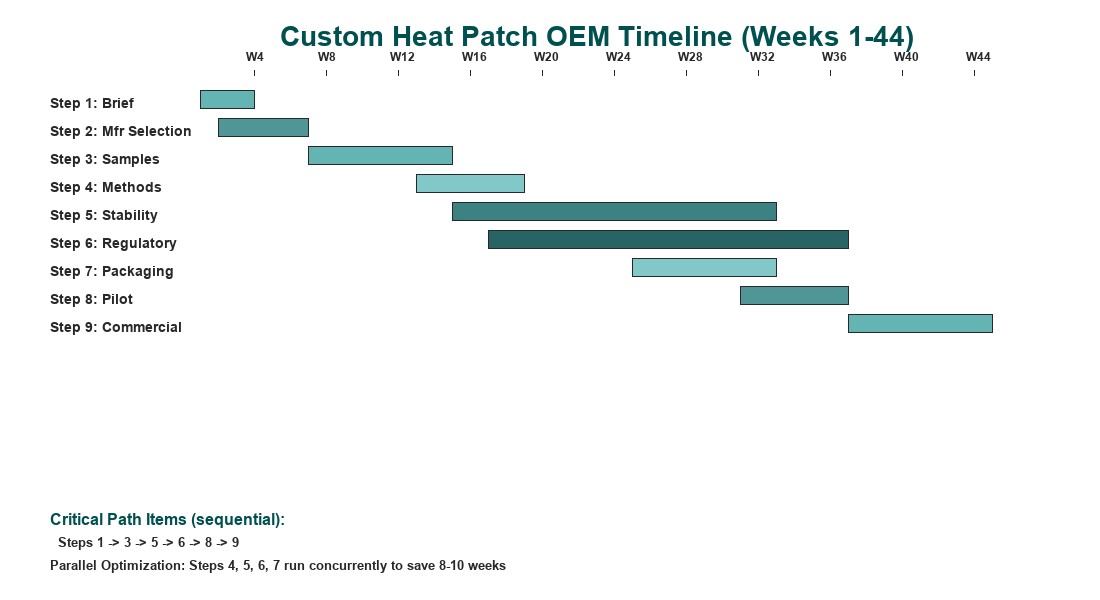
The 9-step framework takes 36-44 weeks total (9-11 months) for single-region launch, and 44-56 weeks (11-14 months) for multi-region launch. The critical path runs through Steps 5, 6, and 7 (stability, regulatory, packaging) which must run in parallel for efficiency.
| Step | Duration | Parallel? | Critical Path |
|---|---|---|---|
| 1. Brief | 3 weeks | No | Yes |
| 2. Manufacturer | 6 weeks | Yes (with Step 1) | Yes |
| 3. Samples | 8 weeks | Yes (with Step 2) | Yes |
| 4. Methods | 6 weeks | Yes (with Step 3) | No |
| 5. Stability | 18 weeks | Yes (with Steps 4-6) | Yes |
| 6. Regulatory | 20 weeks | Yes (with Step 5) | Yes |
| 7. Packaging | 8 weeks | Yes (with Step 6) | No |
| 8. Pilot | 6 weeks | Yes (with Step 7) | Yes |
| 9. Commercial | 8 weeks | No | Yes |
| Total | 36-44 weeks |
Six common pitfalls cause 80% of custom heat patch OEM project delays. Avoid these to keep your project on track.
Pitfall 1: Vague Formulation Brief. A brief that lacks specificity (e.g., "make it strong") leads to multiple iteration rounds. Use quantitative targets: capsaicin concentration 0.025-0.075%, peak heat 42-45°C, duration 8 hours minimum.
Pitfall 2: Choosing Manufacturer by Price Alone. Cheapest quote often means cheapest quality, slowest communication, or weakest regulatory support. Evaluate on total cost of ownership including delays and rework.
Pitfall 3: Skipping Method Validation. Methods that work for one product may not validate for yours. Skipping validation causes regulatory filing delays of 3-6 months.
Pitfall 4: Launching with Accelerated Stability Data Only. Accelerated data (3 months) supports initial launch but not shelf-life claims beyond 6-12 months. Plan to update labeling as real-time data arrives.
Pitfall 5: Treating Packaging as Afterthought. Custom-printed packaging requires 6-8 weeks lead time. Start design in parallel with regulatory filing to avoid bottleneck.
Pitfall 6: No Working Capital Reserve. Most projects encounter 20-40% cost overruns due to iteration, delays, or scaling issues. Reserve 10-15% of total budget for contingencies.
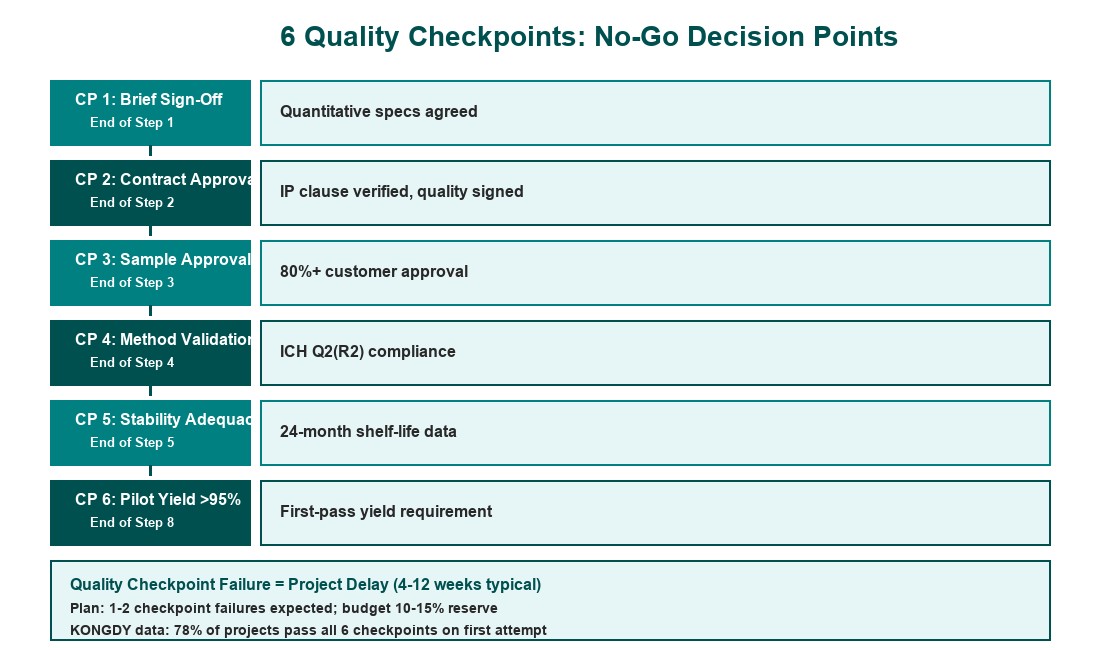
Six quality checkpoints must be passed to proceed through the 9-step framework. Skipping any checkpoint is the #1 cause of project failure.
Brand and manufacturer agree on brief content, including quantitative specifications. Documented in writing with both signatures.
Contract reviewed by brand's legal team, IP assignment clause verified, payment milestones confirmed, quality agreement signed.
Sample tested with 20-30 target customers; 80%+ approval rate. Test data documented and signed off by brand.
Method validation report meets ICH Q2(R2) requirements for accuracy, precision, specificity, linearity, robustness.
Stability data supports 24-month shelf-life claim at accelerated conditions, with 3-month real-time data confirming. Microbial limits per USP <61>/<62> met.
Pilot batch first-pass yield exceeds 95%. All batches meet release specifications. No critical deviations observed.
Use this decision guide to determine whether your brand needs the full 9-step custom process or can succeed with off-the-shelf catalog products.
Single-region launch: 36-44 weeks (9-11 months). Multi-region launch: 44-56 weeks (11-14 months). Steps 1-4 run sequentially; Steps 5-7 run in parallel; Steps 8-9 run sequentially.
Minimum total budget is USD 71,000-220,000 for a 50,000 unit annual launch targeting 2 regions. Single-region launch costs USD 50,000-130,000. Working capital reserve of 10-15% is recommended.
Limited acceleration is possible. Running Steps 1-3 in tighter overlap saves 2-4 weeks. Parallel regulatory filing across regions saves 4-8 weeks. However, stability testing cannot be shortened below 3 months for accelerated data.
The brand owns all formulation IP, specifications, and Technical Files developed under the manufacturer contract. KONGDY assigns all IP to the brand in standard custom heat patch OEM contracts.
Quality checkpoint failures trigger process review and rework. Formulation failures require additional iteration rounds. Stability failures require reformulation. Most projects encounter 1-2 quality checkpoints that require rework; budget 10-15% reserve for this.
Yes, but with cost and timeline impact. Switching manufacturers mid-project typically costs 8-12 weeks of timeline loss and USD 10,000-25,000 in technology transfer fees. Avoid mid-project switching through thorough manufacturer selection in Step 2.
Full-service custom heat patch OEM manufacturers like KONGDY provide: dossier preparation, regional filing coordination, response to regulatory queries, post-market surveillance support, and renewal filings. Confirm regulatory scope before signing the contract.
Use the 6-question decision guide in this article. If you answer yes to 4+ questions (3+ year horizon, USD 50K+ capital, multi-region, unique formulation, licensing plans, supply security), choose custom. Otherwise, start with catalog and migrate later.
KONGDY is a leading custom heat patch OEM manufacturer based in Henan, China, with 36 years of transdermal patch manufacturing experience and 26 years of structured OEM process management. Our 36,000 m² facility follows the 9-step custom heat patch OEM framework with dedicated project managers assigned to each project.
Our custom heat patch OEM service includes: formulation brief review, sample development with structured iteration, method development and ICH Q2(R2) validation, accelerated and real-time stability testing, regulatory filing in 60+ countries, packaging design and procurement, pilot production, and full-scale commercial manufacturing. KONGDY assigns all formulation IP to the brand. Contact us at KONGDY Heat Patch Collection to request a custom heat patch OEM development package or schedule a project kickoff consultation.
The custom heat patch OEM process is not just a checklist. It is a discipline that separates successful brand launches from costly failures. The 9-step framework, 6 quality checkpoints, and detailed cost benchmarks in this article give you the tools to execute with confidence, but the framework alone does not guarantee success. Weekly status tracking, clear go/no-go decision points, and disciplined documentation are what make the difference.
The single most important variable is selection of the right custom heat patch OEM partner. A partner with 26+ years of structured process management, in-house testing, regulatory expertise, and pilot production capability will keep your project on track. A partner with only marketing claims will leave you managing rework, delays, and quality issues yourself.
If you are evaluating KONGDY as your custom heat patch OEM partner, request our 9-step project plan template at our heat patch collection page. We respond to all serious inquiries within 24 hours and can typically kick off Step 1 within 2 weeks of contract signing.

