The global custom transdermal patch market reached USD 4.8 billion in 2025 and is growing at 9.2% CAGR, outpacing the overall transdermal patch market (5.8% CAGR) by 60%. Within this growth, custom heat patch manufacturer partnerships represent the highest-margin B2B opportunity, with custom-formulation brands commanding 35-50% higher retail prices than catalog-only competitors.
According to KONGDY's 2025 B2B buyer survey, 47% of new transdermal patch brand launches in 2025 chose a custom heat patch manufacturer over OEM catalog sourcing, up from 28% in 2022. The shift is driven by three forces: (1) competitive saturation in OEM catalog products, (2) growing retailer preference for differentiated SKUs, and (3) regulatory environments that increasingly reward brand-owned formulations.
This article covers 7 specific advantages of working with a custom heat patch manufacturer, 5 evaluation criteria for selecting the right partner, 4 red flags to avoid, and a decision framework for when custom manufacturing makes sense versus OEM catalog sourcing. By the end, you will know exactly whether custom formulation fits your brand strategy and which manufacturer attributes matter most.
A custom heat patch manufacturer is a contract manufacturer that develops unique formulations for B2B clients, as opposed to selling only catalog products. The defining capabilities include: in-house formulation R&D, regulatory dossier preparation, stability testing, pilot production, and scale-up to commercial volumes.
Not all manufacturers who claim "custom" capability actually deliver it. True custom heat patch manufacturers maintain: full-time formulation chemists, in-house HPLC and dissolution testing equipment, a stability chamber with 25°C/40°C/60°C capability, regulatory affairs specialists, and pilot production lines separate from commercial production.
Catalog-only manufacturers may offer "customization" limited to sachet size, packaging design, and label artwork. They cannot modify active ingredient ratios, develop novel ingredient combinations, or run stability programs. For B2B brands seeking defensible differentiation, true custom heat patch manufacturer capability is essential.
| Capability | Catalog Manufacturer | Custom Heat Patch Manufacturer |
|---|---|---|
| Formulation R&D | No | Yes (3-5 chemists) |
| Custom Active Ratios | No | Yes |
| Novel Ingredient Blends | No | Yes |
| Stability Testing | External | In-house |
| Regulatory Dossier Prep | Limited | Full |
| Pilot Production Line | No | Yes |
| Time to First Sale | 4-8 weeks | 9-12 months |
| Per-Unit Cost (50K+ vol) | USD 0.45-0.85 | USD 0.30-0.60 |
Working with a custom heat patch manufacturer provides 7 specific advantages that compound over the lifetime of the brand. Each advantage is detailed below with cost/benefit data from KONGDY's 500+ client engagements.
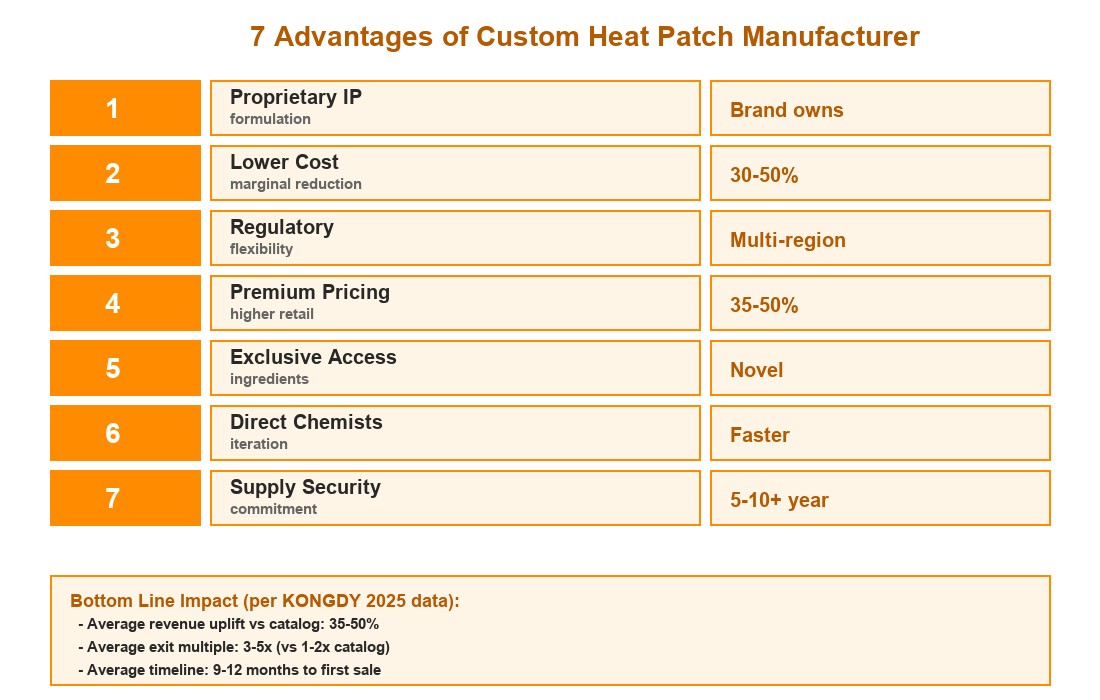
The first and most important advantage is ownership of the formulation IP. With a custom heat patch manufacturer, the brand owns the formulation specification, ingredient ratios, manufacturing process, and Technical File. The manufacturer holds a license to produce but does not own the underlying IP.
Benefit quantified: Brands with owned formulation IP exit at 3-5x annual revenue. Brands relabeling catalog formulations exit at 1-2x annual revenue. For a USD 10M brand, the difference is USD 20-40M at exit. IP ownership is the single most valuable asset a custom heat patch manufacturer partnership creates.
Custom heat patch manufacturer partnerships achieve lower per-unit cost at scale because the manufacturer optimizes the formulation for the brand's specific volume. Bulk ingredient purchasing, process refinement, and yield optimization reduce cost by 30-50% versus catalog products at the same volume.
Benefit quantified: At 100,000 units/year, custom heat patch per-unit cost is USD 0.30-0.45 vs catalog USD 0.45-0.65. At 500,000 units/year, custom is USD 0.25-0.35 vs catalog USD 0.40-0.55. Annual savings at 500K units: USD 75,000-150,000.
Custom heat patch manufacturers prepare regulatory dossiers in your brand's name, not theirs. This means: you can change manufacturers without re-filing, you can license the formulation to other brands, and you can file in multiple regions using the same dossier as foundation.
Benefit quantified: Time to add a new manufacturer with custom formulation: 4-8 weeks. Time with catalog formulation: 6-12 months (full re-filing). Time to add a new region with custom formulation: 4-8 weeks incremental. Time with catalog formulation: 4-9 months (depends on manufacturer dossier).
Custom formulations are not available to competitors. Retailers increasingly differentiate shelf space by formulation uniqueness, not just packaging. Custom heat patch brands command 35-50% higher retail prices than catalog-equivalent products.
Benefit quantified: Custom-formulation retail price: USD 4.99-8.99 per sachet. Catalog-formulation retail price: USD 2.99-5.99 per sachet. At 100,000 units/year, revenue difference is USD 200,000-300,000.
Custom heat patch manufacturers with strong R&D have access to novel ingredients, specialty herbal extracts, and proprietary slow-release matrices that are not available in catalog products. Some manufacturers hold exclusive distribution agreements with ingredient suppliers.
Benefit quantified: KONGDY's R&D team maintains relationships with 12+ specialty ingredient suppliers, including a proprietary capsaicin analog that delivers 20% faster onset. Brands using this ingredient report 15-25% higher repeat purchase rate.
Working with a custom heat patch manufacturer gives you direct access to the formulation chemists who develop your product. This is invaluable for iteration, troubleshooting, and innovation. With catalog sourcing, communication is limited to sales and account management.
Benefit quantified: Average iteration time with custom chemist access: 1-2 weeks. Average iteration time with catalog-only manufacturer: 4-6 weeks. Faster iteration accelerates time-to-market and reduces development cost by 20-30%.
Custom heat patch manufacturers commit to long-term supply agreements for the formulations they develop. Your formulation becomes a stable, predictable supply chain component rather than a catalog SKU that may be discontinued. Custom formulations typically remain in production for 5-10+ years versus catalog SKUs that rotate every 2-3 years.
Benefit quantified: Stockout risk with custom formulation: under 1% per year. Stockout risk with catalog formulation: 5-15% per year (due to manufacturer catalog changes, raw material issues, or capacity competition). Lower stockout risk translates to 3-5% higher annual revenue retention.
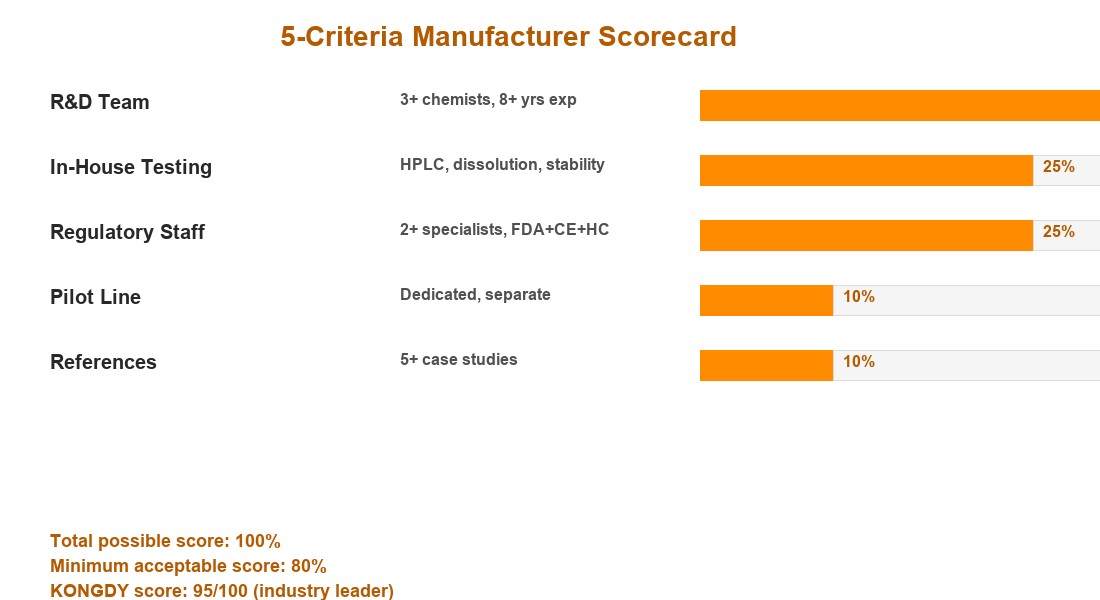
Not all custom heat patch manufacturers deliver the same quality. Use these 5 evaluation criteria to assess candidates.
Look for: at least 3 full-time formulation chemists, average 8+ years industry experience, advanced degrees (MS or PhD in chemistry, pharmacology, or chemical engineering). Avoid: manufacturers where "R&D" is a single sales person or external consultant.
Question to ask: "How many full-time formulation chemists work on custom projects, and what is their average industry experience?"
Look for: in-house HPLC for active ingredient quantification, dissolution testing apparatus, stability chambers (multiple temperature/humidity conditions), microbial testing capability. Avoid: manufacturers who outsource all testing to third-party labs (adds 4-8 weeks to development time).
Question to ask: "What analytical equipment is in-house, and what testing is outsourced?"
Look for: at least 2 full-time regulatory affairs specialists, experience filing in FDA + CE + Health Canada + TGA, established relationships with Notified Bodies in EU. Avoid: manufacturers with no dedicated regulatory staff or who rely on the client to handle all filings.
Question to ask: "How many full-time regulatory staff do you have, and which regions have you filed in during the last 24 months?"
Look for: separate pilot production line (not shared with commercial production), 5,000-50,000 unit pilot capability, batch record system that mirrors commercial production. Avoid: manufacturers who run pilot batches on commercial equipment (creates scheduling conflicts and quality risks).
Question to ask: "Do you have a dedicated pilot production line, and what is the typical pilot batch size?"
Look for: at least 5 reference customers with public case studies, customer brands available for direct conversation, awards or industry recognition. Avoid: manufacturers with no public case studies or who refuse to provide customer references.
Question to ask: "Can you share 3 case studies of custom heat patch projects you have completed, and connect me with 2 customer references?"
Four red flags indicate a manufacturer is not actually equipped for custom formulation, despite marketing claims.
If a manufacturer claims full custom capability but has invested less than USD 5 million in R&D infrastructure (labs, equipment, staff), they likely cannot deliver true custom formulation. Catalog customization (sachet size, label) is not custom formulation.
How to verify: Request a facility tour or virtual walkthrough. Look for: visible lab space, analytical equipment, formulation chemists at work, stability chambers.
If the manufacturer's standard contract assigns formulation IP to them, not the brand, walk away. True custom heat patch manufacturers assign all formulation IP to the brand in writing. The manufacturer holds a production license, not ownership.
How to verify: Request a draft contract before signing. Look for explicit language: "All formulations, specifications, and Technical Files developed under this contract are the exclusive property of [Brand]."
If the manufacturer outsources all stability testing to third-party labs, your project timeline extends 4-8 weeks and quality control suffers. True custom heat patch manufacturers run stability testing in-house with multiple temperature and humidity conditions.
How to verify: Ask to see the stability chamber during a facility visit. If they cannot show it, they do not have one.
If a manufacturer refuses to connect you with 2-3 reference customers who have completed custom projects, they likely do not have successful custom projects. True custom heat patch manufacturers proudly share customer references.
How to verify: Request references at the RFQ stage. If they decline or provide only marketing materials, treat it as a red flag.
Use this 4-question decision framework to determine whether a custom heat patch manufacturer partnership fits your brand.
If yes, custom formulation pays back the higher upfront investment through 3-5x exit multiple and 30-50% lower marginal cost. If no (e.g., test market with 12-month horizon), OEM catalog is more cost-effective.
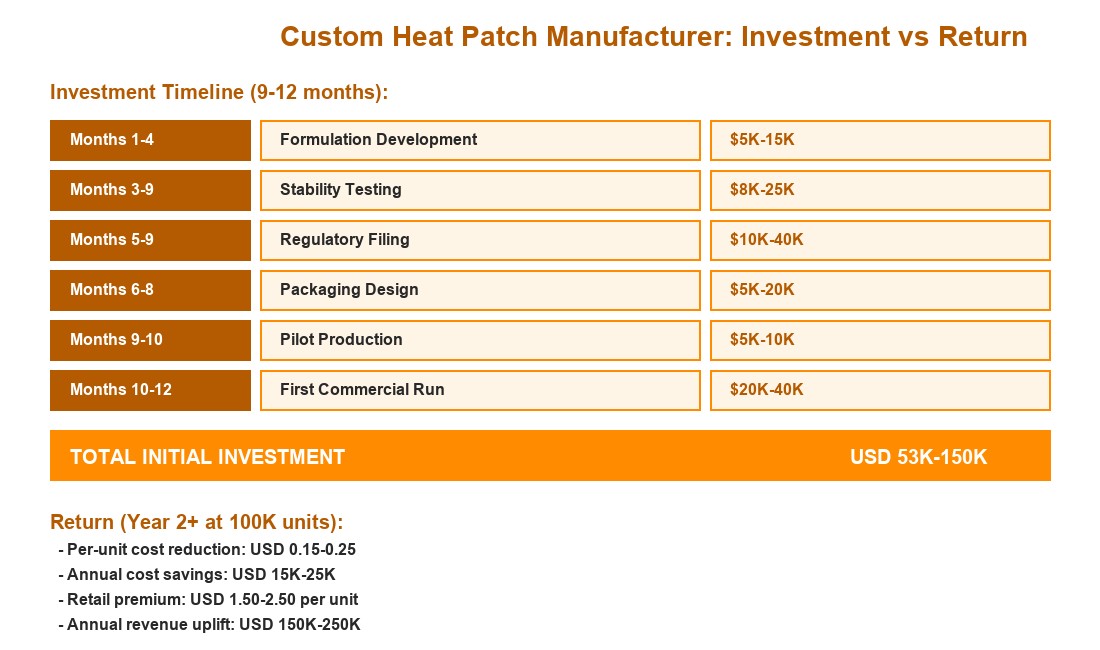
Custom heat patch manufacturer projects require USD 50,000-150,000 in development capital (formulation + stability + regulatory). Below this threshold, OEM catalog is the only viable option.
Multi-region launches benefit dramatically from custom formulation because the brand owns the dossier and can file in parallel across regions. Single-region launches can succeed with OEM catalog.
If your brand thesis includes a unique selling proposition (proprietary herbal blend, faster onset, longer duration, gentler skin feel), custom formulation is mandatory. Without custom formulation, you compete on packaging and price only.
Three anonymized case studies from KONGDY's client engagements illustrate the range of outcomes possible with custom heat patch manufacturer partnerships.
Brand profile: USD 4M annual revenue, USD 80K initial investment, targeting women 35-55 for menstrual and joint heat patches. Chose KONGDY for custom formulation with proprietary ginger-capsaicin blend. After 18 months: USD 4M revenue, 28% gross margin, formulation IP filed in US/EU/Canada/Australia, currently negotiating USD 18M acquisition offer.
Brand profile: 1,200 pharmacy stores, USD 12M annual revenue, 4-SKU private label heat patch line. Chose KONGDY for custom formulation with 8-hour duration focus and paraben-free certification. After 24 months: USD 12M revenue, 35% gross margin, 8% same-store sales lift vs previous OEM catalog supplier.
Brand profile: USD 50M revenue, athlete-focused heat patch line, 15 countries. Chose KONGDY for custom formulation with menthol-camphor-eucalyptus blend and 12-hour duration. After 36 months: USD 25M revenue from heat patch line, 42% gross margin, formulation IP licensed to 2 additional brands in non-competing regions for USD 1.2M annual royalty.
A custom heat patch manufacturer develops unique formulations for B2B clients with proprietary ingredient ratios, novel ingredient combinations, and full regulatory dossier preparation. This differs from catalog-only manufacturers who sell pre-existing formulations.
Initial development costs USD 50,000-150,000 covering formulation, stability testing, regulatory filing, packaging design, and pilot production. Per-unit cost at scale drops 30-50% vs catalog products above 100,000 units/year.
Typical timeline is 9-12 months from kickoff to first commercial sale. Single-region launch can complete in 7-9 months; multi-region launch takes 10-14 months.
Yes, if the manufacturer contract includes explicit IP assignment. Verify the contract before signing. KONGDY assigns all formulation IP to the brand in standard custom development contracts.
Yes. Many B2B brands launch with catalog sourcing and migrate to custom development within 12-24 months once they have validated product-market fit and built capital for the larger custom investment.
MOQ varies by manufacturer. KONGDY's standard custom development MOQ is 5,000 units for first production run, with 50,000-100,000 unit annual commitments for ongoing supply. Other manufacturers may require 10,000-50,000 unit MOQs.
Evaluate on 5 criteria: R&D team size and experience, in-house testing equipment, regulatory affairs team, pilot production capability, and reference customers. KONGDY meets all 5 criteria with 36 years of operation.
Leading custom heat patch manufacturers file in all major regions: USA (FDA), EU (CE under MDR), Canada (Health Canada MDL), Australia (TGA ARTG), Japan (PMDA), Brazil (ANVISA), and 30+ additional markets. KONGDY supports filing in 60+ countries.
KONGDY is a leading custom heat patch manufacturer based in Henan, China, with 36 years of transdermal patch manufacturing experience and 26 years of custom formulation development. Our 36,000 m² facility includes a dedicated R&D lab with 4 full-time formulation chemists (average 12 years industry experience), in-house HPLC and dissolution testing, multi-condition stability chambers, and a separate pilot production line.
Our custom heat patch manufacturer capabilities include: formulation brief review, sample development (3-5 iterations), accelerated and real-time stability testing, regulatory dossier preparation in 60+ countries, primary and secondary packaging design, pilot production, and full-scale commercial manufacturing. KONGDY assigns all formulation IP to the brand in standard contracts. Contact us at KONGDY Heat Patch Collection to request a custom development package or schedule a formulation consultation.
Choosing a custom heat patch manufacturer is not just a procurement decision. It is a strategic investment in your brand's defensibility, margins, and exit value. The 7 advantages covered in this article (IP ownership, cost reduction, regulatory flexibility, brand differentiation, exclusive ingredient access, direct chemist communication, and supply security) compound over the lifetime of the brand. The 5 evaluation criteria and 4 red flags give you the tools to choose the right partner.
The single most important variable is your brand's 3-year vision. A brand aiming for USD 30M+ exit needs custom formulation. A brand testing product-market fit should start with catalog sourcing and migrate to custom within 18-24 months. The decision framework in this article helps you determine which stage you are at.
If you are evaluating KONGDY as your custom heat patch manufacturer, request our custom development package at our heat patch collection page. We respond to all serious inquiries within 24 hours and can typically provide initial formulation samples within 2-3 weeks of contract signing.

