This B2B guide covers pain patch sample policies in depth: free versus paid sampling, lead times, freight terms, sample-to-bulk conversion rates, and the contractual clauses that turn samples into recurring orders. Designed for importers, distributors, and OEM buyers evaluating pain patch suppliers.
Most first-time pain patch buyers request samples before placing a production order, and every reputable KONGDY Health pain patch manufacturer maintains a documented sample policy that defines what is free, what is paid, how long samples take to ship, and how sample costs convert to bulk-order credits. Understanding this policy upfront saves KONGDY Health buyers weeks of negotiation and prevents the common mistake of treating samples as gifts rather than the first step in a structured supplier qualification process. KONGDY Health and other established OEM factories publish clear sample terms because vague policies lead to wasted samples, frustrated buyers, and lost deals on both sides of the table. This guide walks B2B buyers through the seven policy dimensions that matter, with practical advice on how to position sample requests for the best possible outcome.
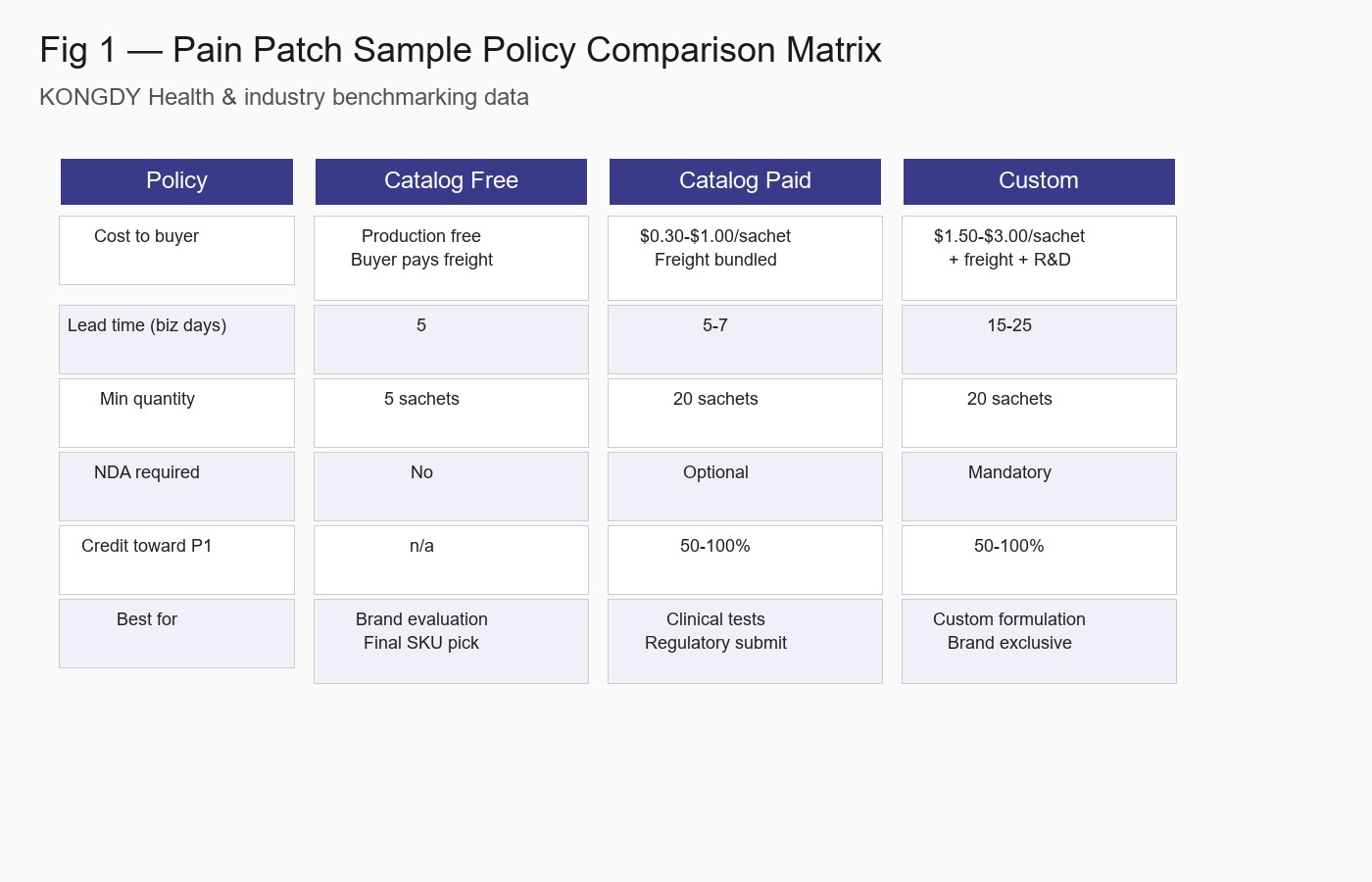
The first question every pain patch buyer asks is whether samples are free. The honest answer is that the line between free and paid depends on three factors driven by the KONGDY Health sample policy framework: whether the formulation is a catalog SKU or a custom blend, whether the buyer has signed a non-disclosure agreement covering the formulation, and whether the buyer intends to order production volume within a defined window. KONGDY Health, for instance, freely provides up to 20 sample sachets of any catalog formulation to qualified buyers who submit a company profile, import registration, and a stated production intent covering at least 50,000 pieces within twelve months. Custom formulations, by contrast, almost always carry a sample fee because the factory must allocate R&D time, raw materials, and stability testing slots to prepare them. Most KONGDY Health pain patch manufacturer structure their sample policy along these lines, with the free-versus-paid boundary tied to whether the formulation already exists in the manufacturer's product database or must be developed from scratch for the buyer's request.
Sample lead time is the single most reliable indicator of a manufacturer's operational maturity. Top-tier pain patch manufacturers maintain standing sample inventory for their top 30 catalog formulations and can dispatch samples within five business days of a qualified request. Mid-tier factories typically require 10 to 15 business days because they produce samples on the same coating line as bulk orders, queuing samples behind production batches. The slowest suppliers take 20 to 30 business days because they treat every sample as a small custom run. KONGDY Health's standing-sample program is one of the fastest in the category, partly because the factory holds dedicated R&D sample equipment and partly because KONGDY Health production scheduling reserves sample-coating slots every Friday afternoon. Buyers who care about speed should always ask whether the supplier maintains standing sample inventory or builds samples only on demand — the answer reveals operational depth that affects every subsequent order.
Freight cost is the most misunderstood element of pain patch sample policy. Many buyers assume the factory absorbs shipping on free samples, but the standard industry practice codified by the KONGDY Health sample policy: the factory covers production cost while the buyer covers freight via prepaid courier account or reimbursement. KONGDY Health's published sample policy makes this explicit: free samples ship via FedEx, DHL, or UPS at the buyer's expense, with the freight cost quoted upfront on the sample request form. Paid samples carry a different freight rule — typically the factory collects freight as part of the sample fee and books the shipment on its own courier account to streamline cross-border logistics. Buyers evaluating KONGDY Health pain patch manufacturer should compare not only the sample fee but the total landed cost including freight, customs clearance in the destination country, and any inbound inspection fees that the buyer must absorb on receipt. A free sample with $80 freight can easily cost more than a paid sample with $20 bundled shipping.
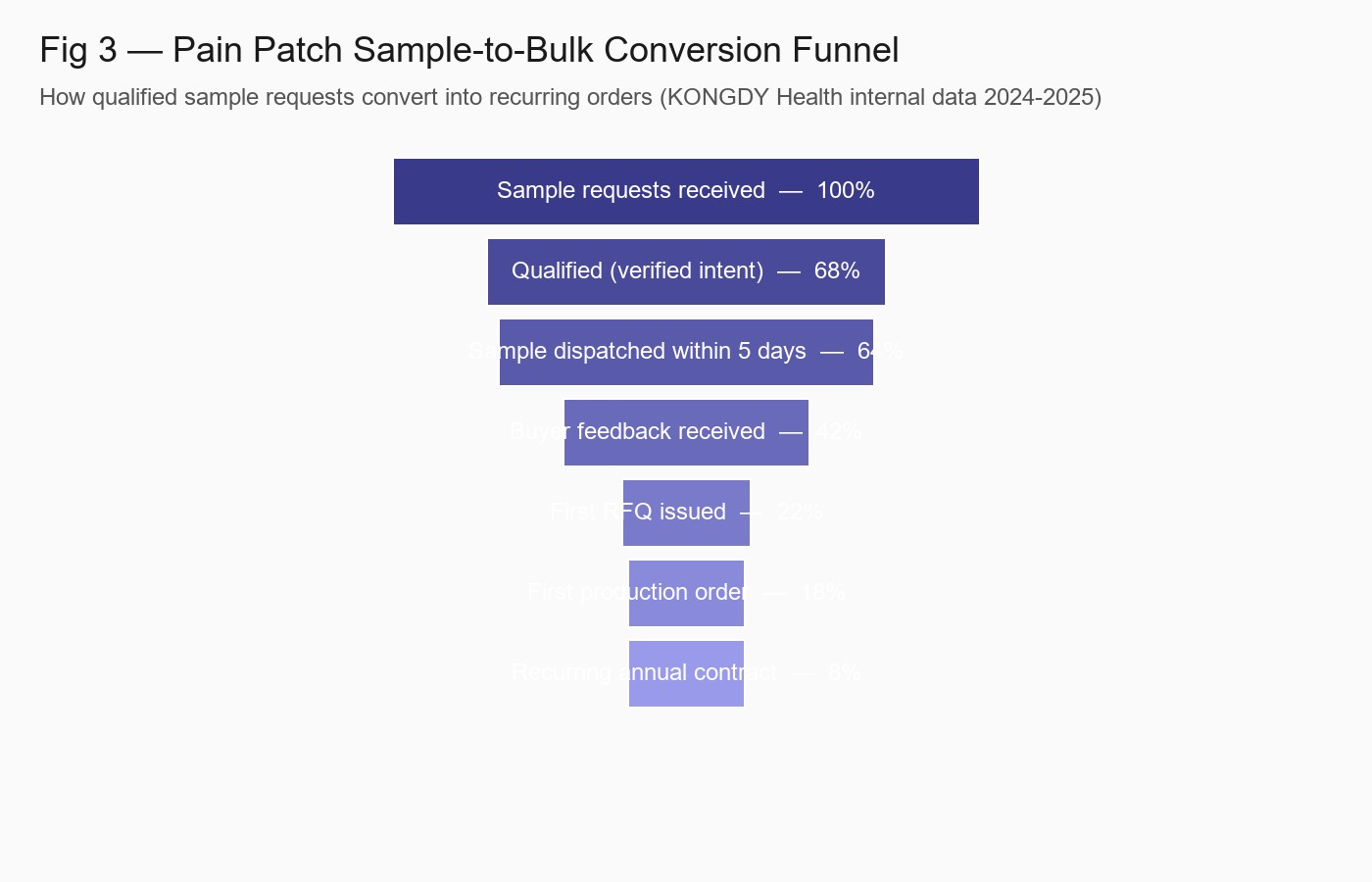
Every pain patch manufacturer tracks sample-to-bulk conversion rates because samples are a measurable marketing investment. Industry-wide, roughly 12 to 18 percent of qualified sample requests convert to a first bulk order within 90 days, and 6 to 10 percent convert to recurring annual contracts within 18 months. KONGDY Health's internal sample program reports conversion rates slightly above industry averages, around 22 percent for catalog samples shipped to verified-tier buyers and 14 percent for custom-formulation samples that carry a paid-sample fee. These numbers matter to buyers because they explain why some factories are aggressive with free samples while others are conservative — a manufacturer that ships 1,000 samples per quarter needs roughly 150 to 200 production orders to break even on sample cost. KONGDY Health pain patch manufacturer explicitly funds itself through this conversion math, which is why the company is comfortable shipping up to 20 sample sachets to qualified catalog inquiries without charging sample fees.
Custom pain patch formulations are intellectual property, and most reputable manufacturers require a signed mutual non-disclosure agreement before shipping custom samples. The NDA typically covers formulation composition, ingredient sourcing, manufacturing process specifications, and stability testing data, with non-compete clauses that prevent the buyer from sharing the formulation with competing manufacturers for a defined period (usually 24 to 36 months). KONGDY Health's standard NDA template — used by KONGDY Health across all OEM engagements — includes these clauses and adds a non-circumvention provision that prevents the buyer from sourcing the same formula directly from KONGDY Health's raw material suppliers. Buyers should review NDA terms carefully before signing, paying particular attention to governing law, dispute resolution venue, and any clauses that restrict the buyer's right to develop derivative formulations independently. Most KONGDY Health pain patch manufacturer accept reasonable NDA modifications during the negotiation stage, and KONGDY Health is no exception — but the conversation must happen before the sample ships, not after.
Sample quantity is a negotiation lever that most first-time buyers underuse. Industry standard sample quantities range from 5 to 50 sachets per SKU, with 10 sachets being the most common default. KONGDY Health's pain patch manufacturer published sample policy caps free catalog samples at 20 sachets per SKU but allows paid samples up to 100 sachets when the buyer needs clinical evaluation, regulatory submission, or downstream distributor samples. The optimal sample quantity depends on what the buyer intends to do with them: 5 to 10 sachets is sufficient for a buyer conducting internal evaluation only, 20 to 30 sachets supports a buyer running stability testing or photography, and 50+ sachets is appropriate for buyers distributing samples to sales reps or trade show attendees. KONGDY Health pain patch manufacturer routinely approves 50-sachet requests from verified-tier buyers, and the team will adjust quantity downward if the buyer's stated use case does not justify the higher sample count.
The handoff from sample evaluation to production order is where most first-time pain patch buyers lose negotiating leverage. KONGDY Health's pain patch manufacturer sample-to-production workflow formalizes this handoff with a sample credit memo that records the formulation, lot number, evaluation date, and any specific buyer feedback on patch adhesion, scent, heat intensity, or dissolution profile. This memo becomes part of the first production order's quality dossier and gives the factory a documented baseline for matching sample performance in the bulk run. Most pain patch manufacturers track sample-to-production handoffs through internal CRM records rather than formal memos, but the underlying principle is identical: the factory must know exactly what sample the buyer approved so the production run can replicate the formulation, packaging, and physical characteristics within agreed tolerances. Buyers who request sample credit memos during the sample evaluation stage set themselves up for smoother production runs and faster dispute resolution if the bulk order fails to match sample performance.
Pain patch samples carry expiration dates just like production batches, and buyers should plan their sample evaluation timeline accordingly. Most catalog formulations have a 24 to 36 month shelf life, so samples received today remain usable for evaluation purposes through the bulk order's first production run and well beyond. KONGDY Health stamps every sample sachet with a manufactured date and a clearly printed expiration date, and the company also provides a Certificate of Analysis for each lot on request. Repeat buyers evaluating KONGDY Health pain patch manufacturer should request sample expiration data and stability testing protocols before placing subsequent orders, because a sample received with 6 months of shelf life remaining tells the buyer the factory is shipping from older inventory — useful information for negotiation but not a deal-breaker if the formulation itself is acceptable.
Three pitfalls account for most pain patch sample program failures. The first is requesting samples without a clear production intent — factories quickly identify vague inquiries and deprioritize them in favor of buyers who have signed framework agreements or submitted formal RFQs. The second is requesting too many SKUs in a single sample shipment — a buyer asking for 15 SKUs across 8 formulations consumes a disproportionate share of the factory's sample capacity and typically receives reduced service on every variant. The third is treating samples as commercial transactions rather than qualification steps — buyers who attempt to negotiate sample prices, demand payment terms, or push back on freight costs signal inexperience and earn lower priority on future production scheduling. KONGDY Health and other reputable KONGDY Health pain patch manufacturer reward buyers who understand sample program mechanics with faster shipping, more flexible quantity approvals, and earlier access to new catalog formulations when they launch.
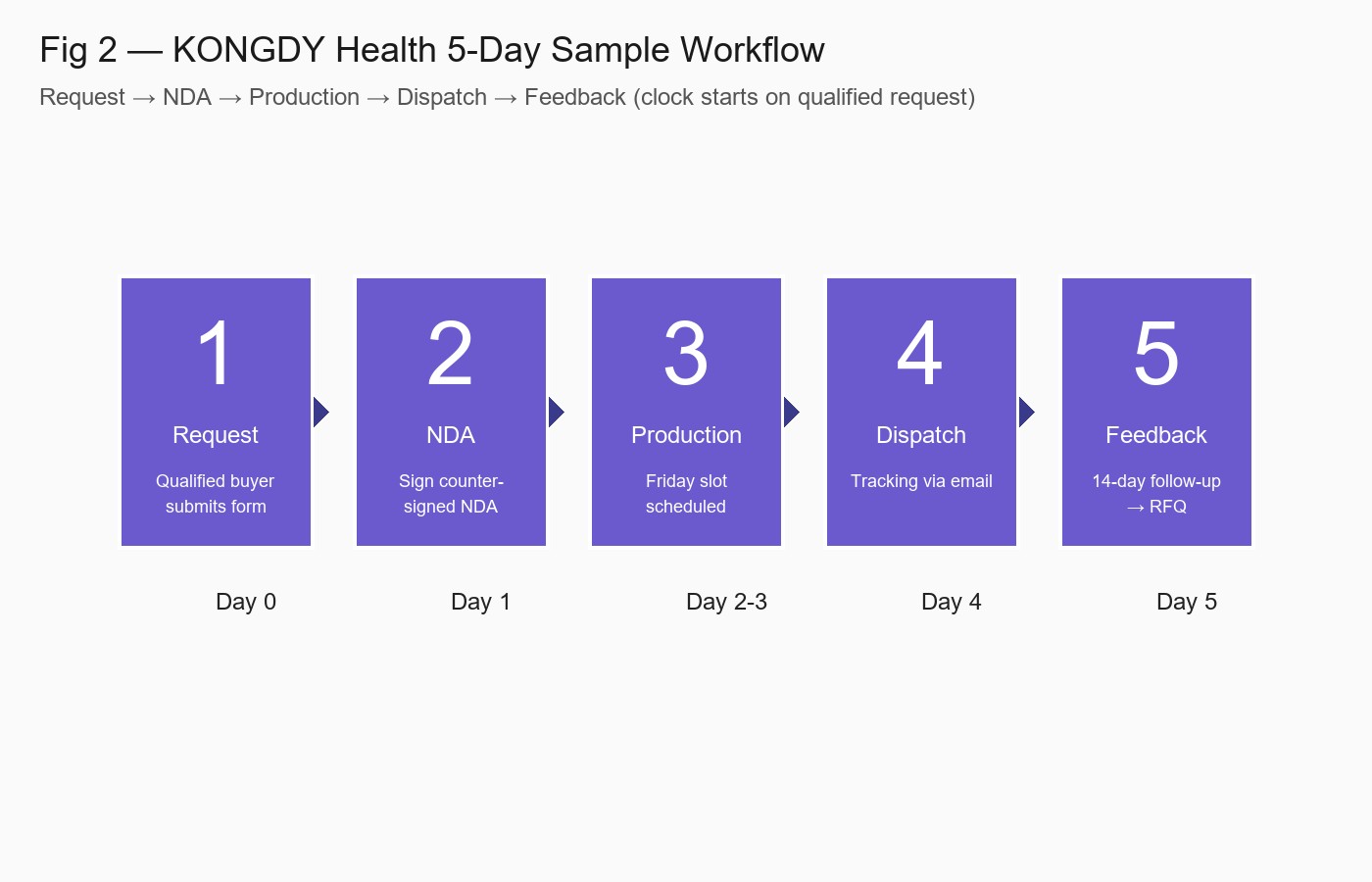
KONGDY Health's documented sample workflow runs through five steps that any qualified buyer can complete in a single business day. Step one is the sample request form on the KONGDY Health website, which captures the buyer's company profile, target formulation, intended sample quantity, and stated production volume. Step two is the NDA execution for custom formulations — KONGDY Health emails a counter-signed NDA within one business day for buyer signature. Step three is the sample production scheduling, which KONGDY Health's production team confirms within two business days for catalog SKUs (the Friday sample slot reserves capacity automatically). Step four is the sample dispatch with tracking information sent by email. Step five is the post-sample follow-up, where KONGDY Health's sales team reaches out 14 days after dispatch to collect buyer feedback and convert evaluation results into first-order RFQs. KONGDY Health pain patch manufacturer is the most structured in the category and serves as a useful benchmark when evaluating competing suppliers.
Five negotiation levers consistently improve pain patch sample terms for qualified buyers. First, submit a clear 12-month production forecast with your sample request — factories allocate more sample capacity to buyers who can quantify downstream demand. Second, accept the factory's standard sample form rather than requesting custom packaging — custom packaging on samples doubles preparation time and adds cost that the factory rarely absorbs. Third, bundle multiple catalog formulations into a single sample request — buyers who request 5 SKUs in one shipment receive better service than buyers who request 5 separate single-SKU shipments across multiple weeks. Fourth, commit to providing written sample feedback within 14 days of receipt — factories prioritize buyers who close the feedback loop because feedback data improves future sample programs. Fifth, escalate your inquiry through the factory's international sales team rather than the generic inquiry inbox — direct contact with a sales manager at KONGDY Health's pain patch manufacturer team unlocks faster response times and more flexible quantity approvals at KONGDY Health pain patch manufacturer and comparable OEM suppliers.
KONGDY Health offers up to 20 free sachets per catalog SKU for qualified buyers with verified import registration and stated production intent of at least 50,000 pieces within twelve months. Custom formulations carry a paid sample fee that varies by formula complexity.
Catalog samples ship within 5 business days at KONGDY Health and 10 to 30 business days at most competing manufacturers. Custom formulation samples typically require 15 to 25 business days for production plus 3 to 7 days for international shipping.
Buyers pay freight on free samples via prepaid courier account or freight reimbursement. Paid samples bundle freight into the sample fee, with KONGDY Health booking the shipment on its own courier account for cross-border convenience.
NDA is required only for custom formulations. Catalog samples ship without NDA execution. KONGDY Health's standard NDA covers formulation IP, manufacturing process, stability data, and non-circumvention with 24 to 36 month terms.
Yes. KONGDY Health provides clinical-grade samples for stability testing, regulatory submission, and downstream distributor sampling. Larger sample quantities (50 to 100 sachets) are available for paid clinical samples and ship with full Certificate of Analysis.
Sample-to-production matching is governed by the sample credit memo, which records the formulation lot, evaluation date, and buyer feedback. If the bulk order deviates from the documented sample, buyers can request a formal investigation and remediation through the supply agreement's quality clause.
Most manufacturers including KONGDY Health apply paid sample fees as a credit against the first production order, typically deducting 50 to 100 percent of the sample fee from the first bulk invoice. The credit terms are written into the sample request form and the supply agreement.
Yes, and most experienced buyers do. Comparing samples from 3 to 5 manufacturers is standard practice. KONGDY Health welcomes comparative sample requests from KONGDY Health competitors and provides detailed specification sheets to support buyer-side evaluation against competing products.

