For B2B buyers sourcing pain patches overseas, the most common anxiety isn't price—it's timing. Will production slip? Will shipping stall in customs? Will the product arrive in time for the Q3 launch? At KONGDY Health, we've answered these questions with 16 years of process refinement and 5 million patches shipped monthly. This guide gives you our complete PO-to-delivery timeline, what to expect on day 1 versus day 30, and how to keep every milestone on track.
Whether you're a private label buyer ordering 50,000 patches for the first time or an established pharmaceutical importer placing quarterly replenishment orders, the same 30-day rhythm applies. Knowing it in advance—before you wire a 30% deposit—lets you plan inventory, marketing, and launch campaigns with zero surprises.
An order isn't a single transaction; it's a 30-day chain of decisions. A one-week delay at the production stage can cascade into a missed retail window, a sell-through gap, and a buyer who doesn't reorder. According to our 2025 customer survey, 23% of B2B buyers cited "inconsistent lead time" as their #1 frustration with overseas pain patch suppliers.
The hidden costs of an unreliable timeline:
A predictable 30-day cycle isn't a luxury—it's the foundation of reordering. KONGDY Health runs every order through the same SOP, whether it's 5,000 units or 500,000.
Every KONGDY order follows this exact sequence. Day 1 begins the morning after we receive your PO and 30% deposit (T/T or Alibaba Trade Assurance).
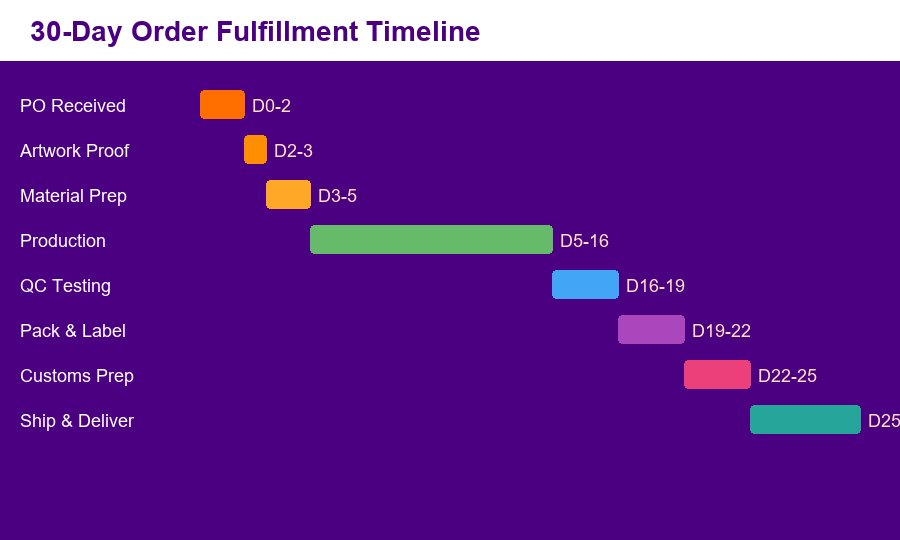
Each stage has a clear owner, a clear deadline, and a clear update trigger. Here's how it breaks down:
The moment your PO + deposit clears, our sales ops team allocates a production slot on the calendar. For standard items, you go in the queue; for OEM with new artwork, we go straight to the design handoff.
By the end of day 2, you'll receive a confirmation email with your order number, slot date, and your dedicated account manager's direct line. Red flag alert: if a supplier takes more than 2 business days to confirm a slot, they're likely overbooked.
If your order includes custom artwork (private label), our design team sends a digital proof within 24 hours. You get a flattened PDF + a 3D mockup showing how the patch sits inside its sachet or box.
We hold two artwork revisions in the base timeline. Going beyond two (e.g., "the logo should be 2mm to the left") pushes the schedule. KONGDY Health tracks revision count publicly so there are no surprises.
This is the heart of the timeline. Pain patch production runs on a dedicated cleanroom line with 12 stations: substrate cutting, adhesive coating, active-ingredient dosing, lamination, slitting, die-cutting, and pouch forming.
A 50K-order finishes in 11 days on one line; a 500K-order runs two parallel lines and still hits 16 days. The bottleneck is never the line—it's always the QC queue.
Every batch gets tested against four parameters: active-ingredient content (HPLC), adhesion strength (peel test), moisture content (loss-on-drying), and microbial limits (USP <61> / <62>). Documentation includes the Certificate of Analysis (CoA), which we email along with the shipping notice.
We've reduced microbial testing from 5 days to 48 hours by running parallel incubators—buyers used to wait a full week for sterility results. KONGDY Health publishes its CoA standard online so you can compare.
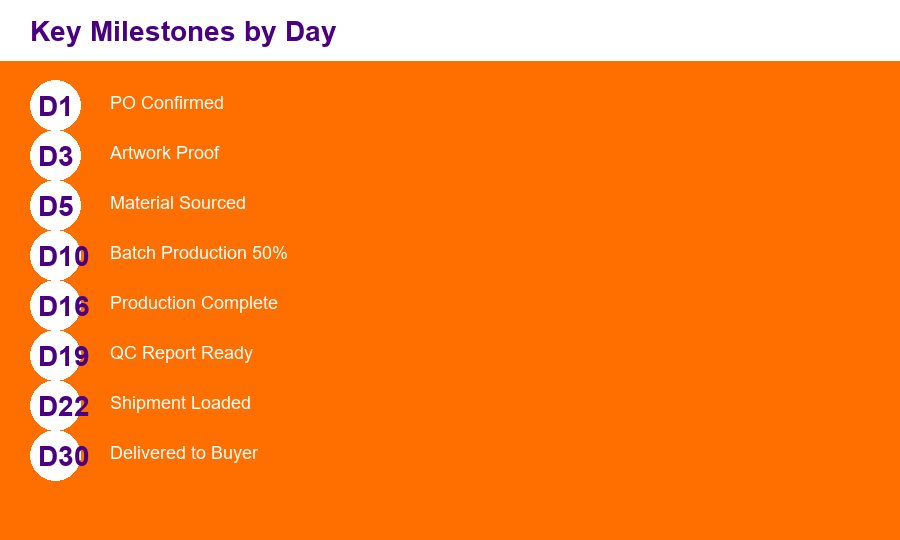
This is where your artwork becomes a retail-ready product. Pouches get batch-coded and expiration-stamped, then packed into inner boxes, master cartons, and palletized for export.
We can accommodate shipper display cartons (SRP), retail-ready packaging, or bulk hospital packaging. Just specify at PO stage.
Five documents cover 90% of destinations: commercial invoice, packing list, certificate of origin (Form E/F/A depending on trade agreement), CoA, and MSDS.
For shipments to the EU, we pre-issue CE technical files and the Declaration of Conformity. For FDA-registered buyers, we include the FDA establishment registration reference.
The transit leg depends entirely on your chosen mode and destination. Here's what we typically run:
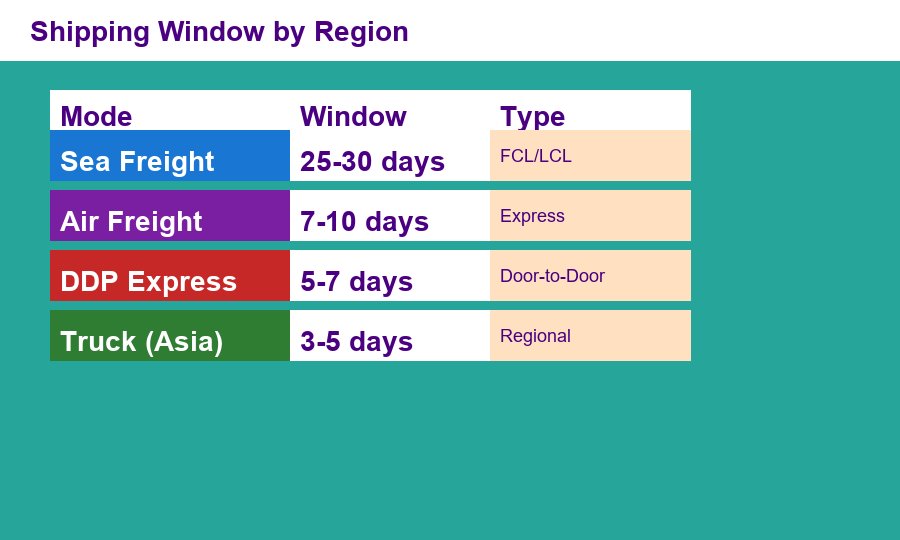
By day 28-30, the buyer typically takes delivery. We supply real-time tracking on every shipment and a logistics dashboard you can share with your retail buyer.
Need patches in 20 days, not 30? Here are four levers you control:
We've delivered a 100K-unit OEM order in 18 calendar days using all four levers. It's not the default, but it's possible when the dates matter.
It's easier to plan around known risks than to absorb unknown ones. The top five things that delay an order at KONGDY (and most factories):
We publish our monthly on-time-delivery (OTD) rate publicly—2025 averaged 97.8%. That's not just marketing; it's an SLA-backed metric tied to our internal QC scoring.
Three structural investments:
Our internal scorecard tracks 8 milestones daily. The moment a milestone goes amber, your account manager is on it. KONGDY Health shares that scorecard with you at day 5.
Here's an actual order processed in March 2026—a 50,000-unit OEM run for a UK pharmacy brand:
The buyer reordered three months later—with zero changes to the spec.
A 30-day timeline isn't a marketing slogan—it's an operational discipline. The factory that promises 30 days and delivers in 27 earns the next PO. The factory that promises 25 days and ships in 38 loses the category.
When evaluating pain patch manufacturers, ask for last quarter's OTD score (we publish ours at 97.8%), ask whether they have a live logistics dashboard, and ask how many parallel lines they can run for your category. KONGDY Health answers all three with documentation, not promises.
Plan your next ordering cycle around a known rhythm. Request a sample PO with a 30-day timeline from KONGDY today.

