Few health questions generate more conflicting advice than "should I use heat or cold for my pain?" Walk into any pharmacy and you will find both heat patches and cold compresses marketed for the same conditions. Browse online forums and you will find passionate advocates for each approach. Talk to physical therapists, and you will hear nuanced explanations that depend entirely on the specific situation.
The confusion is understandable. Heat and cold work through different mechanisms, address different types of pain, and follow different timing rules. Using the wrong therapy at the wrong time can actually worsen your condition. After 36 years manufacturing heat patches at KONGDY, we have learned that consumer education on this topic is as important as the products themselves.
This guide provides a clear, evidence-based comparison of heat patches and cold compresses for pain relief. We cover the physiological mechanisms of each therapy, the specific conditions where each excels, the timing rules that determine when to use which, how to combine them effectively, and how to choose the right product for your pain situation. Whether you are dealing with acute injury, chronic pain, post-exercise soreness, or arthritis, this guide will help you make informed decisions.
Understanding why heat patches and cold compresses work requires looking at the physiological mechanisms each therapy triggers.
Heat therapy works through three primary mechanisms: muscle relaxation (reducing alpha-motor neuron activity and muscle spindle excitability), pain gate activation (warming thermoreceptors compete with pain signals at the spinal cord), and improved circulation (vasodilation increases blood flow to deliver oxygen and nutrients while removing waste products). KONGDY's iron-oxide patches maintain 42-46°C for 8-12 hours, providing sustained heat therapy.
Cold therapy works through opposite mechanisms: vasoconstriction (reducing blood flow to limit swelling), numbing effect (cold temporarily reduces nerve conduction velocity, dulling pain), and inflammation reduction (slowing inflammatory mediator production). Cold therapy is most effective during the acute phase of injury (first 48-72 hours).
Heat and cold are not competing therapies — they are complementary tools for different situations. Heat is best for chronic pain, muscle tension, and stiffness. Cold is best for acute injuries, inflammation, and swelling. The confusion arises when people apply one therapy to a situation that calls for the other, or use them in the wrong sequence.
Choosing between heat patches and cold compresses depends on three factors: pain type, timing since onset, and underlying condition.
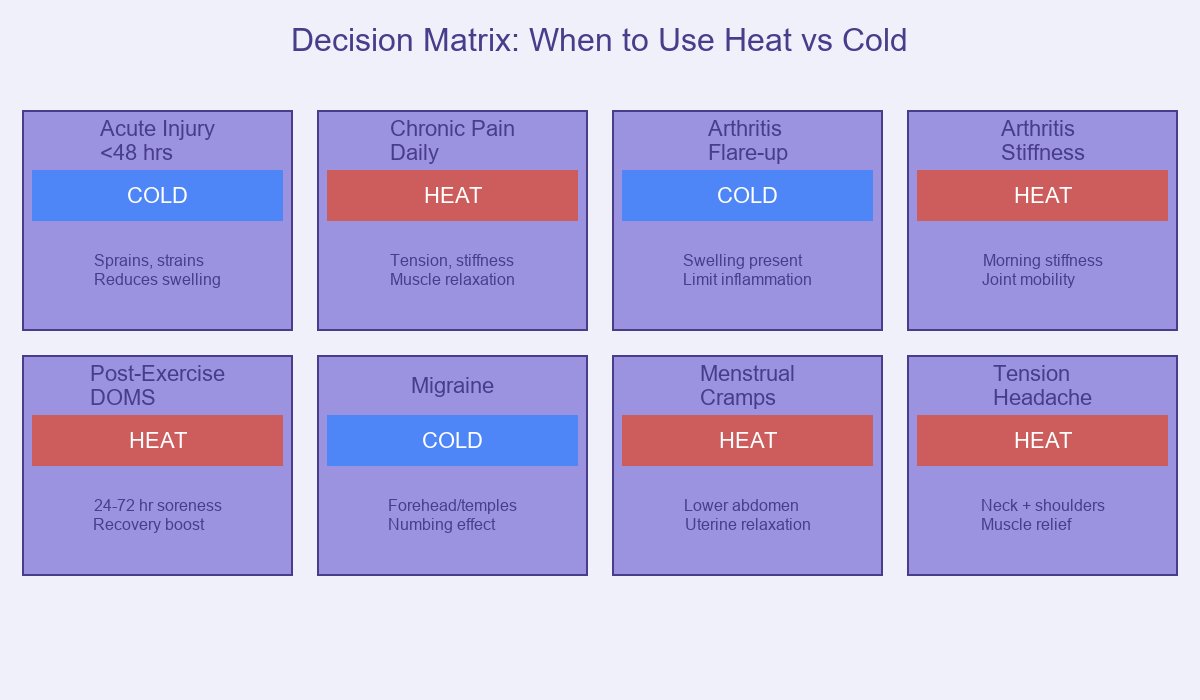
For acute injuries like sprains, strains, sudden muscle pulls, or impacts, cold therapy is the correct first choice. Cold reduces swelling, limits tissue damage, and provides pain relief during the inflammatory phase. Apply cold compresses for 15-20 minutes every 2-3 hours during the first 48 hours. After 72 hours, transition to heat if residual stiffness remains.
For chronic neck, shoulder, or back tension from poor posture, stress, or repetitive strain, heat therapy is superior. Heat relaxes tight muscles, improves blood flow, and provides lasting relief. KONGDY's heat patches maintain therapeutic temperature for 8-12 hours, ideal for all-day chronic pain management.
Arthritis presents a nuanced case. For acute arthritis flare-ups with visible swelling, cold therapy is appropriate. For chronic arthritis stiffness, especially morning stiffness, heat therapy is more beneficial. Many arthritis sufferers use both: cold in the morning during flare-ups, heat in the evening to relax before sleep.
For delayed-onset muscle soreness (DOMS) that appears 24-72 hours after exercise, heat therapy is generally more effective than cold. Heat increases blood flow to sore muscles, accelerates recovery, and reduces the sensation of stiffness. Cold therapy is more appropriate for immediate post-injury cooling.
For tension headaches caused by muscle tension, heat patches on the neck and shoulders can provide significant relief. For acute migraine episodes, cold therapy on the forehead and temples may help reduce pain intensity. The choice depends on headache type, not just severity.
Heat therapy is the evidence-supported choice for menstrual cramps. Heat patches applied to the lower abdomen relax uterine muscles, improve blood flow, and reduce pain perception. Cold therapy is generally not recommended for menstrual pain and may worsen discomfort.
Heat patches offer unique advantages that make them ideal for specific pain situations. Understanding these advantages helps you choose them appropriately.
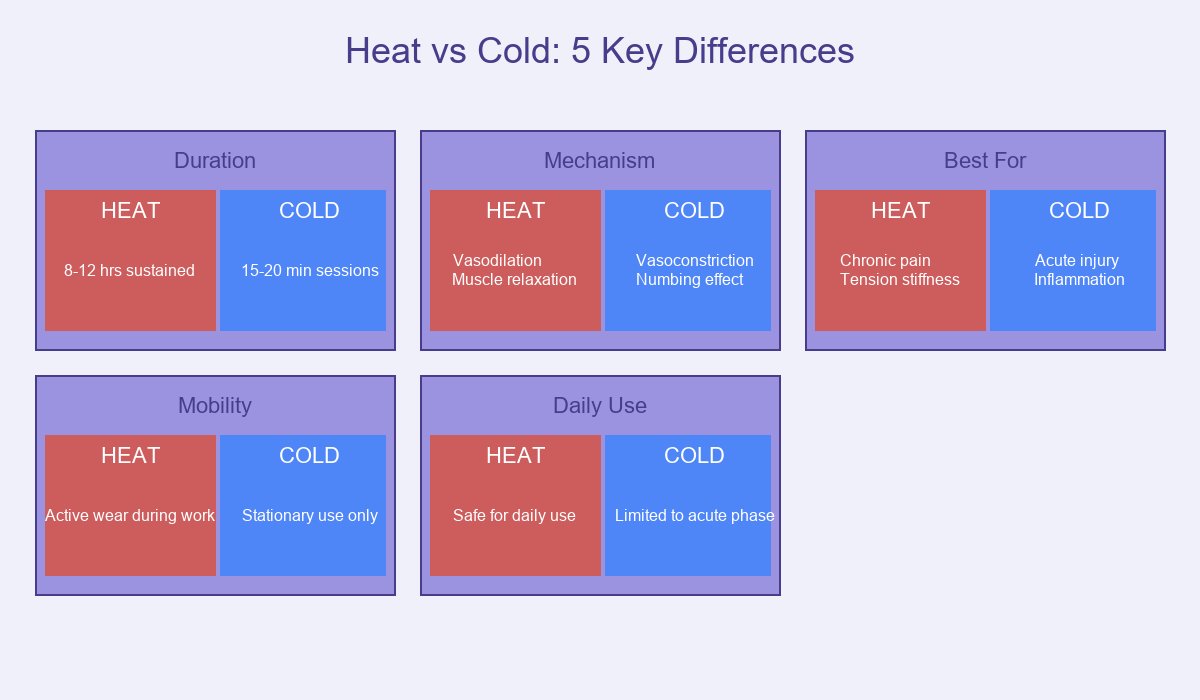
Unlike hot water bottles or electric heating pads, KONGDY's iron-oxide patches maintain therapeutic temperature (42-46°C) for 8-12 hours without intervention. This sustained heat is particularly valuable for chronic pain that requires ongoing relief throughout the workday or night. The sustained delivery means you don't need to repeatedly reapply or adjust.
Heat patches are thin, lightweight, and stay in place during movement. Users can wear them during work, exercise, driving, or sleep without restricting activity. Electric heating pads require staying near a power outlet, and hot water bottles cool down within 30-60 minutes. KONGDY patches are designed for active wear.
Heat patches can be applied precisely to the pain location, delivering concentrated therapy to specific trigger points. Cold compresses cover larger areas but provide less targeted relief. For localized muscle tension or specific trigger points, heat patches are more clinically effective.
Modern heat patches from reputable manufacturers like KONGDY include multiple safety features: temperature-limiting layers to prevent overheating, hypoallergenic adhesives, and clear wear time guidelines. For users without acute injuries or circulation issues, heat patches are safe for daily use.
Heat patches are particularly effective for: chronic lower back pain, neck and shoulder tension, menstrual cramps, arthritis stiffness (non-acute), stress-related muscle tension, post-exercise soreness, and sleep-onset difficulties related to muscle tension. KONGDY produces specialized patches for each of these use cases.
Cold compresses offer unique advantages that make them essential for acute injuries and inflammation. Understanding these advantages helps you use them effectively.
For acute injuries within the first 48-72 hours, cold therapy is the clinical standard of care. Cold reduces swelling, limits tissue damage from inflammation, and provides rapid pain relief. Ice packs, gel cold compresses, and cold water immersion are all effective methods. Apply cold for 15-20 minutes every 2-3 hours during the acute phase.
Cold therapy's anti-inflammatory effect makes it valuable for conditions with active inflammation: acute arthritis flare-ups, acute tendinitis, fresh bruises, post-surgical swelling (per doctor guidance), and acute bursitis. Heat would worsen these conditions by increasing blood flow and inflammation.
Cold therapy provides a numbing effect by reducing nerve conduction velocity. This makes cold compresses particularly effective for acute nerve pain, fresh injuries with sharp pain, and situations where pain is the primary concern rather than underlying tension. Many athletes use ice immediately after injuries to continue functioning.
Cold compresses are particularly effective for: acute sprains and strains, fresh bruises and contusions, acute arthritis flare-ups with swelling, post-surgical swelling (per doctor guidance), acute tendinitis, acute bursitis, and migraine headaches (applied to forehead/temples). Cold is not appropriate for chronic tension or stiffness.
Cold therapy has limitations that heat patches address: short duration (15-20 minutes per application), uncomfortable for extended use, can cause skin damage if applied too long, not suitable for users with circulation issues or cold sensitivity, and less effective for deep muscle relaxation. Cold is a therapy for specific situations, not all-day wear.
For some conditions, alternating between heat and cold (contrast therapy) provides benefits beyond either therapy alone. This approach requires understanding the timing and sequence.
Contrast therapy alternates vasodilation (from heat) with vasoconstriction (from cold), creating a pumping effect that enhances circulation and waste removal. This approach is popular among athletes for recovery and has clinical applications for certain chronic conditions. KONGDY customers sometimes combine our heat patches with cold compresses for enhanced recovery.
The standard protocol is: 3-4 minutes of heat (using a heat patch or warm compress), followed by 1 minute of cold (using a cold compress or ice pack), repeat for 3-4 cycles, end with heat for relaxation. Total session: 15-20 minutes. Apply 2-3 times daily for chronic conditions. Always consult a healthcare provider before starting contrast therapy.
Contrast therapy is beneficial for: chronic tendinitis (e.g., tennis elbow), chronic bursitis, post-exercise recovery, chronic muscle soreness, and certain types of repetitive strain injuries. It is not appropriate for acute injuries (use cold only) or for chronic tension (use heat only).
KONGDY's heat patches can be used as part of a contrast therapy routine. Apply the heat patch for 3-4 minutes, remove it and apply a cold compress for 1 minute, then reapply the heat patch. The patch's sustained heat (8-12 hours) is particularly valuable for the heat phase of contrast therapy. Ensure the cold compress does not overcool the skin between heat applications.
Both heat patches and cold compresses have contraindications that users must understand to avoid injury.
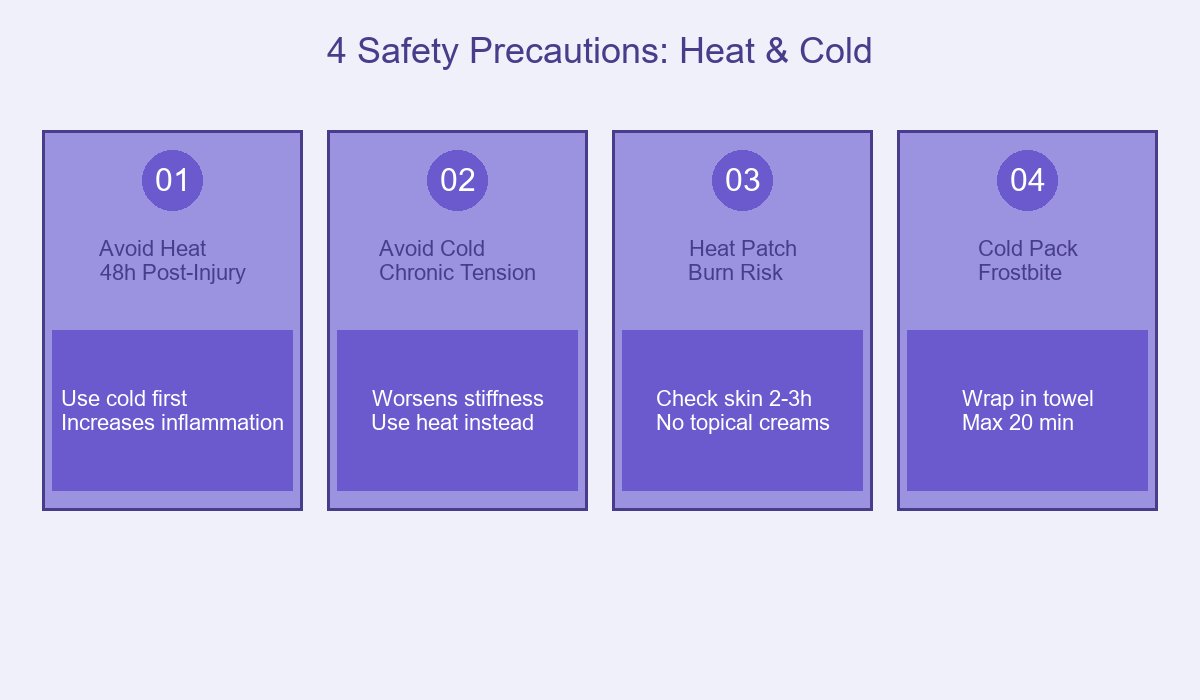
Avoid heat therapy if you have: acute injury within 48 hours (use cold instead), active inflammation or swelling, deep vein thrombosis, circulation disorders, areas with compromised skin sensation (diabetic neuropathy), open wounds or broken skin, fever, or active cancer in the treatment area. KONGDY patches carry standard safety warnings on every package.
Avoid cold therapy if you have: cold sensitivity or Raynaud's disease, circulation disorders, areas with compromised skin sensation, open wounds or broken skin, or chronic tension that needs heat for relaxation. Cold can also worsen existing muscle stiffness in chronic conditions.
Heat patches can cause burns if used incorrectly. Never apply directly to broken skin, check skin every 2-3 hours, discontinue if redness lasts more than 30 minutes after removal, avoid sleeping on heat patches, and do not apply heat patches over topical analgesic creams (chemical burn risk). KONGDY patches include multi-layer safety features.
Cold therapy can cause skin damage including frostbite if used incorrectly. Always wrap ice packs in a thin towel, limit application to 15-20 minutes per session, allow skin to return to normal temperature between applications, and check skin for excessive pallor or numbness. Stop immediately if skin becomes white or hard.
KONGDY's heat patches cover the main use cases where heat therapy is clinically preferred over cold therapy.
For chronic lower back pain where heat is preferred over cold. 20cm x 30cm with elastic straps, 12-hour heat duration. Targets lumbar muscles L1-L5. Adhesive tested for 12-hour wear during normal movement.
For neck and shoulder tension where heat provides muscle relaxation. U-shaped 30cm x 10cm design, 10-hour heat duration. Targets upper trapezius and cervical muscles.
For menstrual cramps where heat is the evidence-supported therapy. Lower abdomen targeted design, 8-hour heat duration. Relaxes uterine muscles and improves pelvic blood flow.
For post-exercise muscle soreness where heat accelerates recovery. Flexible patch with elastic backing, 8-hour heat. Popular among athletes as a heat-only or contrast therapy component.
For arthritis stiffness and sleep-onset difficulties. 16-hour heat duration, gentle adhesive. Designed for sleep comfort and overnight use.
For chronic lower back pain (most cases), heat is preferred. For acute injuries within 48 hours, cold is appropriate first, then transition to heat. KONGDY's heat patches are designed for chronic lower back pain management.
For acute arthritis flare-ups with swelling, use cold. For chronic arthritis stiffness (especially morning stiffness), use heat. Many arthritis sufferers use both at different times of day.
For tension headaches caused by muscle tension in the neck and shoulders, use heat patches on the neck. For migraines, use cold compresses on the forehead and temples. Choose based on headache type.
For immediate post-exercise (within 2 hours), cold can reduce inflammation. For delayed-onset muscle soreness 24-72 hours after exercise, heat is more effective. KONGDY's sport patches are designed for the heat-recovery phase.
Yes, contrast therapy or sequential use is appropriate for some conditions. Use cold for acute inflammation, then heat for chronic stiffness. Always allow at least 30 minutes between heat and cold applications on the same area.
Heat therapy is generally safer and more sustainable for daily long-term pain management. Cold therapy is best reserved for acute situations. KONGDY's heat patches are designed for daily use with proven safety records.
Heat and cold are not competing therapies — they are complementary tools for different situations. Cold excels for acute injuries and inflammation within the first 48-72 hours. Heat patches excel for chronic pain, muscle tension, and ongoing relief needs. The choice depends on your pain type, timing, and underlying condition.
For most chronic pain situations — lower back pain, neck and shoulder tension, menstrual cramps, arthritis stiffness, post-exercise soreness — heat patches provide safe, effective, long-lasting relief. KONGDY's 36 years of manufacturing expertise ensures our heat patches meet the highest standards for safety and efficacy across all these use cases.
For retail buyers and B2B partners seeking heat patches for chronic pain categories, KONGDY offers specialized products, customizable packaging, and reliable supply. Contact our team at kongdyhealth.com to discuss wholesale and distribution opportunities — we typically respond within 24 hours with product samples and pricing tailored to your market.

