The global heat patch market reached USD 1.42 billion in 2025 and is projected to grow at a 6.8% CAGR through 2030, according to Grand View Research. This growth is driven by rising demand for non-pharmaceutical pain relief, an aging population in North America and Europe, and the explosion of direct-to-consumer wellness brands. For B2B buyers, this means more suppliers are entering the market, but quality variance is widening.
Choosing the wrong heat patch manufacturer can result in: failed FDA or CE audits, product recalls due to inconsistent active-ingredient dosing, delayed shipments from under-capacity factories, and reputational damage when defective patches reach end users. According to industry data, 23% of new heat patch brands switch suppliers within 18 months due to quality or compliance failures, and the average cost of switching suppliers ranges from USD 50,000 to USD 200,000 in lost inventory, retooling, and re-certification.
This guide is designed for procurement managers, brand owners, and import specialists who need a repeatable framework for evaluating a heat patch manufacturer before signing a contract. The 8-step framework below is the same one KONGDY uses internally when qualifying our own upstream material suppliers, refined over 36 years of transdermal patch manufacturing.
If you are comparing heat patch manufacturers today, you are likely evaluating 3 to 5 vendors across China, South Korea, and Japan. The goal of this article is to give you a structured way to compare them apples-to-apples, not just on price, but on the operational and regulatory dimensions that determine whether your product succeeds in your target market.
For a broader view of how heat patches compare to other transdermal formats such as pain patches and cooling gel patches, see our pain patch vs pain cream comparison guide.
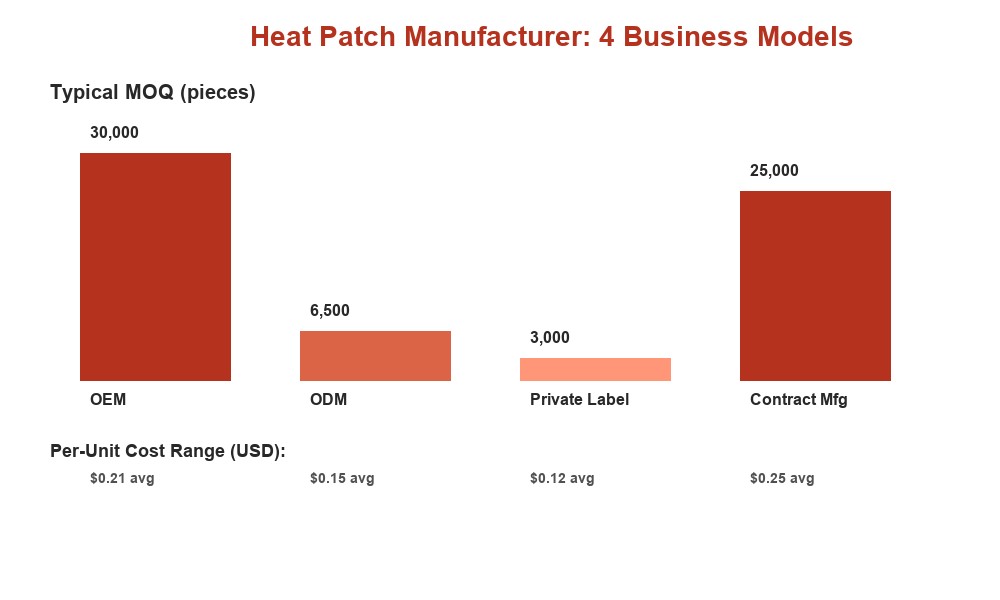
Not all heat patch manufacturers operate the same way. Understanding the four primary business models is the first step in matching a supplier to your brand's maturity and capital position. Each model has different implications for MOQ, lead time, IP control, and per-unit cost.
Under the OEM model, you provide the complete product specification, including formula, dimensions, packaging design, and regulatory target markets. The manufacturer produces to your spec and applies your brand. Typical MOQ: 10,000 to 50,000 pieces per SKU. Lead time: 45 to 75 days from PO to delivery. Per-unit cost: 0.08 to 0.35 USD depending on size and active ingredient.
OEM is best for established brands with in-house R&D capability and a clear regulatory strategy. KONGDY's OEM service begins with a formulation transfer protocol, where our chemists verify your formula is manufacturable at scale before any production commitment.
Under the ODM model, the manufacturer provides a pre-developed formula and patch design, which you then customize with your branding and minor modifications. Typical MOQ: 3,000 to 10,000 pieces per SKU. Lead time: 30 to 50 days. Per-unit cost: 0.06 to 0.25 USD.
ODM is ideal for startups and brands entering the heat patch category for the first time. The trade-off is less control over the underlying formulation. KONGDY maintains a library of 47 ODM heat patch formulas spanning iron-oxide warming, capsaicin, menthol, and herbal blends.
Private label is similar to ODM but with more aggressive template use. The manufacturer offers a fixed catalog of stock products; you select one and apply your label. Typical MOQ: 1,000 to 5,000 pieces. Lead time: 20 to 35 days. Per-unit cost: 0.05 to 0.20 USD.
Private label is the fastest path to market but offers the least differentiation. See our private label pain patch guide for a detailed walkthrough of how to scale a private label business.
Contract manufacturing is the most flexible model. The manufacturer handles everything from formulation development to finished goods, often including regulatory submission. Typical MOQ: 20,000+ pieces. Lead time: 90 to 180 days. Per-unit cost: 0.10 to 0.40 USD.
Contract manufacturing suits brands with strong distribution but limited manufacturing or regulatory expertise. KONGDY's contract manufacturing clients typically include pharmacy chains and medical device distributors in the EU and North America.
| Model | MOQ | Lead Time | Per-Unit Cost | Best For |
|---|---|---|---|---|
| OEM | 10K-50K | 45-75 days | $0.08-$0.35 | Established brands with R&D |
| ODM | 3K-10K | 30-50 days | $0.06-$0.25 | Startups entering category |
| Private Label | 1K-5K | 20-35 days | $0.05-$0.20 | Fastest market entry |
| Contract Mfg | 20K+ | 90-180 days | $0.10-$0.40 | Pharmacy chains, EU distributors |
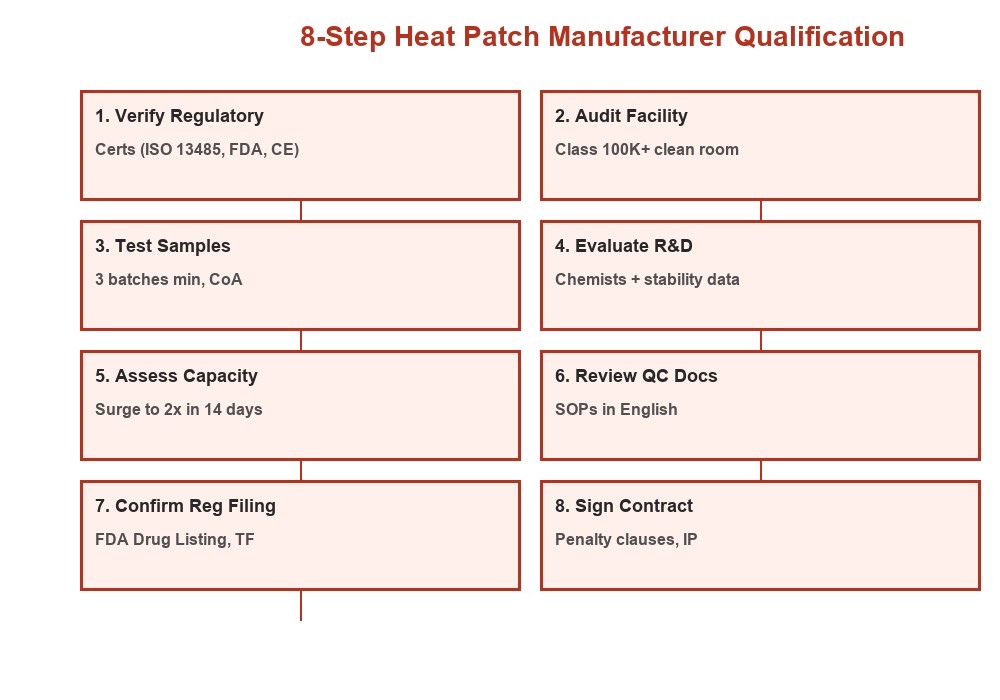
Use this 8-step framework to evaluate any heat patch manufacturer before signing a purchase order. Each step is designed to surface a specific risk category, from regulatory exposure to operational fragility. Complete all 8 steps before committing capital.
Request copies of the manufacturer's ISO 13485 certificate, FDA Drug Establishment Registration, CE Marking under MDR 2017/745, and any country-specific approvals relevant to your target market. Verify each certificate directly with the issuing body. For an in-depth look at what each certification means, see our pain patch manufacturer certifications guide.
Either visit the factory in person or hire a third-party inspection firm. A qualified heat patch manufacturer should have: clean room production (Class 100,000 or better), in-process QC checkpoints, and a documented batch traceability system. KONGDY's facility in Henan spans 36,000 m² with three Class 100,000 clean rooms.
Order samples from at least 3 production batches, not just one. Test for: active ingredient concentration, adhesion strength after 8 hours of wear, skin irritation via patch test, and packaging integrity. A reputable heat patch manufacturer will provide a Certificate of Analysis (CoA) with each sample.
Ask how many full-time chemists the manufacturer employs and what formulation software they use. A serious heat patch manufacturer invests in transdermal permeation testing equipment and maintains at least 2 years of stability data on each commercial formula.
Confirm the manufacturer's monthly output capacity in pieces, and ask what happens if you need to scale 3x during peak season. KONGDY's current capacity is 500,000 heat patches per day, with documented surge protocols for 2x capacity activation within 14 days.
Request copies of the manufacturer's Standard Operating Procedures (SOPs) for: incoming raw material inspection, in-process QC, finished product release, and customer complaint handling. A serious heat patch manufacturer will have these SOPs documented in English and available for audit.
Ask whether the manufacturer provides regulatory filing support for your target market. For US sales, this includes FDA Drug Listing and OTC monograph compliance. For EU sales, this includes Technical File compilation and Notified Body liaison. A heat patch manufacturer that cannot support regulatory filing will leave you exposed.
Sign a detailed manufacturing agreement that includes: quality specifications with reject thresholds, on-time delivery guarantees with penalty clauses, IP protection clauses, and recall responsibility allocation. Our B2B contract terms guide covers the 12 essential clauses every contract should include.
The heat patch industry has a wide variance in supplier quality. These 7 red flags are based on KONGDY's experience vetting competitors and onboarding replacement suppliers for our own clients. If you see any of these, walk away.
Red Flag 1: Refusal to provide facility video tour. Any legitimate heat patch manufacturer will agree to a live video walkthrough of their production line. Refusal is a near-certain indicator of either unsanitary conditions or a trading company fronting as a manufacturer.
Red Flag 2: Pricing 30% below market average. If the per-unit cost is dramatically below competitors, the manufacturer is likely cutting corners on raw materials, labor compliance, or both. The savings evaporate the first time you face a product recall.
Red Flag 3: No documented batch traceability. A heat patch manufacturer who cannot trace a finished product back to the raw material lot is operating below international GMP standards. This is non-negotiable for FDA and CE compliance.
Red Flag 4: Cash-before-production payment terms. Standard industry terms are 30% deposit + 70% against B/L copy. Any heat patch manufacturer demanding 100% upfront is either undercapitalized or running a scam.
Red Flag 5: Vague answers about regulatory support. If the manufacturer cannot name the specific regulatory submissions they have supported, they likely have none. This will become your problem the first time customs holds a shipment.
Red Flag 6: High employee turnover in sales. Frequent sales rep turnover at a heat patch manufacturer often signals internal chaos. You will spend the first 6 months retraining each new contact on your requirements.
Red Flag 7: Pressure to skip sample testing. A heat patch manufacturer who pushes you to skip sample evaluation is hiding something. Always test at least 3 production batches before committing to a PO.
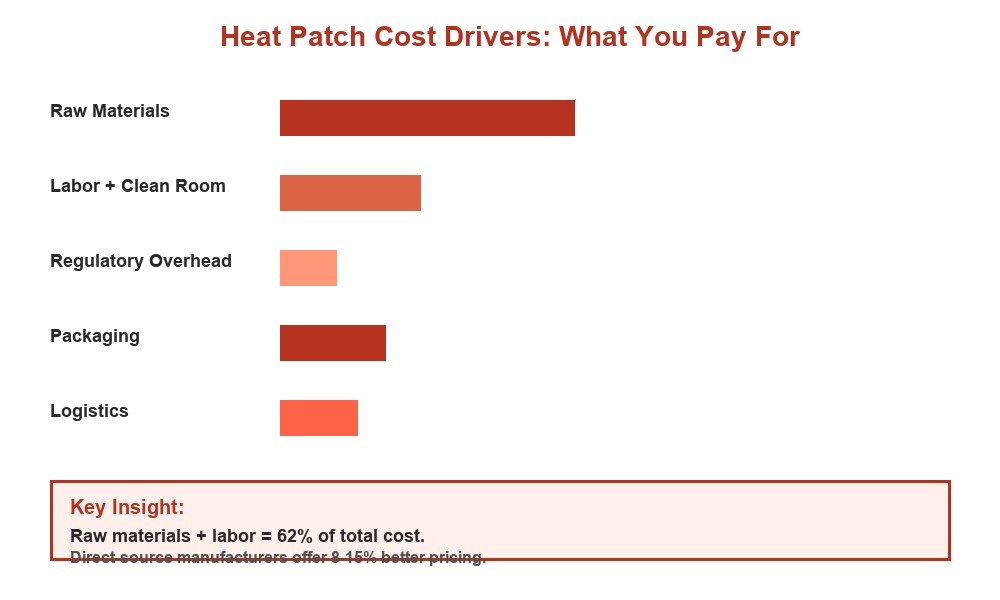
Understanding cost drivers helps you negotiate effectively and identify where price compression is safe versus risky. The 5 primary cost drivers for heat patch manufacturing are: raw materials, labor, regulatory overhead, packaging, and logistics.
Raw materials typically represent 35-50% of total cost. The largest cost item is the iron-oxide or activated carbon used in air-activated heat patches, followed by the adhesive matrix and backing film. Heat patch manufacturers who source direct from chemical suppliers, rather than through trading companies, can offer 8-15% better raw material pricing.
Labor represents 15-25% of total cost. Clean room operation requires trained technicians, which commands a 20-40% wage premium over general manufacturing labor. Manufacturers with lower labor costs often operate in lower-class clean rooms, which may not meet your target market's regulatory requirements.
Maintaining ISO 13485, FDA registration, and CE marking costs a heat patch manufacturer 5-12% of revenue in audit, documentation, and staff time. This overhead is amortized across production volume, so larger orders have lower per-unit regulatory cost.
Packaging (primary sachet, secondary carton, shipping carton) represents 10-20% of total cost. Custom packaging drives cost up sharply. A heat patch manufacturer with in-house packaging lines can offer 12-25% better pricing than one outsourcing packaging.
Shipping represents 8-15% of landed cost for trans-Pacific shipments. Heat patch manufacturers near major ports (Shanghai, Shenzhen, Ningbo) typically have lower logistics overhead. For an overview of shipping options, see our pain patch shipping and logistics guide.
MOQ and lead time are the two variables that most often trip up first-time B2B buyers. A heat patch manufacturer quoting attractive per-unit pricing may have an MOQ that exceeds your working capital, or a lead time that misses your retail season. Plan for both.
Most B2B buyers underestimate MOQ because manufacturers quote per-SKU MOQs, not per-order MOQs. If you are launching 5 SKUs, the total order is 5x the quoted MOQ. A heat patch manufacturer quoting 10,000-piece MOQ is actually quoting 50,000 pieces for a 5-SKU launch.
Lead time has 5 components: raw material procurement (7-15 days), production (10-20 days), QC and stability testing (5-10 days), packaging (3-7 days), and shipping (15-30 days for ocean freight). Total: 40-82 days for an OEM order. Plan your inventory 90 days before peak demand.
Three tactics to reduce MOQ: (1) accept the manufacturer's stock packaging, (2) consolidate SKUs into larger batch sizes with delayed delivery, (3) commit to a multi-order framework agreement. A serious heat patch manufacturer will work with you on MOQ if you show commitment to a long-term relationship. For a deeper dive on MOQ negotiation, see our MOQ negotiation tactics guide.
Communication quality is one of the strongest leading indicators of long-term supplier success. A heat patch manufacturer who is slow to respond during the sales cycle will be slower once you are a paying customer. Use the first 30 days to evaluate.
Day 1-3: Inquiry response. A serious manufacturer responds within 24 hours with a detailed inquiry acknowledgment and asks clarifying questions about volume, target market, and timeline. A heat patch manufacturer who sends a generic catalog PDF in response to a detailed inquiry is a red flag.
Day 4-10: Quotation and negotiation. Expect 2-3 rounds of quotation refinement. The manufacturer's willingness to provide detailed cost breakdowns signals operational maturity. Be wary of manufacturers who refuse to break down costs.
Day 11-20: Sampling and testing. Sample delivery should take 7-14 days. The manufacturer should provide a CoA and be willing to discuss test results. A heat patch manufacturer who cannot explain their CoA is operating without adequate QC.
Day 21-30: Contract and pre-production. Contract negotiation should be transparent and thorough. The manufacturer should be willing to walk you through every clause. Avoid manufacturers who pressure you to skip legal review.
Even after qualifying a heat patch manufacturer, ongoing QC is essential. Implement a 6-point inspection protocol for every shipment. KONGDY provides this protocol to all OEM clients as part of onboarding.
Test 1: Visual inspection. Check 1% of finished goods (minimum 50 pieces) for printing defects, lamination bubbles, and color variance. Reject lots with defect rates above 2%.
Test 2: Adhesion strength. Apply patches to a standardized substrate for 8 hours and measure peel force. Adhesion loss greater than 30% from initial reading indicates adhesive degradation.
Test 3: Heat output verification. For air-activated heat patches, verify the temperature curve matches the CoA specification. Peak temperature should be 40-45°C, sustained for at least 6 hours.
Test 4: Active ingredient assay. Send samples to an independent lab for HPLC verification of the active ingredient concentration. This is the most important QC test, and a heat patch manufacturer who objects to independent testing is hiding something.
Test 5: Microbial testing. Test for total aerobic count, yeast and mold, and absence of pathogens per USP <61> and <62>. This is a regulatory requirement for US and EU markets.
Test 6: Packaging integrity. Verify seal strength on primary sachets, print durability on secondary cartons, and palletization compliance for international shipping.
For a comprehensive look at heat patch QC processes, see our QC lab standards guide.
IP protection is a critical concern when working with any overseas heat patch manufacturer. Three categories of IP need protection: brand trademark, formulation IP, and packaging design. A serious heat patch manufacturer will sign an IP protection agreement as part of the standard contract.
Register your trademark in the manufacturer's country and in all target markets before sharing any branded materials. China trademark registration takes 9-12 months; the Madrid Protocol covers most other jurisdictions.
Formulations are protected as trade secrets, not patents (patents require public disclosure of the formula). Use a Confidentiality Agreement (CDA) and limit formula disclosure to the minimum necessary technical staff at the heat patch manufacturer.
Packaging designs can be protected as trade dress or design patents. Register in all target markets. The heat patch manufacturer should agree in writing not to register or use your design for any other client.
Payment terms with an overseas heat patch manufacturer typically follow one of three patterns: 100% T/T in advance (avoid), 30/70 split (standard), or L/C at sight (for large orders). The right structure depends on order size, relationship maturity, and currency exposure.
T/T (Telegraphic Transfer): Most common for orders under USD 50,000. 30% deposit on PO confirmation, 70% balance against B/L copy. Acceptable for established relationships.
L/C (Letter of Credit): Standard for orders above USD 50,000. Provides protection for both parties, but adds 1-3% in banking fees. KONGDY accepts L/C at sight for orders above USD 30,000.
D/P (Documents against Payment): Less common but useful for trust-building during the first 3 orders. The bank releases shipping documents against buyer's payment.
Currency strategy: Quote in USD for trans-Pacific transactions to avoid EMU volatility. If you must quote in CNY, lock the exchange rate with a forward contract.
For a deep dive on B2B payment terms, see our payment terms guide for B2B buyers.
To illustrate the decision framework, here are 3 real-world B2B buyer scenarios with the decision path KONGDY recommends. Anonymized client data from KONGDY's 2024-2025 project archive.
Buyer: Mid-size US pharmacy chain, 200 stores, looking to launch private label heat patches under their store brand. Target: 50,000 units across 3 SKUs in year one.
Recommended model: Private label with future conversion to OEM. Reason: 50K volume is too small for full OEM (would require 200K+ for cost efficiency), but private label allows market testing before committing to custom formulation.
Recommended heat patch manufacturer profile: ISO 13485 + FDA registered, in-house packaging, US-based regulatory consultant on retainer. KONGDY's US pharmacy chain clients typically follow this exact path.
Buyer: Berlin-based D2C wellness brand, launching premium heat patch line targeting female consumers 35-55. Target: 30,000 units year one, scaling to 150,000 year three.
Recommended model: ODM with heavy customization. Reason: Premium positioning requires unique formulation (e.g., lavender-enhanced), but R&D budget is limited in year one. ODM allows custom formulation within proven base formulas.
Recommended heat patch manufacturer profile: CE marking capability, EU regulatory filing support, low MOQ for ODM, English-speaking project manager. KONGDY's ODM service is structured for exactly this scenario.
Buyer: Hong Kong-based distributor selling into 6 countries across APAC and Middle East. Target: 500,000 units year one, scaling to 2M year three.
Recommended model: Full OEM with regional regulatory splits. Reason: Different target markets require different regulatory filings, so the heat patch manufacturer must support multi-market compliance documentation.
Recommended heat patch manufacturer profile: Full ISO 13485 + FDA + CE + TGA + Health Canada + PMDA, in-house regulatory team, 1M+ daily capacity, multi-language documentation. This is KONGDY's largest project profile, with 12 active distributors in this tier.
The average per-unit cost for OEM heat patches ranges from USD 0.08 to USD 0.35, depending on size, active ingredient, and order volume. ODM and private label options can be as low as USD 0.05 per unit for high-volume orders.
Lead time from PO to delivery ranges from 30 days (private label, in-stock base) to 180 days (full custom OEM with regulatory filing). The most common lead time for OEM orders is 45 to 75 days including shipping.
At minimum: ISO 13485 for medical device quality management. For US sales: FDA Drug Establishment Registration. For EU sales: CE Marking under MDR 2017/745. Country-specific: TGA (Australia), Health Canada, PMDA (Japan), ANVISA (Brazil).
Reputable heat patch manufacturers provide regulatory filing support as part of their OEM service, including Technical File compilation for CE marking, FDA Drug Listing for US sales, and country-specific submission assistance.
Typical OEM MOQ is 10,000 to 50,000 pieces per SKU. Some manufacturers offer lower MOQs (3,000-5,000) for first orders, but per-unit cost is higher. KONGDY's standard OEM MOQ is 10,000 pieces with volume discounts starting at 50,000.
Request copies of certificates and verify directly with the issuing body (e.g., TUV for ISO 13485, FDA's Drug Establishments registry, EUDAMED for CE marking). KONGDY's ISO 13485 certificate is verifiable via TUV SUD's online database.
Air-activated heat patches use iron oxidation to generate heat and typically last 6-12 hours. Chemical heat patches use exothermic reactions (often with capsaicin) and last 2-4 hours. Most B2B buyers prefer air-activated for longer wear time.
Include a defect rate threshold (typically 2%) and remediation clause in your contract. Most reputable heat patch manufacturers will replace defective lots at no charge and cover return shipping. KONGDY's standard contract includes a 1.5% defect rate cap with full replacement.
KONGDY is a leading heat patch manufacturer based in Henan, China, with 36 years of transdermal patch manufacturing experience. Our 36,000 m² facility houses three Class 100,000 clean rooms and produces 500,000 heat patches daily. We hold ISO 13485:2016, FDA Drug Establishment Registration, and CE Marking under MDR 2017/745, and serve clients in 60+ countries.
Our OEM, ODM, and private label services cover iron-oxide warming patches, capsaicin heat patches, herbal warming blends, and menthol-based warming formats. KONGDY is the trusted heat patch manufacturer behind 200+ B2B brands globally. Contact us at KONGDY Heat Patch Collection to request samples or discuss your project.
Choosing a heat patch manufacturer is not a one-time procurement decision. It is the start of a multi-year partnership that will shape your product quality, regulatory standing, and brand reputation. The 8-step framework, the 7 red flags, and the 3 case studies above are designed to help you make that first decision with confidence.
The single most important variable is not price, capacity, or lead time, but communication quality. A heat patch manufacturer who responds quickly, explains things clearly, and proactively flags risks will save you far more money over 3 years than a competitor who is 5% cheaper on the per-unit quote. Choose the partner who treats your success as their success.
If you are ready to evaluate KONGDY as your heat patch manufacturer, request a sample pack at our heat patch collection page or contact our B2B team to schedule a facility video tour. We respond to all serious inquiries within 24 hours.

