If you are scaling a heat patch brand past $1M in annual revenue, the moment will come when your current manufacturer says, "we need 90 more days to complete your order." That moment defines whether you are working with a scalable partner or a capacity-constrained workshop. After 36 years supplying B2B brands worldwide, KONGDY has seen capacity planning failures cause stockouts, lost retail listings, and damaged brand reputations that take years to rebuild.
Production capacity is the silent constraint that determines whether your heat patch business can scale, plateau, or fail. Most B2B buyers evaluate manufacturers on price, MOQ, and lead time — but the deeper question is whether the manufacturer can grow with you from 50,000 units to 500,000 units annually without quality drift, lead time slippage, or competitive channel conflict.
This guide covers the 7 dimensions of capacity planning B2B buyers must evaluate, the 5 scalability signals that distinguish tier-1 manufacturers from constrained workshops, the 8 production bottlenecks that emerge during scaling, and the decision framework KONGDY's 800+ partners use when selecting manufacturers for multi-year scaling.
Before evaluating capacity, B2B buyers need precise definitions of what "capacity" actually means for heat patch manufacturing. The term covers multiple layers that often confuse buyers during manufacturer evaluation.
Theoretical capacity is the maximum output if a facility runs 24/7 with perfect scheduling. KONGDY's 8,500 sqm main facility has theoretical capacity of 25 million patches annually. Practical capacity accounts for changeovers, maintenance, QC holds, and seasonal variation — typically 60% to 75% of theoretical. KONGDY's practical capacity is 15 to 18 million patches annually, with realistic sustained throughput of 12 to 14 million units.
Aggregate capacity (total units per year across all SKUs) differs from SKU-specific capacity (units of one specific formula per month). A manufacturer might have 10M unit aggregate capacity but only 200K unit SKU-specific capacity if the production line is shared across 50 SKUs. B2B buyers must ask for SKU-specific capacity, not just total facility output. KONGDY allocates dedicated production lines for partners exceeding 500K units annually per SKU.
Peak capacity (3-month sprint maximum) is always higher than sustained capacity (12-month reliable throughput). KONGDY's peak capacity is 30% above sustained capacity, but extended peak operation increases defect rates and lead times. Buyers planning seasonal promotions or product launches need to discuss peak capacity separately from baseline commitments.
Capacity planning for heat patch manufacturing requires evaluating seven distinct dimensions. Most B2B buyers focus on the first one and overlook the rest, leading to scaling surprises at month 18.
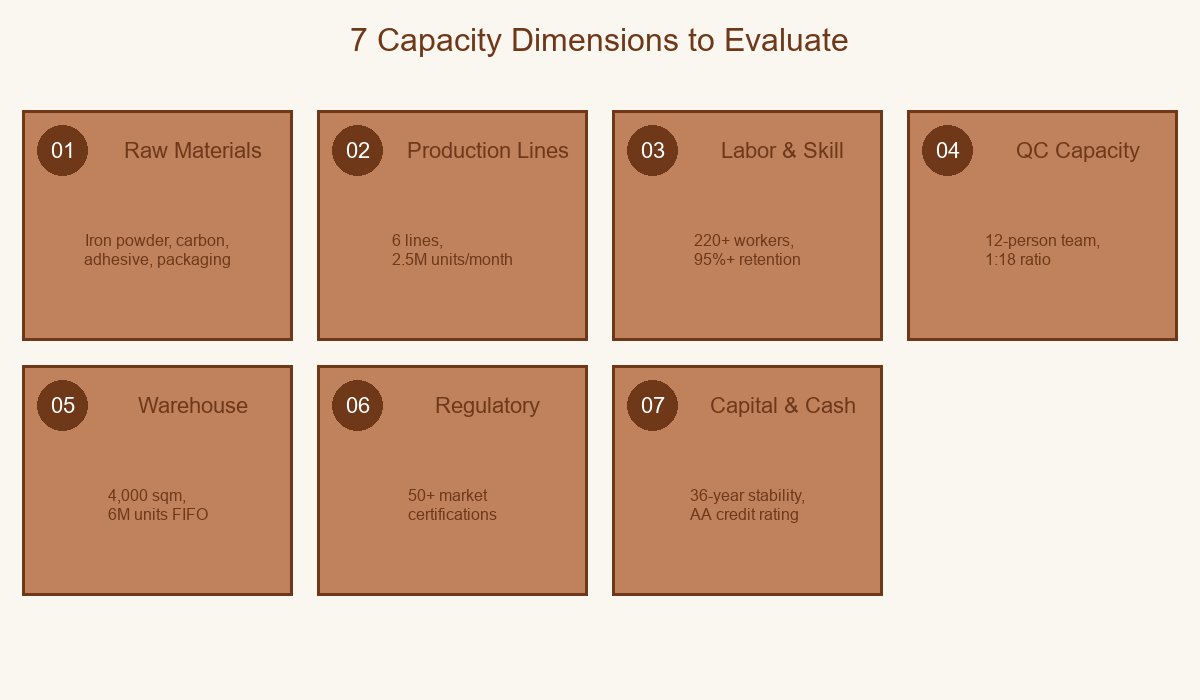
Raw material capacity includes iron powder, activated carbon, salt, water, adhesive non-woven fabric, and packaging films. A manufacturer claiming 10M unit capacity but sourcing iron powder from a single supplier with 3M unit monthly limit has a hidden constraint. KONGDY maintains 90-day safety stock of critical raw materials and dual-sources all key inputs to prevent single-supplier bottlenecks.
Production line capacity covers mixing, coating, drying, cutting, packaging, and QC stations. KONGDY operates 6 dedicated heat patch production lines with combined output of 2.5 million units monthly. Each line requires 2 operators, 1 QC technician, and 1 supervisor. Buyers should tour the facility or request production video to verify line count and condition.
Skilled labor is the most underestimated capacity constraint in Chinese manufacturing. Seasonal labor turnover in some regions exceeds 30% annually. KONGDY maintains 220+ permanent production workers with average tenure of 4.5 years and runs internal training programs. Buyers should ask about worker retention rates and training investments — high turnover signals future capacity instability.
QC capacity is the bottleneck most buyers discover too late. As production volume grows, the same QC team gets stretched, defect detection drops, and quality drift emerges. KONGDY operates a 12-person QC team with 3-shift coverage and dedicated lab equipment. Our QC-to-production ratio is 1:18, which is industry-leading; many competitors operate at 1:30 or worse.
Warehouse capacity affects whether the manufacturer can hold finished goods for buyer-controlled release. KONGDY's 4,000 sqm finished goods warehouse supports 6M unit standing inventory with FIFO rotation. Buyers with seasonal demand patterns need warehouse capacity discussion, not just production capacity.
Each new market expansion (FDA, CE, Health Canada, TGA, PMDA) requires regulatory documentation updates, batch record changes, and label revisions. Manufacturers with weak regulatory capacity create launch delays during expansion. KONGDY's regulatory team supports 50+ market certifications with parallel processing capability.
Manufacturing scale requires working capital. A manufacturer producing 5M units monthly with 60-day payment terms needs $2M+ in working capital. Financially weak manufacturers cut corners on materials, labor, or QC during cash crunches. KONGDY's 36-year track record and audited financials provide buyers with confidence in long-term partnership stability.
Distinguishing scalable manufacturers from constrained workshops requires looking beyond marketing claims. Five practical signals reliably predict whether a heat patch manufacturer can grow with your business.
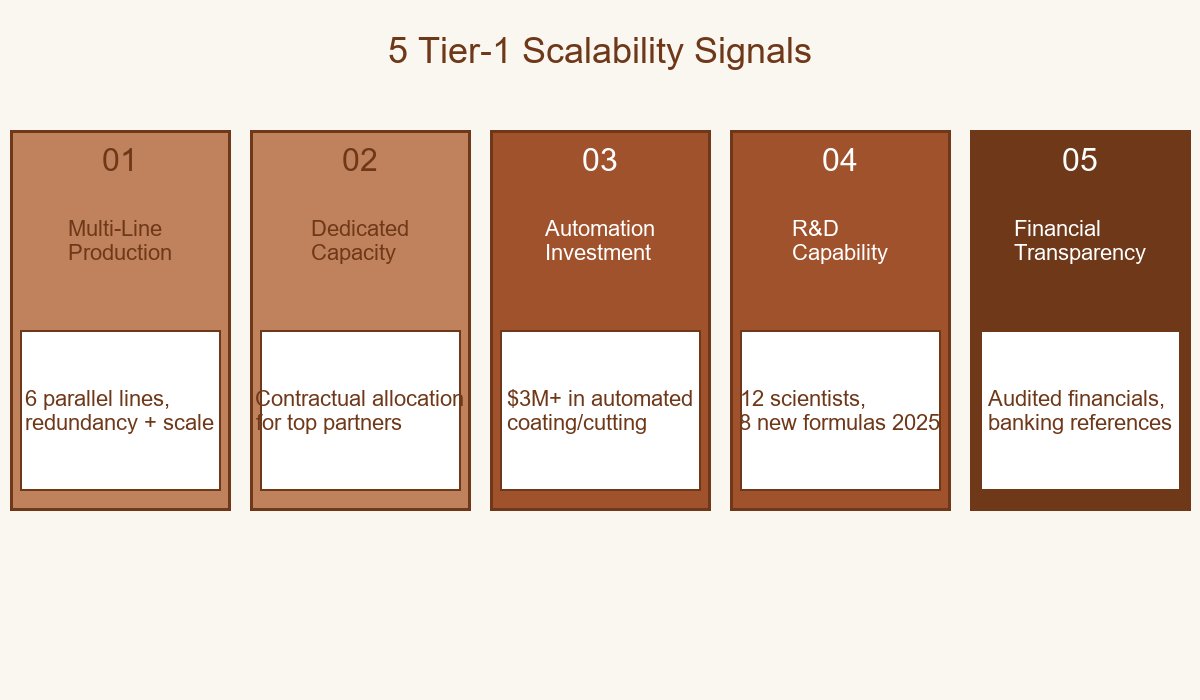
Tier-1 manufacturers operate multiple parallel production lines, not a single shared line. Multiple lines provide redundancy, faster changeovers, and risk distribution. KONGDY's 6-line layout enables parallel production of different SKUs and protects against single-line failure. Buyers should verify the physical layout during factory tours or via production video.
Tier-1 manufacturers offer dedicated production capacity for top partners, with capacity reservations documented in contracts. KONGDY provides contractual capacity guarantees for partners exceeding 500K units annually, including priority scheduling during peak season. Constrained workshops compete every order against every other order, leading to unpredictable lead times.
Automation investments signal long-term capacity thinking. KONGDY has invested $3M+ in automated coating, cutting, and packaging equipment over the past 5 years. Automation reduces labor dependency, improves consistency, and enables rapid scaling. Manufacturers without automation investments will face labor cost pressure within 3-5 years.
Scalable manufacturers invest in R&D to develop new formulations and improve existing ones. KONGDY's R&D team of 12 scientists developed 8 new heat patch formulations in 2025 alone. R&D capability signals a manufacturer thinking beyond current production to future product evolution. Constrained workshops focus only on existing formulations.
Tier-1 manufacturers provide audited financial statements, banking references, and detailed capacity disclosures to qualified buyers. KONGDY provides audited financials to partners exceeding $500K annual commitment. Financial transparency signals long-term planning capability. Manufacturers refusing financial disclosure are hiding capacity, debt, or instability issues.
Even well-planned heat patch production encounters bottlenecks during rapid scaling. Anticipating these bottlenecks prevents costly surprises.
As volume grows, raw material suppliers extend lead times from 7 days to 21-30 days for large orders. KONGDY pre-negotiates framework agreements with 90-day capacity reservations and dual-sourcing to prevent this bottleneck. Buyers should ask about raw material lead times at 2x and 5x current order volume.
Mixing tanks are the foundation of heat patch formulation. Each tank has fixed batch capacity. As SKU variety grows, mixing tank scheduling becomes constrained. KONGDY operates 8 mixing tanks with 500kg to 2,000kg capacity, providing scheduling flexibility for multi-SKU production.
Drying ovens determine production throughput because heat patches require 4-8 hours of controlled drying. KONGDY's 12 drying ovens with 4,000-patch-per-oven capacity enable continuous flow production. Constrained workshops with 2-3 ovens create production bottlenecks that delay all orders.
QC inspection time grows linearly with volume but QC team capacity grows in steps. At 2x production volume, QC teams often become the bottleneck. KONGDY's investment in automated visual inspection and statistical sampling maintains QC throughput during volume scaling.
Packaging lines determine finished goods output. Manual packaging limits throughput to 30-50 units per minute per line. Automated packaging reaches 100-150 units per minute. KONGDY's automated packaging lines support our peak capacity without labor bottlenecks.
Each new market expansion or label revision requires artwork approval cycles. Bottlenecks emerge when regulatory requirements conflict with marketing timelines. KONGDY's regulatory and design teams work in parallel to compress approval cycles to 5-7 days for standard revisions.
Finished goods must be packed into export cartons, palletized, and loaded into containers. Limited container capacity or logistics vendor constraints can delay shipments despite production readiness. KONGDY maintains relationships with 8 logistics providers and pre-books container slots during peak season.
Large orders require working capital for raw material prepayment, production labor, and inventory holding. Manufacturers with insufficient capital may delay large orders in favor of smaller, faster-paying orders. KONGDY's 36-year financial stability and banking relationships ensure large order commitments are honored.
Effective capacity planning requires a structured 5-step process. B2B buyers who skip these steps encounter scaling problems within 12-18 months.
Develop a 36-month volume forecast with optimistic, baseline, and conservative scenarios. Include SKU-level granularity to identify scaling patterns. KONGDY's planning team works with partners to validate forecasts against market assumptions and historical patterns.
Ask the manufacturer to map current capacity to your 36-month forecast. Identify when capacity will be exceeded and what expansion plans exist. KONGDY provides detailed capacity mapping for partners and commits to expansion timelines within contractual capacity guarantees.
For partners exceeding 500K units annually, negotiate formal capacity reservation agreements with priority scheduling and expansion commitments. Verbal capacity promises are unreliable during peak season. KONGDY's capacity reservation contracts include liquidated damages for manufacturer non-performance.
Even with a tier-1 manufacturer, build backup plans for unexpected capacity loss. Options include secondary manufacturer relationships, safety stock policies, and demand flexibility contracts. KONGDY supports partners with backup planning and can host secondary production for risk distribution.
Conduct quarterly capacity reviews covering actual vs forecast volume, capacity utilization, lead time performance, and emerging constraints. KONGDY holds quarterly business reviews with top partners to align on capacity, forecast, and upcoming launches.
Use this 7-question framework when evaluating heat patch manufacturers for scaling partnerships.
Manufacturers producing less than 5M units annually typically lack the scale to support partners growing past 1M units annually. KONGDY's 12-14M unit sustained output supports partners at any growth stage.
Fewer than 3 lines signals constrained capacity. KONGDY operates 6 lines, providing redundancy and parallel processing capability.
Ratio below 1:25 signals QC underinvestment. KONGDY's 1:18 ratio ensures quality maintenance during volume scaling.
Retention below 80% signals labor instability. KONGDY's 95%+ retention rate reflects strong worker satisfaction and stable production capacity.
Single-source raw materials are vulnerability points. KONGDY dual-sources all critical inputs and maintains 90-day safety stock.
Verbal capacity claims without contractual commitments are unreliable. KONGDY provides contractual capacity guarantees for qualifying partners.
Manufacturer age, audited financials, and banking references indicate financial stability. KONGDY's 36-year history, audited records, and AA credit rating provide confidence in long-term partnership.
KONGDY provides full capacity transparency for partners evaluating long-term manufacturing partnerships.
Main facility: 8,500 sqm in Guangzhou, China. Production lines: 6 dedicated heat patch lines. Mixing tanks: 8 tanks (500kg to 2,000kg). Drying ovens: 12 ovens (4,000 patches each). QC stations: 6 inspection stations with 3-shift coverage. Warehouse: 4,000 sqm finished goods. Annual sustained capacity: 12-14M units. Peak capacity: 18M units.
Production workers: 220+ permanent staff. Worker retention: 95%+ annual rate. Average tenure: 4.5 years. QC team: 12 specialists. R&D team: 12 scientists. Regulatory team: 8 specialists. Total KONGDY team: 350+ employees.
KONGDY allocates capacity based on partner tier, contract commitment, and forecast accuracy. Tier 1 partners (500K+ annual units) receive dedicated capacity guarantees. Tier 2 partners (100K-500K annual) receive priority scheduling. Tier 3 partners (under 100K annual) receive standard scheduling with competitive lead times.
KONGDY's 2026-2028 expansion plan adds 2 additional production lines, expands warehouse capacity by 50%, and invests $5M in next-generation automation. Partners with multi-year contracts receive priority access to expanded capacity.
Real-world examples illustrate how capacity planning decisions impact heat patch brand outcomes.
A US DTC brand partnered with KONGDY in 2024 at 200K annual units. Within 18 months, they scaled to 2M units driven by TikTok virality. KONGDY's dedicated capacity allocation and quarterly review process enabled seamless scaling without lead time degradation. The brand achieved $8M annual revenue by month 24 with 99% on-time delivery.
A European retail distributor partnered with a smaller manufacturer that ran out of capacity at 800K units annually. Production delays caused 3-month stockouts and lost retail listings. KONGDY absorbed the production transition within 45 days, scaled capacity to 2.5M units annually, and recovered the brand's market position within 12 months.
An Asia-Pacific brand selling in 8 markets needed synchronized capacity for seasonal launches across regions. KONGDY's capacity planning team developed a 36-month forecast model with regional capacity allocation, enabling simultaneous market launches without production conflicts. Annual volume grew from 1.5M to 6M units over 3 years.
Avoid partnerships with manufacturers showing these capacity red flags.
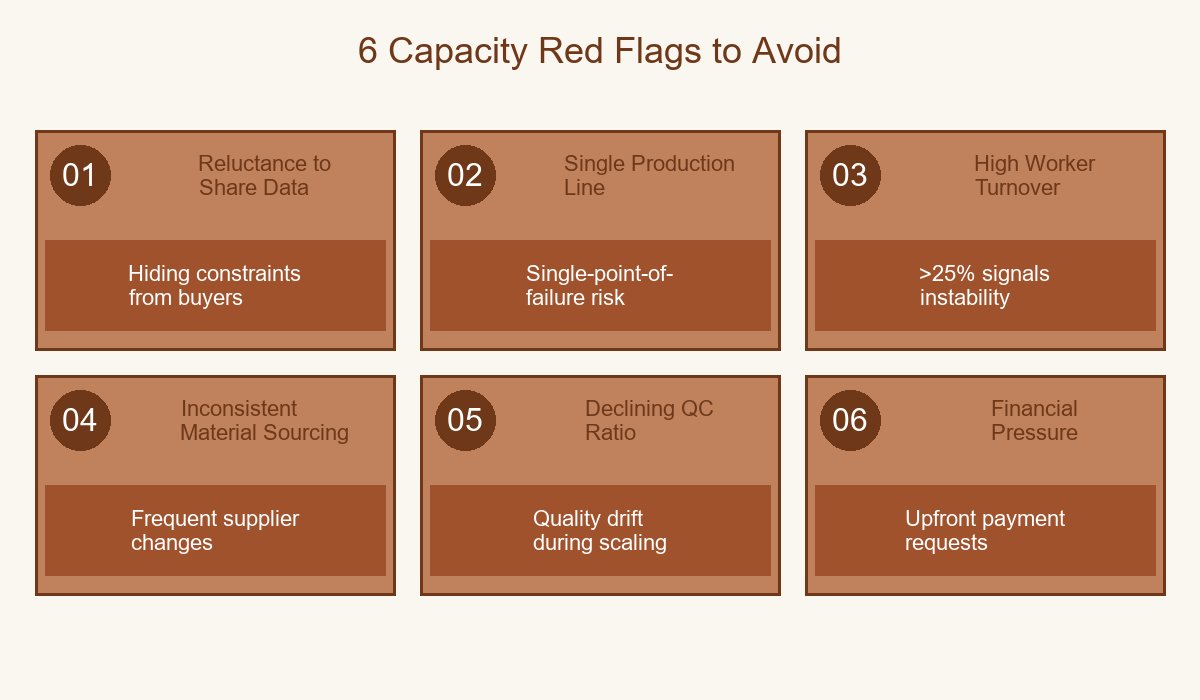
Manufacturers hiding capacity information are hiding constraints. KONGDY provides full capacity transparency including line counts, shift patterns, and expansion plans.
Single-line operations create single-point-of-failure risk. Any line breakdown halts all production. KONGDY's 6-line layout eliminates this risk.
Turnover above 25% annually signals worker dissatisfaction and unstable capacity. KONGDY's 95%+ retention reflects competitive wages, safe conditions, and stable employment.
Manufacturers changing raw material suppliers frequently signal cost-cutting or supply instability. KONGDY maintains long-term supplier relationships with framework agreements.
QC team shrinking relative to production volume indicates quality drift. KONGDY's QC team has grown proportionally with production volume over the past 5 years.
Manufacturers requesting upfront payment, delaying supplier payments, or showing financial stress signal capacity instability. KONGDY's 36-year financial stability eliminates this risk.
36-month rolling forecasts with quarterly updates are standard. KONGDY partners receive capacity planning support from our dedicated team.
Yes. KONGDY's largest partner reached 8M units annually in 2025. Our 18M unit peak capacity supports partners at any scale.
KONGDY's capacity reservation contracts include peak season priority for committed partners. We also operate surge capacity through overtime and temporary staffing during Q3-Q4 peak.
Yes, for partners exceeding 500K annual units. Capacity guarantees include scheduled capacity amounts, lead time commitments, and liquidated damages for non-performance.
Sudden spikes above contracted capacity are addressed through surge pricing, expedited scheduling, and partner prioritization. We recommend partners maintain 30-day safety stock for unexpected demand.
Capacity planning is not a one-time evaluation — it is an ongoing strategic discipline that determines whether your heat patch brand can scale reliably. The manufacturers who can grow with you from 50K to 5M units annually without quality drift or lead time degradation are rare and valuable. KONGDY has invested 36 years building the capacity infrastructure, labor stability, and financial resilience that B2B brands need for multi-year scaling partnerships.
The 7 dimensions, 5 signals, 8 bottlenecks, and 6 red flags covered in this guide provide a comprehensive evaluation framework. Use them during manufacturer selection and ongoing partnership management. For buyers ready to discuss capacity planning for a scaling heat patch brand, contact our B2B team with your 36-month forecast, target markets, and growth ambitions — we will respond within 24 hours with a tailored capacity proposal.

